


Views: 7709 Author: Site Editor Publish Time: 2026-11-24 Origin: Site


Content Menu
Walking the Line: Five Stations, One Direction
Station One: Frames, Shells and the Batch Card
Station Two:Where Two Materials Become One Tool
Station Three: Trimming and Polishing the Handle Edge
Station Four: Ties a Knife to a Batch With The Labels
Station Five: Count, Crate, Hand Over
● What actually happens in a knife assembly workshop?
● Why does a cheap knife show a gap between blade and handle?
● Can Insight assemble our design on your line?
● How is quality checked after assembly?
Yangjiang Insight Industry And Trade Co., Ltd. finishes every knife in the same kind of place it starts: on a bench, by hand, in daylight. The assembly workshop is the last twenty metres of a twelve-stage route, and it is the only stage a customer ever touches — which is why we treat it as a quality gate rather than a packing room.
Insight has designed, produced and sold chef knives, santoku knives, bread knives, paring knives and kitchen tools for more than 23 years, in a 20,000 square metre plant that ships roughly five million pieces a month for brands buying OEM and ODM. This is what the assembly floor actually looks like, station by station, including the parts that are not pretty.
The assembly workshop here runs in one direction, and nothing goes backwards. Five stations, in the order a knife travels.
Station |
What happens |
What it prevents |
Handle prep |
Handle frames, shells and rivets staged by batch card |
Mixing colours or counts between orders |
Attach and rivet |
Blade seated in the handle, rivets set by hand |
Gaps, cracked scales, loose handles |
Trim and polish |
Flash and burrs removed from the handle edge |
Sharp handle edges, visible sink marks |
Label |
Barcode and brand labels applied to position |
Retail rejections, lost traceability |
Count and crate |
Pieces counted into crates, handed to QC |
Short shipments, mixed batches |
Line balance is the quiet discipline behind those five stations. At five million pieces a month the floor is not a row of identical desks; it is a set of stations sized to the slowest step. When riveting runs slower than trimming, crates pile up at bench two while the label table sits idle, so a supervisor moves one operator instead of adding a machine. A normal week here runs two riveting benches to one trimming bench, because a rivet set by hand is the slowest action in the chain.
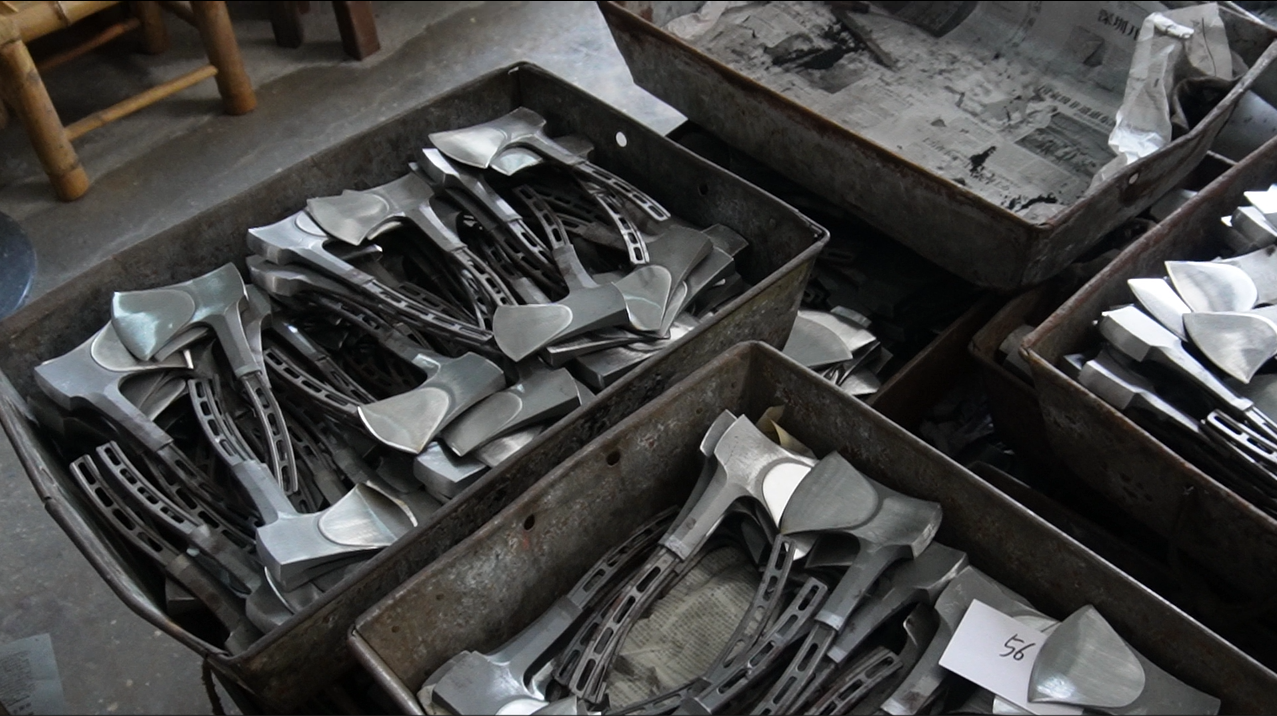
Assembly starts with parts that look nothing like a knife. The bins below hold stainless handle frames — hollow-ribbed inner structures that the rivets bite into and that carry the load between blade and hand. The frame is the reason a plastic or wooden handle can survive a drop: it spreads the impact across the whole grip instead of one rivet.
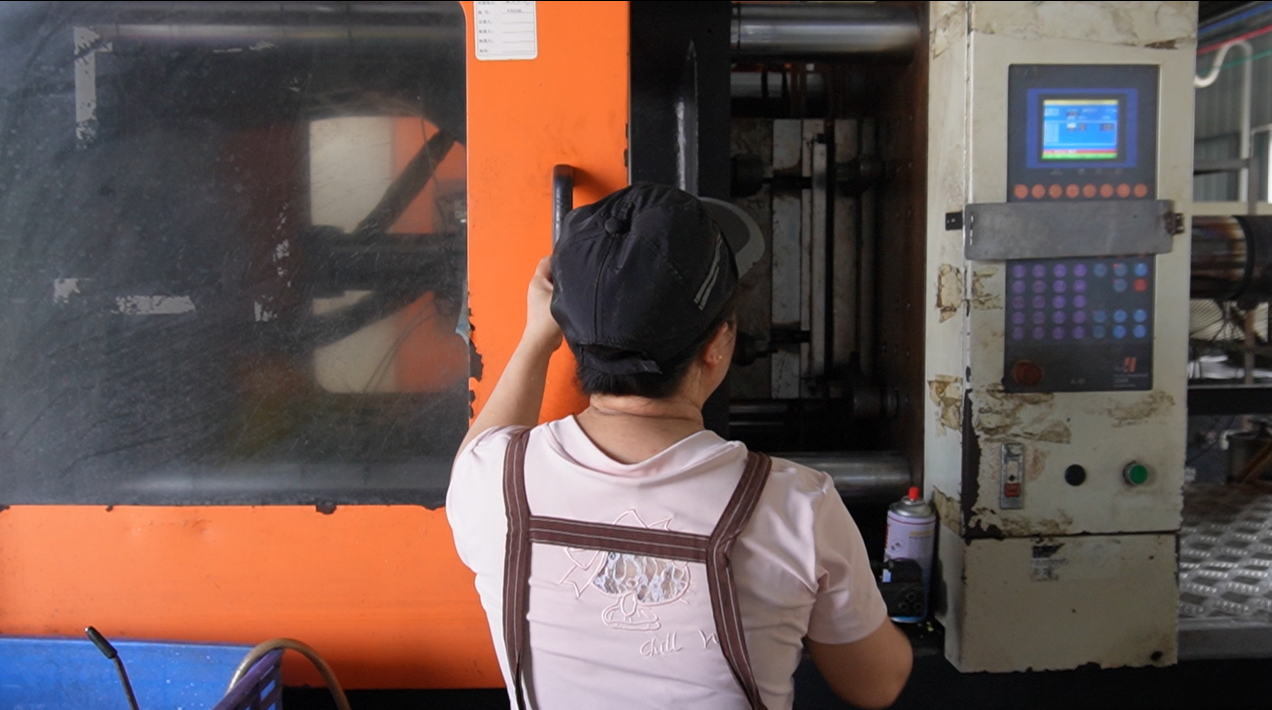
Those frames are fed by the moulding side of the plant. In the photo below the operator is at an injection machine, watching the panel while the tool closes — the handle shell that will sit over a frame like this is made a few metres away, on the same floor, which is what keeps colour and count aligned with the assembly workshop schedule.
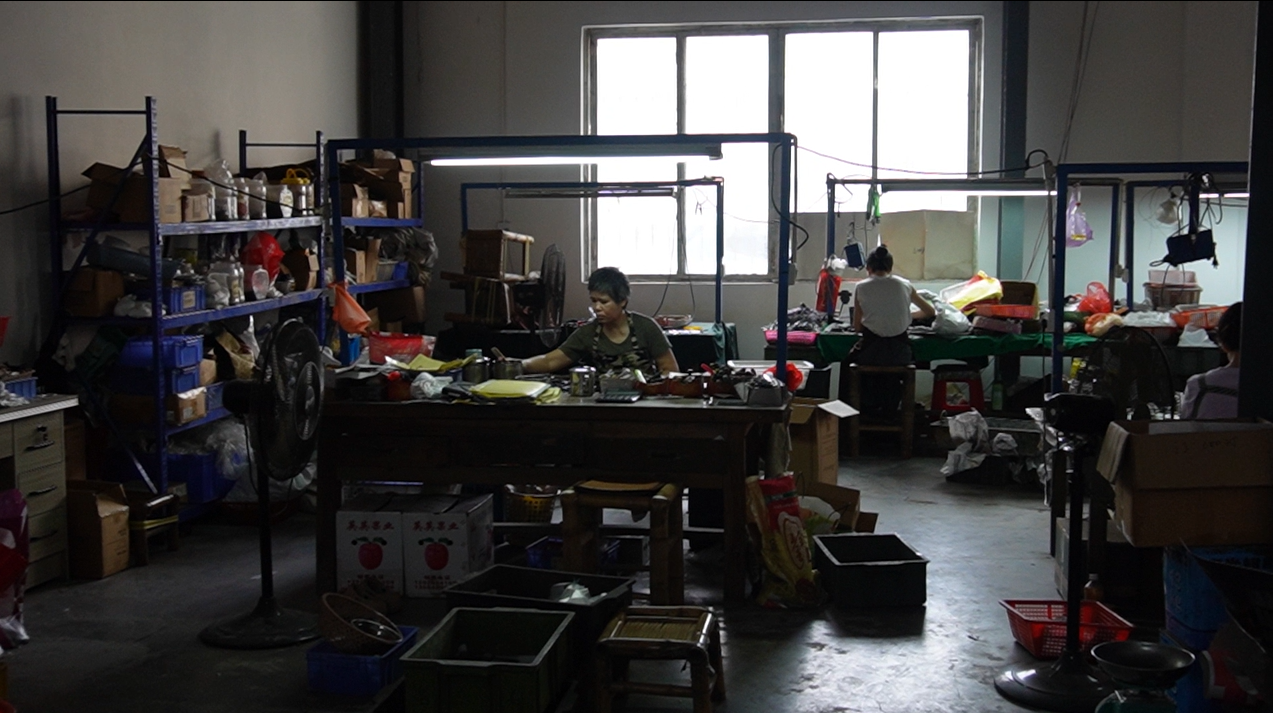
This is the station most buyers imagine when they hear the words assembly workshop, and it is still done by hand here — deliberately. Blades arrive in stacks on a padded cloth, rivets sit in an aluminium tray, and the operator works with a wooden-handled hammer, gloved on both hands.
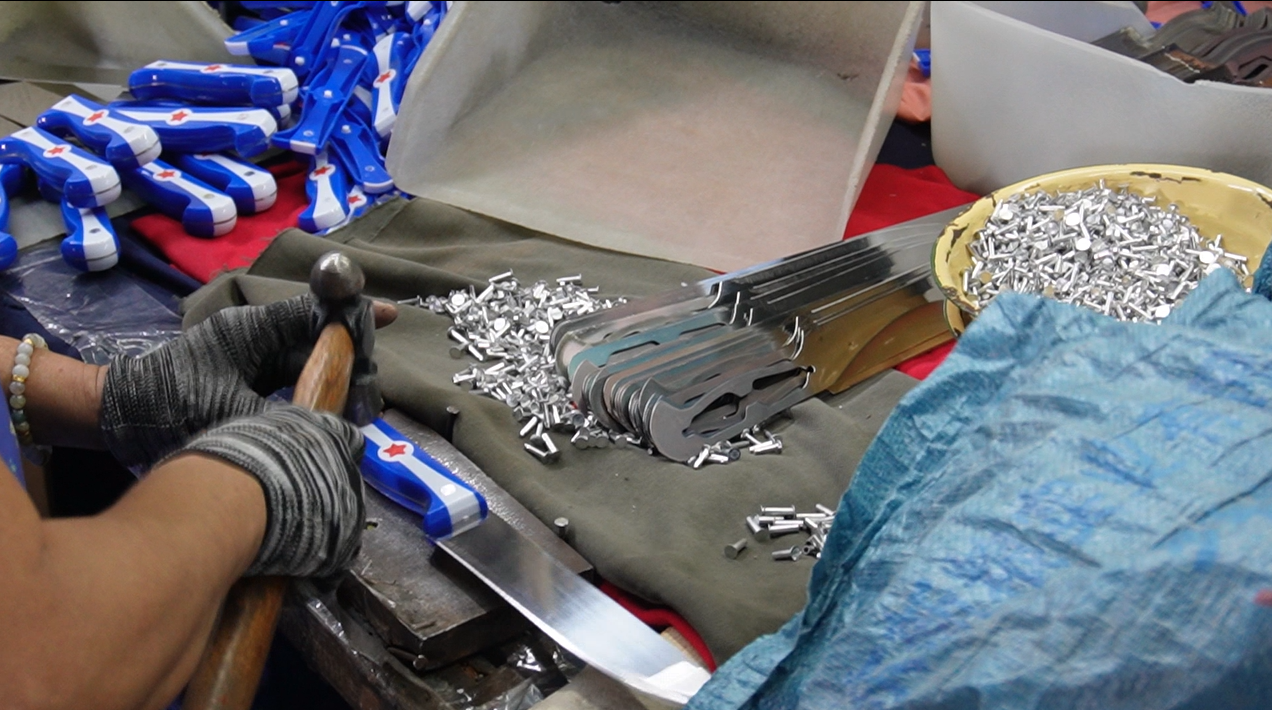
The craft is in the strike. A rivet needs to expand into the frame, not into the scale: too light and the handle moves after a hundred washes, too hard and the scale cracks along the rivet line — a defect that only shows up six months later in a dishwasher. Operators here set three rivets per knife and check the third by feel, then look for light between blade and bolster before the piece leaves the bench.
Rivet choice is a specification, not a default. Solid stainless rivets hold hardest in a wooden scale; semi-tubular rivets spread load better in a plastic shell and set faster; copper rivets are softer and are kept for handles that must not crack. The type is printed on the batch card and matched to the handle material, because the rivet that works in a rosewood scale can split a thin PP shell in one strike.
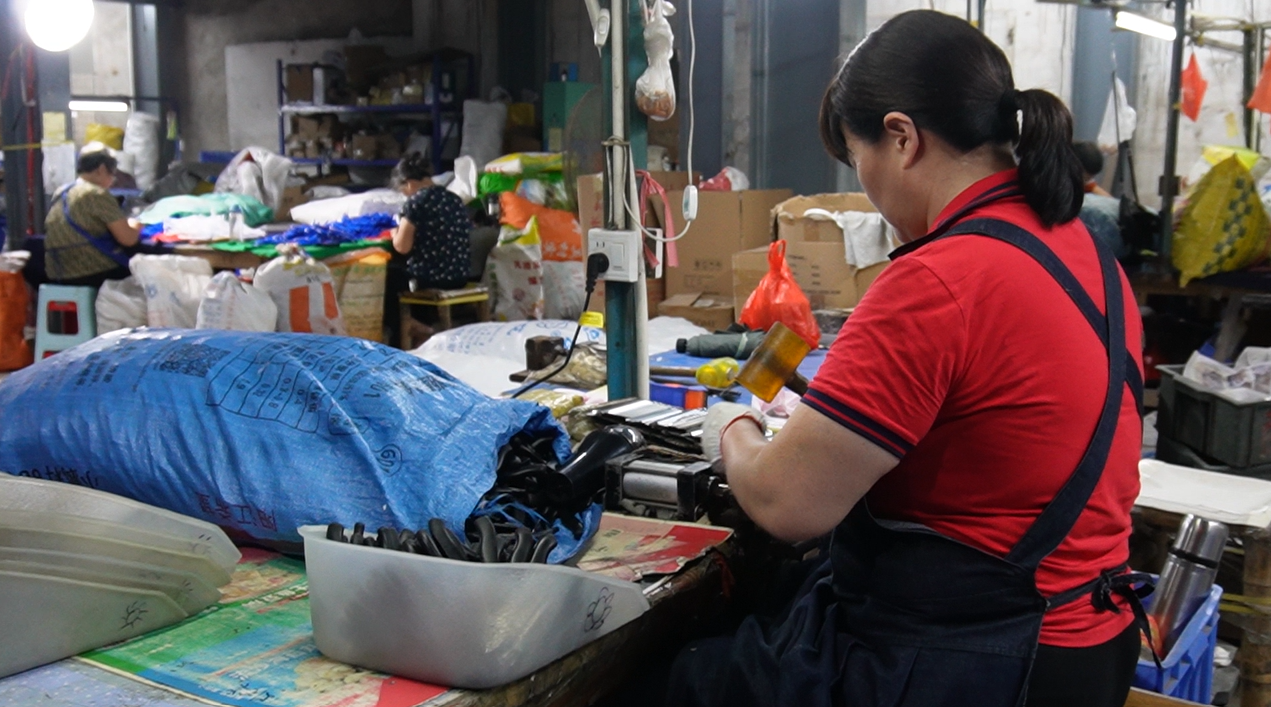
Next to the riveting bench sits the material feed: a woven bag of black handle shells, a basin of components, and a hammer within reach. It looks informal and it is not — each bag carries a card, and each card carries a count, because a bench that runs out of shells mid-batch is how colours get mixed.
Every moulded handle leaves the tool with a gate mark and a thin flash along the parting line. Left in place, that flash becomes a sharp edge in a palm. So the third station is abrasive: the operator holds the blade, brings the handle edge to a rotating wheel, and takes off a few tenths of a millimetre in one pass.
This pass also acts as an inspection. Polishing a handle reveals what moulding hides: sink marks, flow lines, a colour streak where the melt ran hot. A shell that looked acceptable in the bin often fails here, which is why the station is staffed by someone who has run it for years rather than by whoever is free.
Between the bench and the carton there is a table covered in printed sheets, a tape dispenser, and stacks of white labels. A worker takes each label, checks the print against the order sheet, and applies it to the handle at the position shown on the approval card.
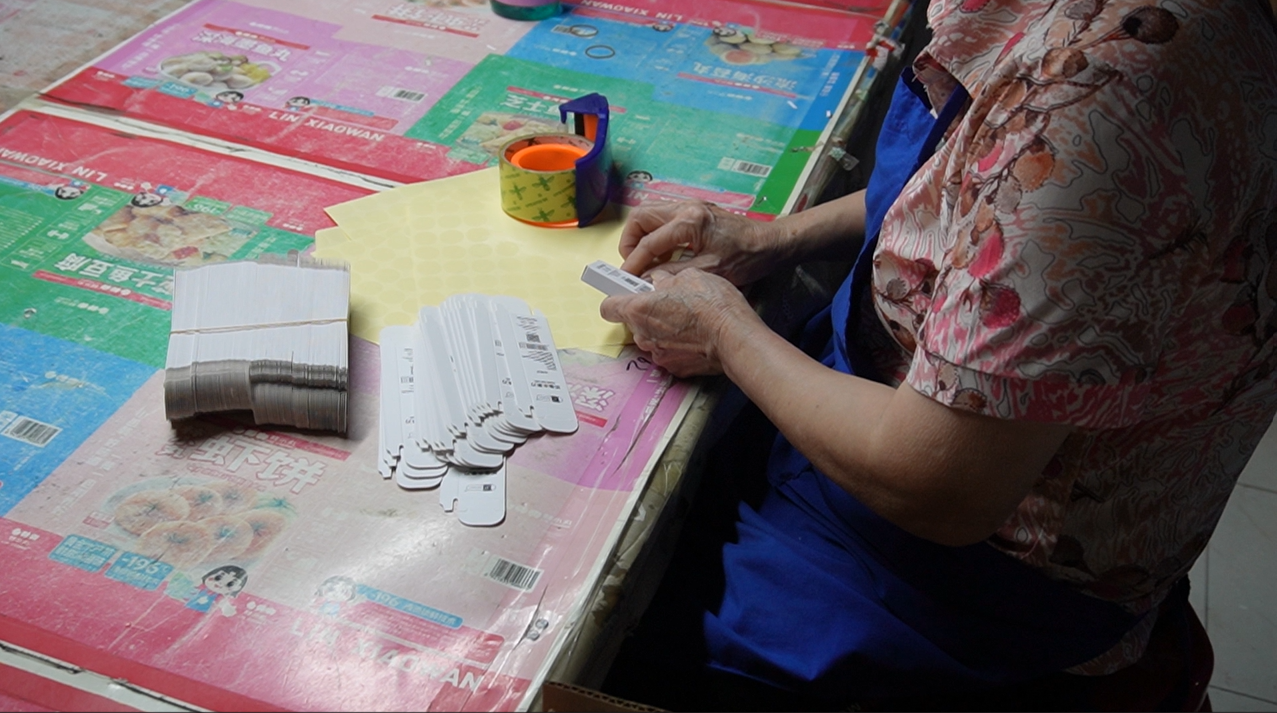
It looks like the least technical job on the floor and it is the one that costs the most when it fails. A label two millimetres off the approved position is a retail chargeback; a label from the wrong batch is a recall. In an assembly workshop producing five million pieces a month, the label is also the only object that links a specific knife back to a steel lot, a heat-treatment batch and a riveting operator.
The last station is a pair of gloved hands and a white crate. Finished knives — blue and white handles, red star mark, blades still bright — are stacked in counted rows, then handed to QC with the traveller sheet.
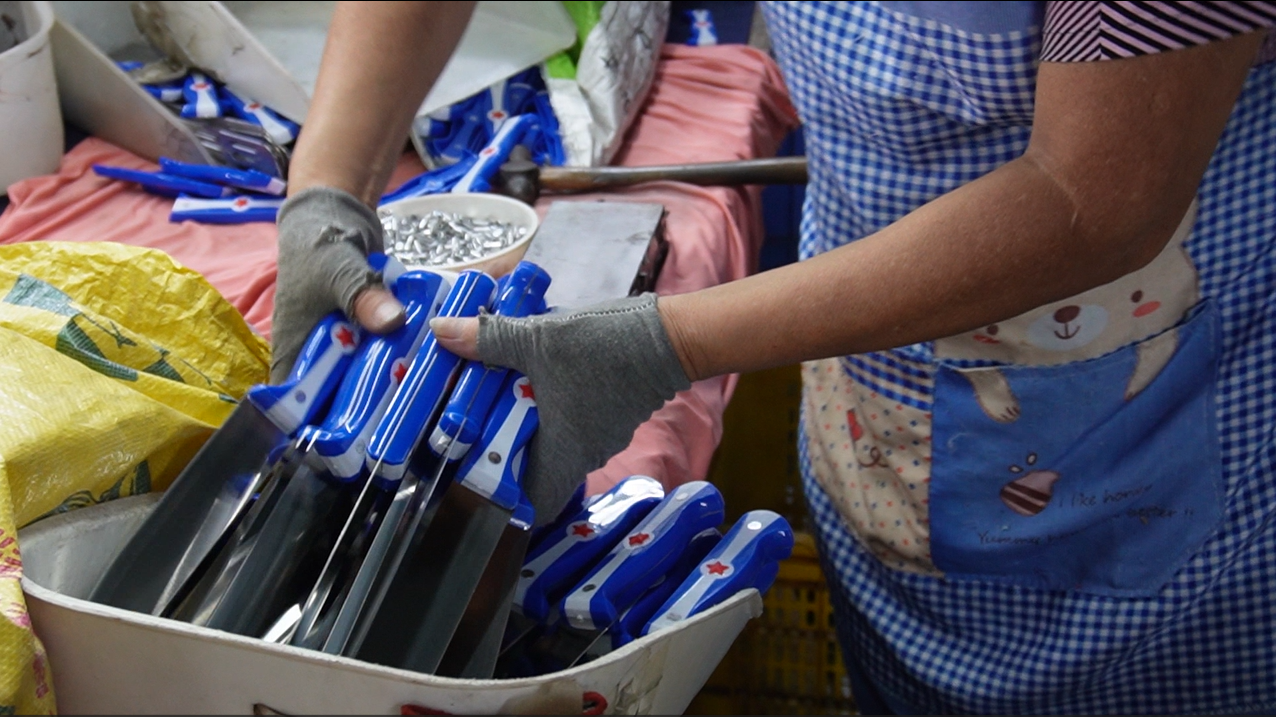
Counting by layer rather than by weight is deliberate: a scale cannot tell a short crate from a heavy one, and a buyer opening a container in Rotterdam can. The handover is also the moment when the assembly workshop stops owning the piece — from here it belongs to inspection, then packing, then the container.
Insight has been designing, producing and selling kitchen knives from Yangjiang for more than 23 years, in a plant of 20,000 square metres with monthly capacity of roughly five million pieces. The assembly workshop sits inside that same building as blanking, heat treatment, wet grinding and packing, which matters more than it sounds: when a rivet batch behaves differently, the fix happens the same day, not after a truck ride to a subcontractor.
We build chef knives, santoku knives, bread knives, paring knives and kitchen tools for brands buying OEM and ODM — private label, colour programmes, gift sets. If you want to see how your own handle and blade would be assembled, the practical next step is a sample built on our line with your specification, not a catalogue page: handle material, rivet type, label position, packing format.
Ask for a bench-built sample of your handle and blade combination. Most private-label programmes here begin with one model assembled on this floor, photographed at every station, before a single carton is planned.
Five things in sequence: handles and frames staged by batch, blade and handle joined with rivets, the moulded edge trimmed and polished, labels applied to position, and finished pieces counted into crates for inspection.
Actually because the handle was assembled without a frame, or the rivet was set too light.
Yes — that is the normal OEM and ODM route. You specify handle material, rivet type, label position and packing; we build a sample on the assembly floor and photograph each station for approval.
Piece by piece at the bench and at handover, then sampled again by inspection against the agreed standard before packing. Anything that fails returns to the station that caused it, with the batch card attached.


