


Views: 9208 Author: Site Editor Publish Time: 2026-11-20 Origin: Site


Content Menu
Why a Plastic Handle Knife Still Wins in Retail
SK-JS011: Two-Tone Handle, Five Colours
SK-JS012: One Colour, One Seam, One Cap
SK-JS013: The Chrome Collar Trick
Why Buyers Come to Insight for This Category
● Are plastic handle knives dishwasher safe?
● Can you match our brand colour exactly?
● What is the MOQ for a private-label plastic handle knife set?
● Are these sets food-contact compliant?
This week Yangjiang Insight Industry And Trade Co., Ltd. put three new plastic handle knife sets on the sample table — SK-JS011, SK-JS012 and SK-JS013 — and they are the same five blades wrapped three different ways. Same steel family, same five-piece logic, three handle stories. For a brand buying OEM or ODM cutlery, that is the interesting part: the handle decides the retail price, the shelf colour and the repeat purchase.
Insight has designed, produced and sold chef knives, santoku knives, bread knives, paring knives and kitchen tools for more than 23 years, in a 20,000 square metre plant that ships roughly five million pieces a month. What follows is how we would present these three models to a buyer — and what to check before you put a plastic handle knife on a shelf.
Wood handles sell on craft, steel handles on weight, and plastic handles on volume, colour and price. In the channels we ship to — supermarket house brands, discounter seasonal programmes, marketplace and social-commerce sellers, hotel and restaurant suppliers — the plastic handle knife is usually the entry price point that brings a shopper into a brand.
· Price architecture: a moulded handle removes machining, riveting and polishing steps, so cost sits in the blade and the tool, not in hand assembly.
· Colour as shelf language: a handle colour can carry a five-piece story across a wall of hanging cards. Steel and wood cannot.
· Cleanability: no rivet gaps, no bolted scales, no water trap. One moulded surface is easier to clean and easier to certify.
· Weight: a light set sells as "easy for everyday"; a forged set sells as "professional". Different shopper, different price.
· Safety: no sharp bolster edge, no loose rivet, no cracked scale at a screw.
None of this makes plastic a compromise. It makes it a channel decision — and the three models below are three different answers to the same question.
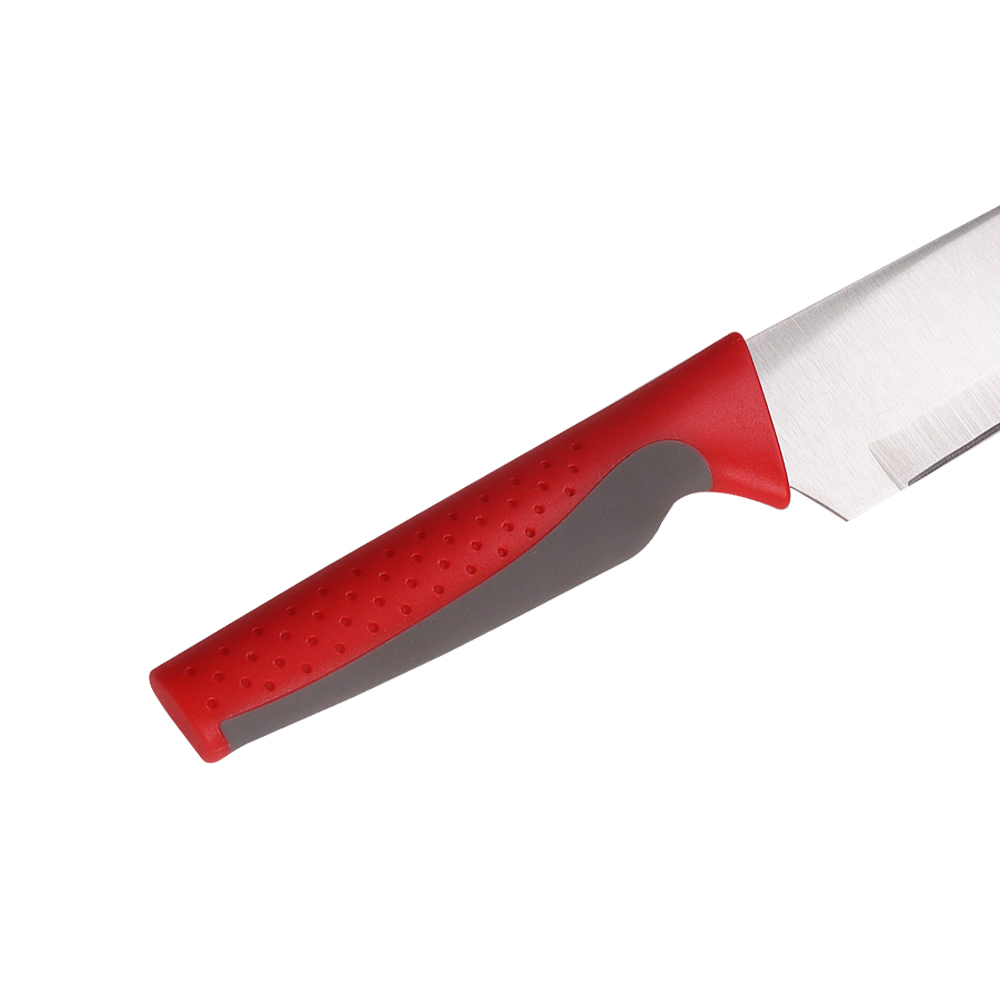
The first model is the loudest of the three, and deliberately so. The body is a solid colour — magenta on the paring knife, blue on the utility, green on the carving blade, orange on the bread knife, red on the wide blade — with a charcoal grip patch running along the spine of the handle. That patch is a second material, a softer TPR, moulded over the coloured body in the same tool.
Two details do the work. The first is texture: the coloured section carries a field of small dimples that break up water and grease on a wet hand — the same logic as a tyre tread, at a smaller scale. The second is shape: the handle tapers into a shallow S, so the index finger sits below the blade joint rather than on it.
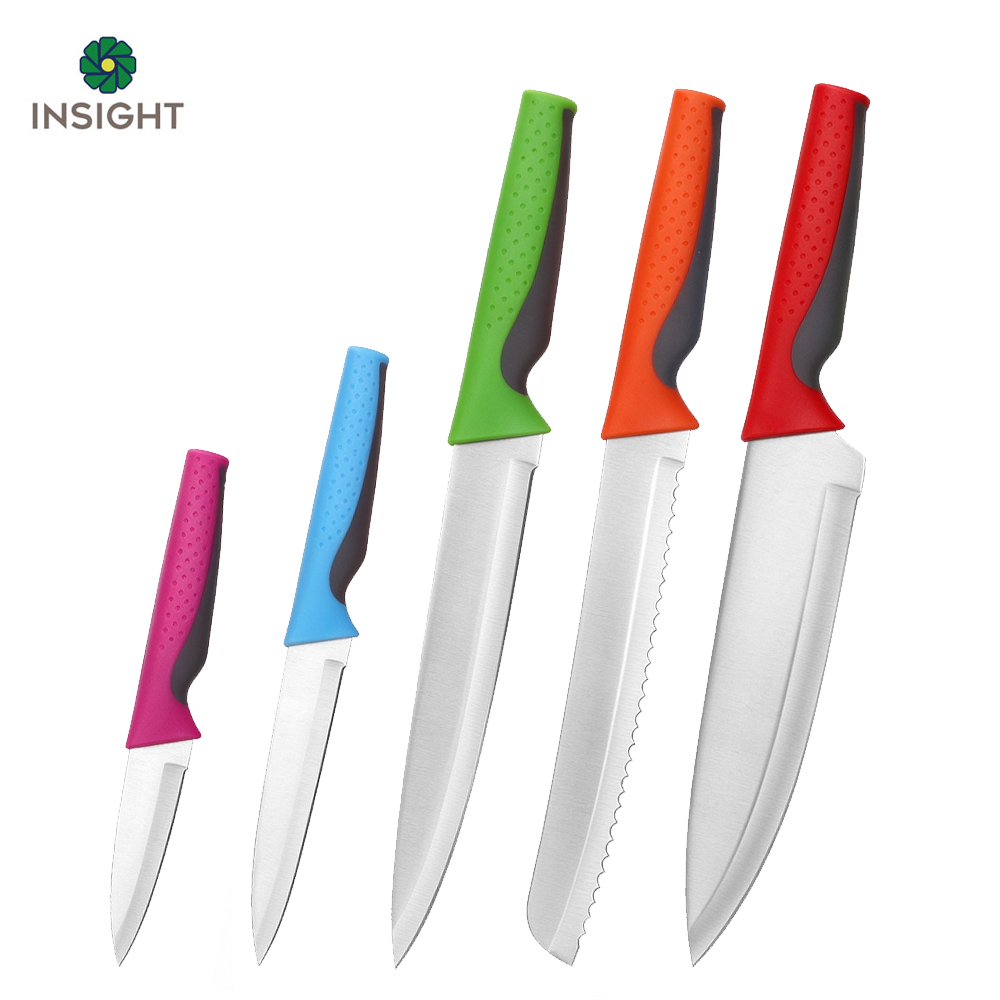
A two-material handle means two shots and one tool, so mould cost is higher than a single-material handle while piece cost stays low. What you buy with it: grip that survives washing-up liquid, a colour story that reads across five SKUs, and a visible quality cue at arm's length on a hanging card. What you give up: the ability to change body colour without re-approving the patch colour, and a slightly longer first-article cycle.
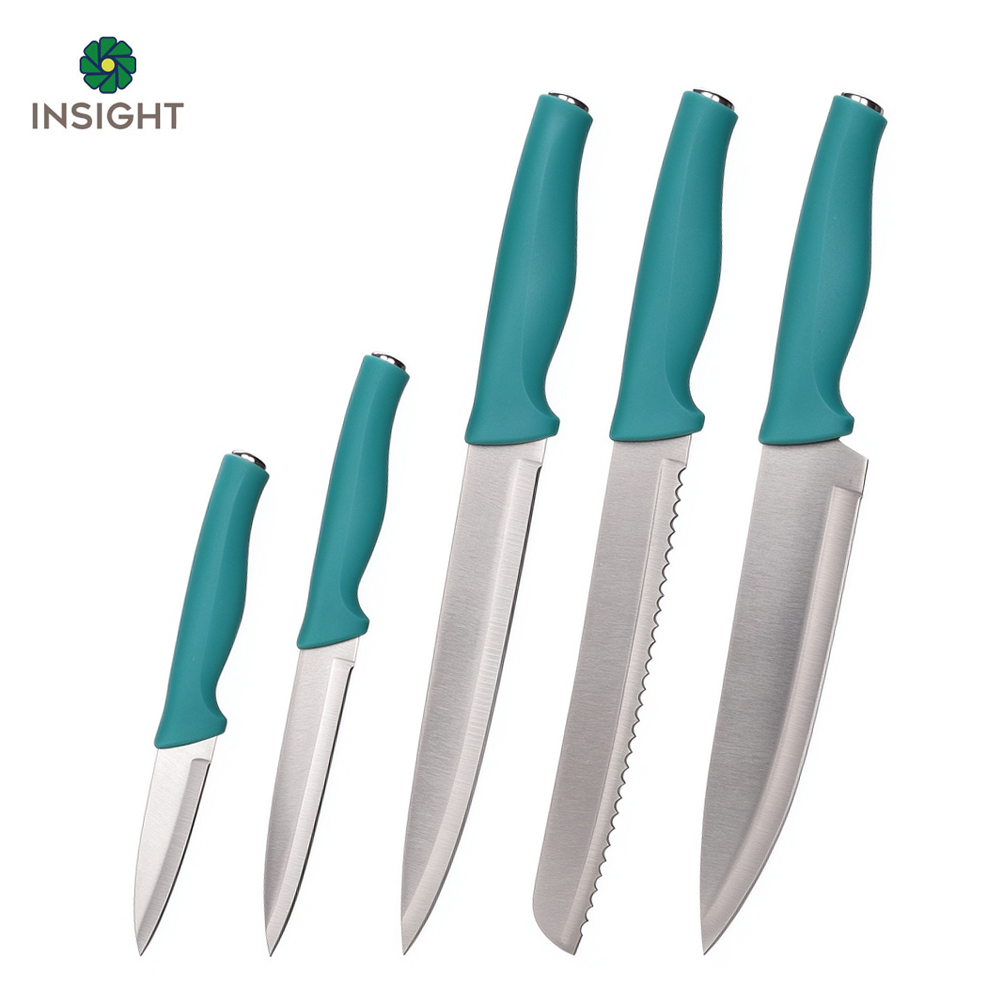
The second model is the quiet one. A single teal polymer, no second material, no patch, no colour blocking; the handle is moulded in one shot around the tang and finished with a small metal cap at the butt. The silhouette is longer and softer — a gentle S that pushes the hand back from the edge — and the only metal on the handle is that cap.
This is the model we quote when a brand wants a clean, "designed" look at a discounter price, or when a set has to sit in a gift box without shouting. One material means one colour to match, one shrinkage behaviour to control, and a shorter first-article cycle than the two-shot set.
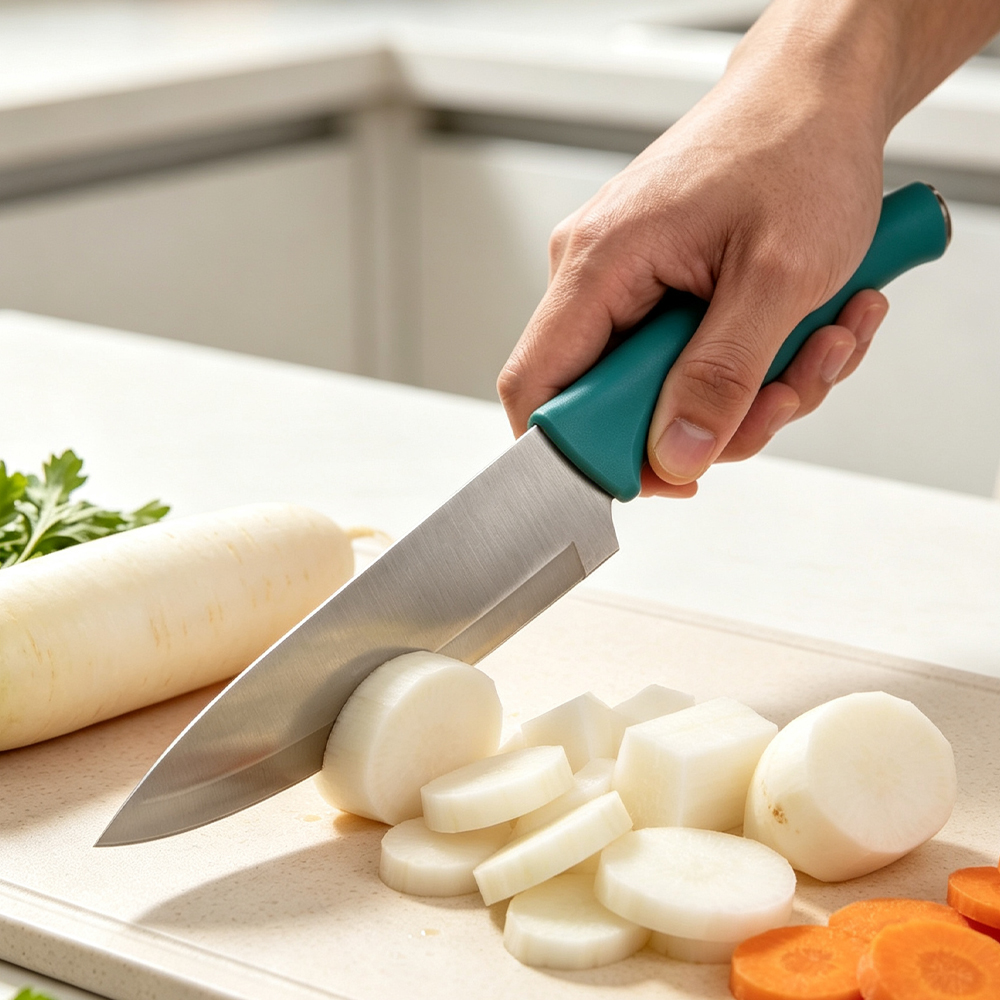
The test photo below is the argument. A short utility blade going through a daikon radish on a plastic board: what you are checking is not sharpness — any new knife is sharp — but whether the handle rolls in the hand when the wrist rotates. A mono handle with a straight spine rolls; this one carries a subtle flat under the palm to stop it.
The third model is the one buyers mistake for a forged knife. Black handle, a polished chrome collar where the blade meets the handle, a chrome cap at the butt — and no rivets anywhere. At a metre on a shelf it reads as a traditional three-rivet handle; in the hand it is a single moulded piece with two plated parts.
That collar is the whole design idea. It hides the junction, it adds a visual shoulder that makes a thin blade look stronger, and it gives the set a premium cue without a premium process. The close-up below shows how tight the collar sits: no gap for water, no ledge for food.

The trade-off is plating. Chrome on a handle that goes into a dishwasher needs a real adhesion layer, not a cosmetic flash. That is a specification conversation, not a design preference — and it is the first thing we test on this model.

All three sets carry the same five-role logic, and the blade work is where a plastic handle knife earns a second purchase. A shopper buys the colour; she comes back for the edge.
· Paring: short and pointed, for peeling, trimming and in-hand work.
· Utility: narrow and straight, for small prep and garnish.
· Carving: long and thin, for meat, fish and even slices.
· Bread: scalloped, to cut crust without crushing the crumb.
· Wide chef-style: tall blade with a gentle belly, for board work and transfer.

On steel, the retail band we quote most often is martensitic stainless in the 52–56 HRC window, moving to 56–58 HRC when a brand wants a sharper-feeling edge and accepts the extra finishing cost. On geometry, 15–20 degrees per side suits paring and utility blades, a steeper bevel keeps a wide chef-style blade alive through board contact, and the bread knife keeps its scallops shallow so it saws rather than tears.
Insight has been designing, producing and selling kitchen knives and kitchen tools for more than 23 years from Yangjiang, the cluster that makes most of China's cutlery. The plant covers 20,000 square metres and ships roughly five million pieces a month; injection, heat treatment, wet grinding, assembly and packing sit under one roof, which is what turns a two-shot handle and a plated collar into a scheduling question rather than an outsourcing chain.
We build chef knives, santoku knives, bread knives, paring knives and kitchen tools for brands buying OEM and ODM — private-label sets, colour programmes and gift boxes included. If one of the three models fits a channel you already sell, the fastest route is a specification, not a catalogue: send the polymer grade, the compliance market, the colour reference and the packing format, and ask for a sample set.
Ask for a sample set of SK-JS0011, SK-JS0012 or SK-JS0013 with the blade spec you need. A trial run on an existing mould is how most private-label programmes here begin, and a colour chip is usually the only new tooling involved.
Yes for PP handles within the cycles you specify — and that qualifier matters. A retail claim of twenty household cycles at around 65°C is a fair test target; commercial high-temperature tunnel washing is a different specification and should be stated before sampling.
Yes, against a Pantone reference with a ΔE limit agreed per colour. Colour is approved on a physical chip, not on a screen; metallics and pearlescents add cost and a longer approval loop.
It depends on colour count and mould ownership. On an existing mould, a trial run in one colour is small enough to test a channel; a new body shape or a new patch colour is the point where tooling enters the conversation.
We supply material declarations for FDA, EU 10/2011 and LFGB markets, with test reports tied to the material lot rather than to the model name. Ask for the market you sell into and the documents follow.


