


Views: 6845 Author: Site Editor Publish Time: 2026-11-12 Origin: Site


Content Menu
The Order: Knives, Cards and Tools in One Dispatch
What Was Checked Before the Doors Closed
● How do I verify the steel grade after packing?
● Can one order mix knives, scissors and utensil sets?
● Why does the retail card matter as much as the knife?
● What happens if the inspection finds defects?
On 9 November a supermarket order from Southeast Asia left our plant in Yangjiang. The cutlery, the retail cards and the kitchen tools were on the packing bench at 11:52 and inside the container by 15:34, and these photographs were taken on that day, not arranged for a brochure.
Yangjiang Insight Industry And Trade Co., Ltd. has designed and manufactured knives and kitchen tools for more than 23 years, on a 20,000 square metre site, at roughly five million pieces a month, supplying chef knives, santoku knives, bread knives, paring knives and kitchen tools to brands that buy OEM and ODM. This is the short record of one shipment day, and of the system that makes it uneventful.
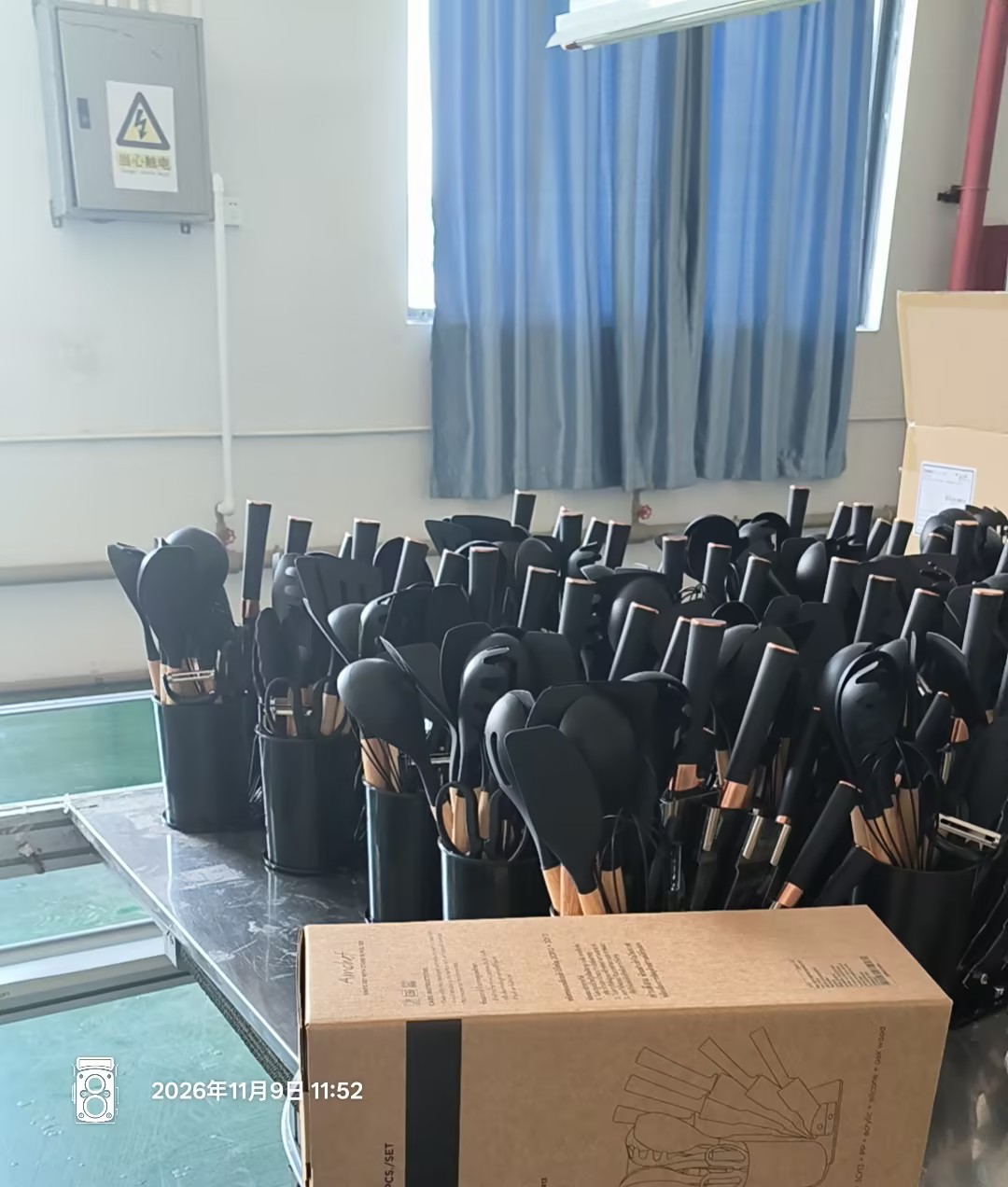
A supermarket order is a planogram rather than a wish list: knife ranges, a two-piece kitchen scissors set on a retail card, and utensil sets in holders, packed so a carton can go straight to a store or a distribution centre.The utensil sets were laid out in rows on the bench, which is how colour, handle symmetry, collar alignment, joint torque and holder clarity get compared across a batch instead of against a photograph.
Beside the bench sat an open carton, checked for print registration and barcode position on the same pass. A carton that scans badly at a distribution centre becomes a manual key-in at every store in the chain, so it is treated as part of the product, not as packaging.
By 15:34 the bench had moved to the card the shopper actually reads. The two-piece scissors set was held up on its kraft card: blades tied flat to the board, red pivot caps, and a material line printed in small type — SS 2Cr13 blade, PP handle, TPR grip. That line is a specification, not decoration: once it is printed and shipped, the blade in the carton has to match the blade on the card.
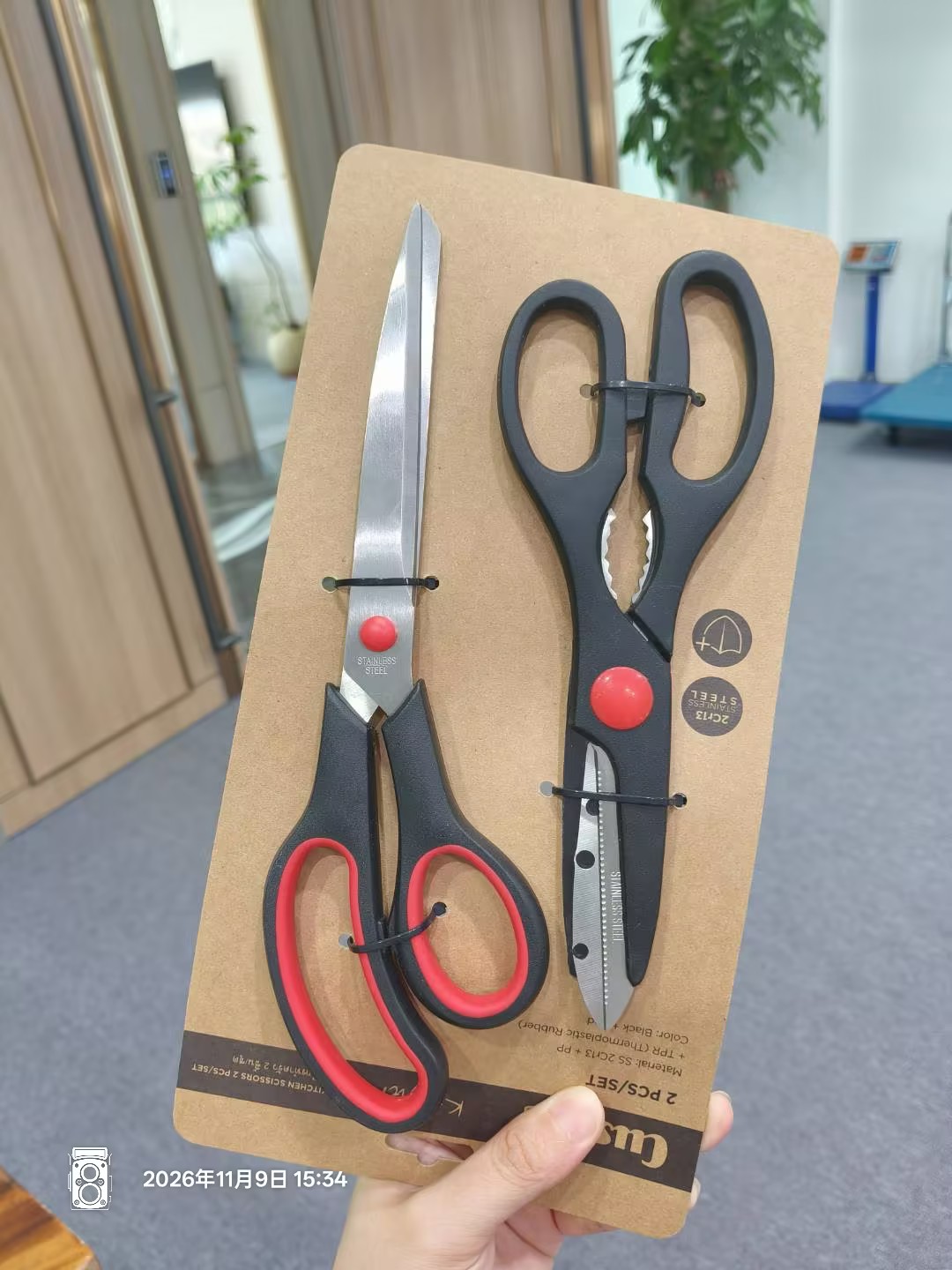
The blades in the same dispatch go through the sharper routine: no wire edge, no burr and no ripple, confirmed by a cut test; spine straight and tip centred; thickness measured against the callout; and hardness held inside the grade window, from 2Cr13 at 48 to 50 HRC through 3Cr13 at 52 to 54 to 5Cr15MoV at 55 to 58. Handles are checked for flush rivets, matched wood colour and no cracking, and the laser mark is checked for legibility, because a brand that fades in the first wash is the fastest way to lose a retail account.
Then the Container.Cartons are counted against the packing list, taped consistently and palletised with the printed panels facing outward, so marks can be read without breaking the stack. Loading runs rear-first to the plan, the space is braced, and the doors close on a seal. For a Southeast Asian destination there is one extra variable worth raising with any supplier: humidity, because kraft cards and wood handles absorb moisture on a sea leg, and a curled card is a claim waiting at the other end.
Insight is a manufacturer first. More than 23 years in Yangjiang, a 20,000 square metre plant, a capacity of roughly five million pieces a month, four knife families plus kitchen tools, and OEM or ODM work for brands rather than catalogue sales.
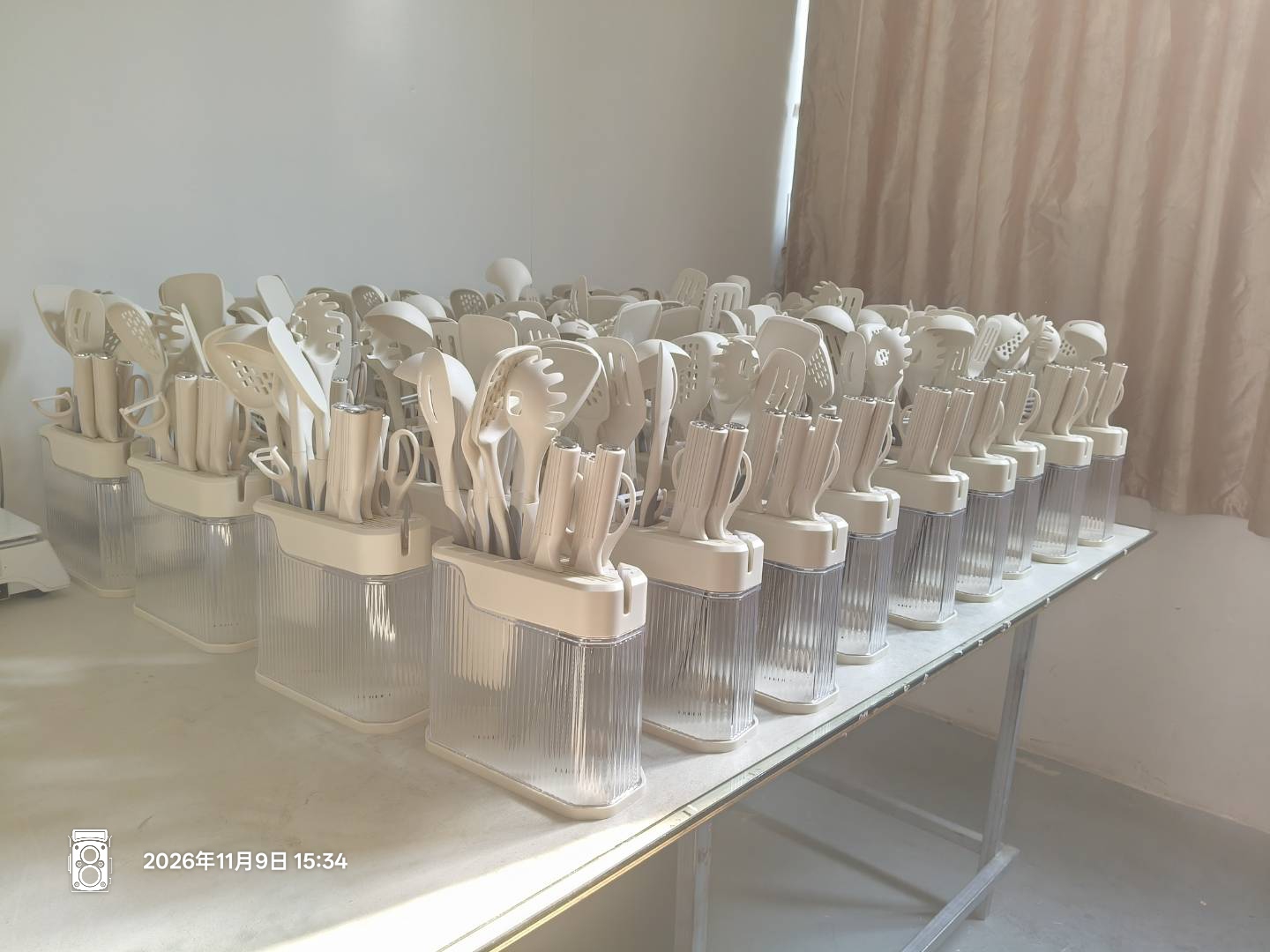
One day can carry cutlery, scissors and utensil sets without the quality drifting between them because the supporting systems sit in the same building: supply and material qualification, in-process parameter control, warehousing, packing, QC, pre-shipment inspection and after-sales. Steel arrives with a batch identity and leaves with a hardness record, cards are proofed against the specification rather than against a mock-up, and the team that inspects a blade also checks the carton it goes into.
That is what the photographs show. Not a factory that can make one good knife, which Yangjiang has hundreds of, but a factory where the last day before shipment is boring: the sets match, the cards are right, the pallets are square, and the container closes on time.
By batch. Ask for the batch identity on each carton and the hardness records tied to that batch, then sample a few blades from the shipped lots.
Yes. At Insight the four knife families, kitchen tools and scissors are produced and packed under one roof, so one inspection covers the whole range.
It carries the material promise the shopper relies on and the barcode and hang geometry the retailer relies on. A wrong material line becomes a consumer-protection problem in the destination market.
They are sorted, reworked or replaced before the container is closed, and the load plan is re-cut around the corrected quantity.


