


Views: 9659 Author: Site Editor Publish Time: 2026-11-04 Origin: Site


Content Menu
>> Introduction: The Difference Between a Booth and a Booth
>> Before You Go: Documents and Paperwork to Request
>> The Five-Minute Interview: Questions That Separate Factories from Traders
>> What the Products Tell You at the Booth
>> On the Shop Floor: What to Inspect During a Factory Visit
>> Quality Systems: Incoming, In-Process, and Final Inspection
>> Capacity and Lead Times: Can They Actually Deliver?
>> Red Flags and How to Respond
>> A Benchmark Example: How Yangjiang Insight Measures Up
>> Frequently Asked Questions (FAQ)
>> Conclusion: Verify First, Partner Second
Every exhibitor at the Canton Fair has a booth. Fewer have a factory. Yet when you are sourcing kitchen knives, the booth is only a window — the factory behind it is what determines your product quality, your delivery dates, and your relationship for years to come. This guide gives you a practical audit checklist so you can separate genuine manufacturers from intermediaries, and verify a supplier's real capability before you commit an order.
The good news is that verification does not require expertise — it requires the right questions and the right order to ask them. We use Yangjiang Insight Industry And Trade Co., Ltd., a 23-year-old kitchen knife manufacturer in Yangjiang, China's cutlery capital, as our benchmark example throughout, so you can see what a passing factory looks like.

Verification starts before you shake hands. Prepare a short list of documents to request from every serious candidate:
Business registration and export license — confirm the entity you are negotiating with is a registered manufacturer, not a shell.
Factory address and facility details — facility size, number of workers, and production scope. Concrete numbers are the first test of honesty.
Product certifications and quality certificates — ask which quality management systems the factory runs and what product certifications it holds.
Existing client references — a legitimate manufacturer can usually point to brands, markets, or product lines it has produced.
At the fair, ask each supplier to walk you through these. A factory answers with specifics; a trading company tends to answer with generalities.
You can filter candidates in a five-minute conversation. Ask these questions, in this order, and listen to how they answer:
"Are you the manufacturer? Where is your factory?" — A real factory names its location without hesitation and welcomes visits.
"How many workers do you have, and how large is your facility?" — Specific answers (not "we have a big factory") are the mark of someone who works on the shop floor.
"Which processes do you do in-house?" — Forging, heat treatment, finishing: a genuine manufacturer names its own processes; a trader cannot.
"Can we visit your factory this trip?" — This is the single most powerful filter. Factories say yes; intermediaries find reasons why not.
"Show me a product that has been in daily use." — Real-world performance is the truth that polish cannot hide.
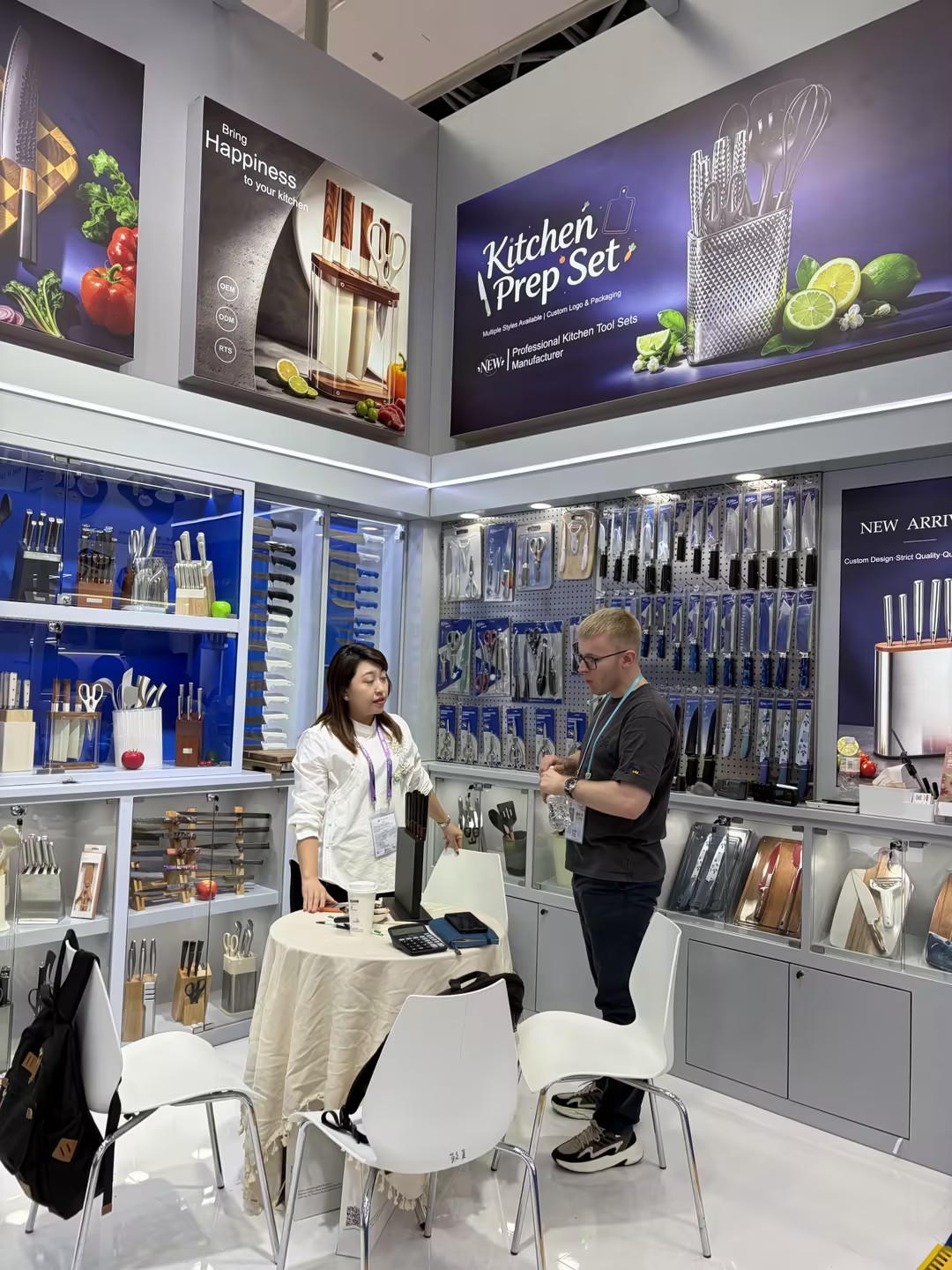
Before you dig into paperwork, let the knives speak. Inspect the range on display with the fundamentals in mind: steel grade and hardness, heat treatment quality, handle material and construction, tang, balance, and finish. Test the edge on paper or a tomato if you can, and compare multiple samples of the same model — inconsistent edges between supposedly identical knives are a warning sign.
Also notice what the booth does not show. Ask where the product is made, which processes are contracted out, and how they handle defects. The answers, not the display, are the real product information.
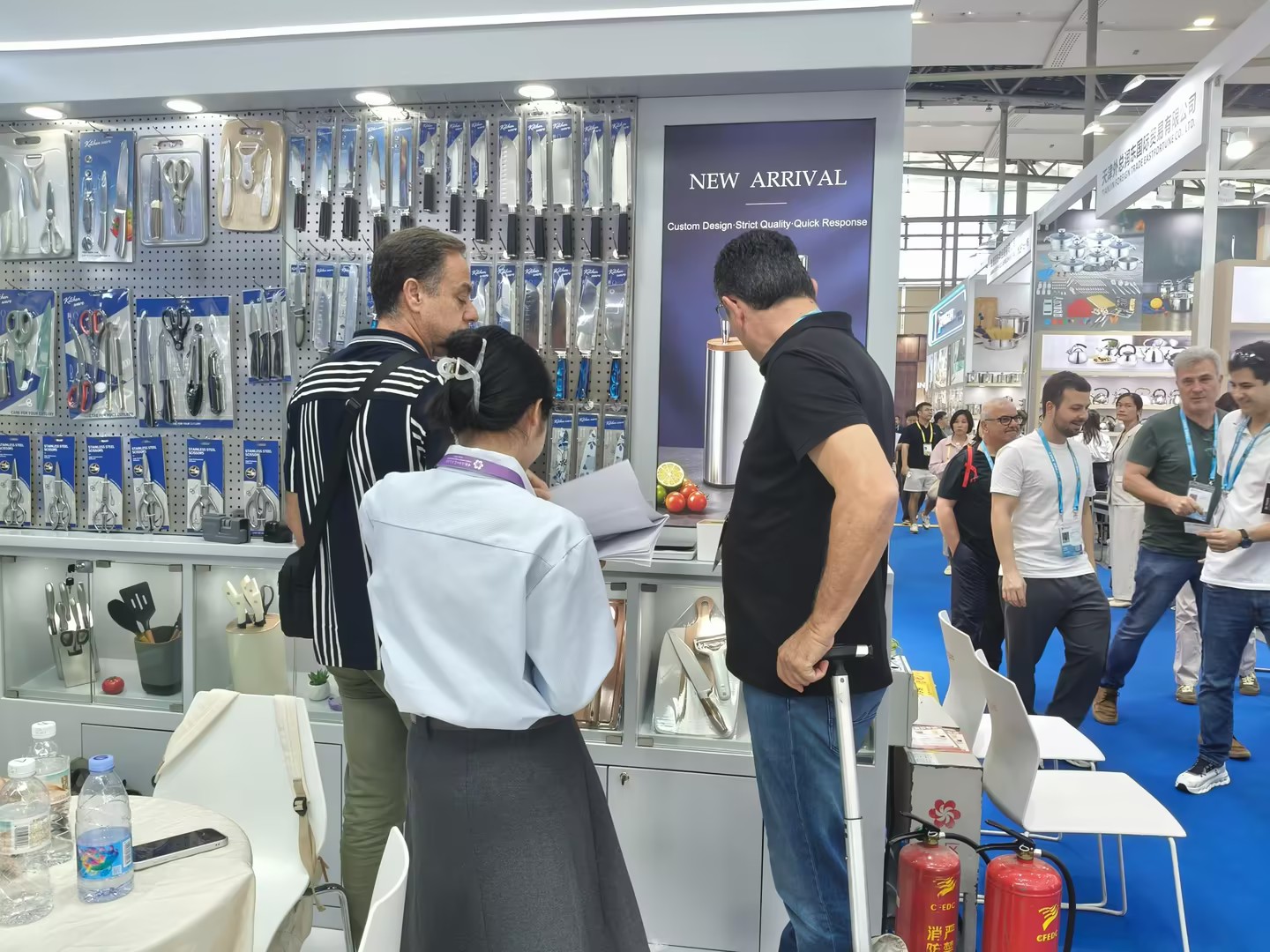
A factory visit is the gold standard of verification, and Yangjiang is only a short high-speed rail ride from Guangzhou — so it is easy to arrange. On the shop floor, focus on four things:
Production lines — Are the lines running? Are workers organized and materials staged properly? A busy, orderly line is harder to fake than any document.
Machinery and tooling — Forging, heat treatment, grinding, and finishing equipment tell you what the factory can genuinely produce itself.
Workforce and working conditions — A stable, skilled workforce is the real asset behind consistent quality.
Scale and flow — Walk the full process from incoming steel to finished, packaged product; you will see exactly how much of the process is truly in-house.
Quality is not a final check — it is a system. Ask your candidate factory about the three inspection stages:
Incoming material inspection — how they verify the steel and handle materials they buy.
In-process checks — what is inspected during forging, heat treatment, and finishing, and who does it.
Final inspection — what is checked before shipment, and whether reports are available to the buyer.
The strongest signal of all is how a factory answers "what happens when a batch has a problem?" A reliable partner explains the process calmly; a weak one improvises.

A beautiful product is worthless if the factory cannot deliver it on time. Ask about monthly capacity, current order load, and typical lead times for your product type. Then compare that with your expected volumes: a factory that stretches to meet your first order will fail your third.
Scale also matters for flexibility. A factory with deep capacity can absorb small trial orders into larger production runs and offer a realistic path for you to grow. When you hear numbers like a 20,000-square-meter facility and a monthly capacity of about five million pieces — that is the scale that allows a manufacturer to say yes to a serious buyer.
Keep these warning signs in mind as you evaluate candidates: answers that never include numbers; certifications that cannot be shown; an address that does not match the company name; reluctance to schedule a visit; products that vary visibly between samples; and quality questions answered only with promises. No single red flag is fatal, but several together should move a candidate down your list — and a serious factory will understand your questions and welcome them.
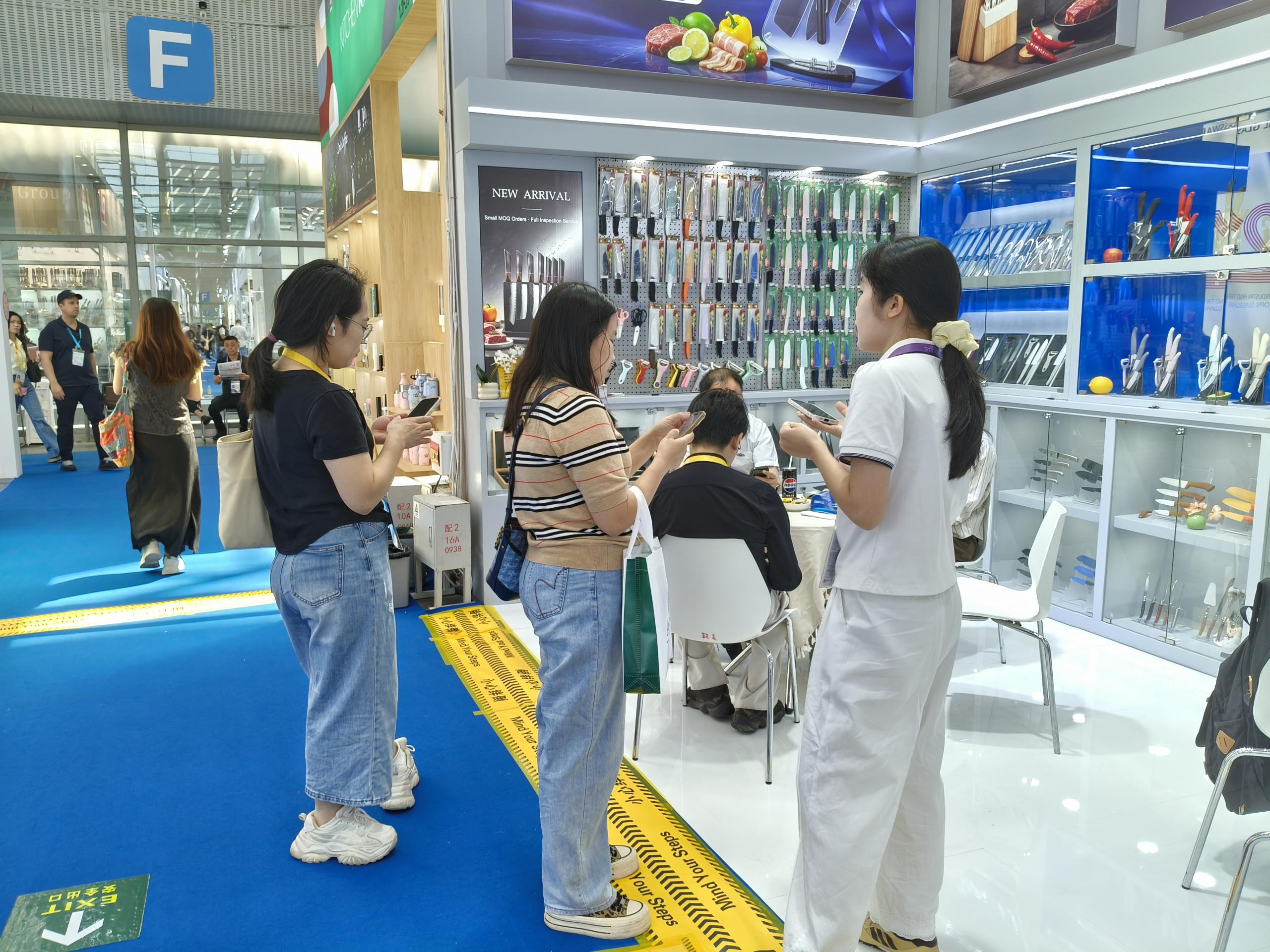
To see what a passing factory looks like, use Yangjiang Insight as your benchmark. The company has been manufacturing kitchen knives in Yangjiang for 23 years — experience that has built its quality systems rather than just its catalog. Its 20,000-square-meter facility and monthly capacity of about five million pieces provide the scale to grow from a trial order to container shipments. Production, quality control, and finishing follow the full process, and its core range of chef knives, santoku knives, bread knives, and paring knives is developed with OEM, ODM, and private-label branding in mind. When you visit the fair, ask Yangjiang Insight the same questions you would ask any candidate — and see how a factory answers.
Q1: How do I know if an exhibitor is a real manufacturer? Ask direct questions about factory location, facility size, workforce, and in-house processes, and request business registration and quality documents. Then arrange a factory visit — the most reliable verification.
Q2: What documents should I request before sourcing? Business registration and export license, facility details, product certifications and quality certificates, and client references.
Q3: What should I inspect during a factory visit? Production lines, machinery and tooling, workforce and working conditions, and the full process flow from incoming materials to finished product.
Q4: What are the three quality inspection stages? Incoming material inspection, in-process checks, and final inspection before shipment — and ask for inspection reports.
Q5: How much does a factory visit cost? Reputable factories typically welcome serious buyers at no cost. Yangjiang is only a short high-speed rail ride from Guangzhou, and Yangjiang Insight is glad to arrange a tour of its 20,000-square-meter facility.
Q6: What if a supplier refuses a factory visit? Treat it as a strong warning sign. Legitimate manufacturers understand verification and welcome it.
The Canton Fair makes it easy to fall in love with a booth. But your product, your deadlines, and your brand depend on what happens behind it — the factory's processes, its scale, and its willingness to be inspected. Verify first, and you can partner with confidence.
Put the checklist to work at the 140th Canton Fair: test the knives, ask the questions, and if you are sourcing in volume, take the high-speed rail to Yangjiang and see the factory with your own eyes. Start with our booth — we will show you our chef knives, santoku knives, bread knives, and paring knives, and we will be glad to arrange the visit that proves the rest. We look forward to meeting you.


