


Views: 7238 Author: Site Editor Publish Time: 2026-11-13 Origin: Site


Content Menu
What "Lasts" Actually Means for Kitchen Scissors
The Edge: The Number That Decides the Life
The Pivot: The Screw Nobody Specifies
Three New Designs That Follow These Rules
● JD-001: Serrated Edge, Sculpted Shanks
● JD-002: Straight Edge, Slim Profile
● JD-003: Serrated Edge, Satin Finish, Wide Oval Handles
How to Verify "Lasts" Before the Container Closes
Why This Spec Sheet Exists: 23 Years Under One Roof
● How long should kitchen scissors from China last?
● Which steel grade is right for kitchen scissors?
● Serrated or straight edge, if I can only choose one?
● Are all-steel kitchen scissors dishwasher safe?
● Can we put our logo and our own card on the order?
Most kitchen scissors do not fail because they were cheap. They fail because three things were never written down: the edge, the pivot and the joint. A buyer who specifies those three properly gets a pair that still cuts after two years of daily use; a buyer who specifies a price and a colour gets a carton that photographs well and returns badly. This article is about the first path, and about the question every importer eventually asks, which is how to tell the difference before the container leaves.
Yangjiang Insight Industry And Trade Co., Ltd. has designed and manufactured knives and kitchen tools for more than 23 years, on a 20,000 square metre plant, at roughly five million pieces a month. Chef knives, santoku knives, bread knives, paring knives and kitchen scissors ship from the same site to brands buying OEM and ODM, which means the specification below is not theory: it is the document our own buyers and QC team work from every month.
A pair of kitchen scissors is a lever with a hinge. The blade is asked to hold an angle under load, the pivot is asked to keep the two halves in contact, and the handle is asked to transmit hand force without cracking. Those three jobs fail in three different ways, and each has its own specification.
The first failure is the edge rolling. A blade that is too soft deforms instead of severing, and once the apex has rolled it will not cut paper cleanly no matter how it is honed. The second is pivot play: the halves drift apart, material folds between the blades instead of being sheared, and the user starts squeezing harder to compensate. The third is the joint: a two-material handle cracks at the insert, or a riveted pivot loosens with no way to re-set it. None of these show up in a product photo. All of them show up in a second order that never comes.
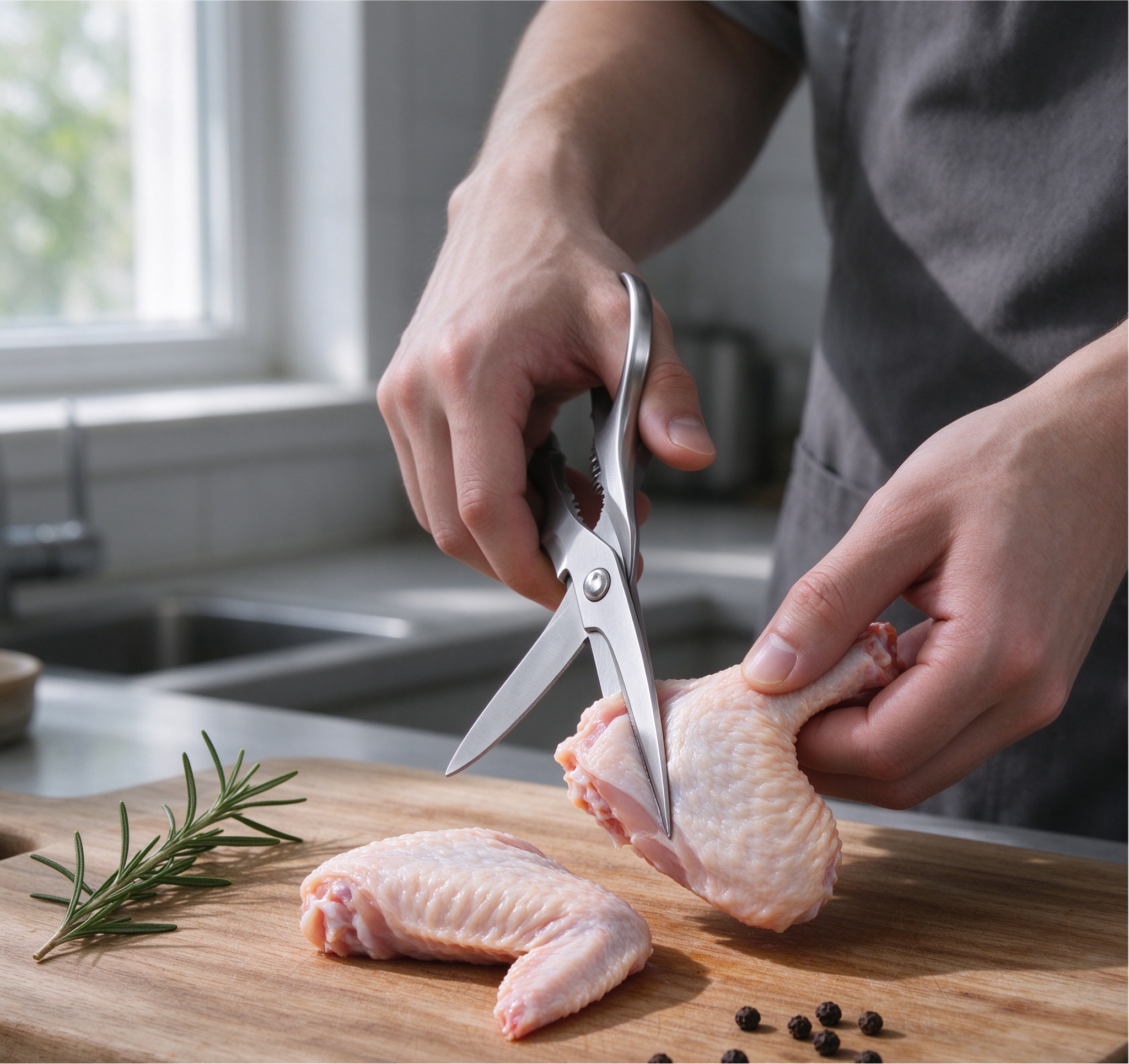
Hardness is the specification that decides how many cuts a pair will deliver before it needs attention. On the grade ladder Insight quotes, 2Cr13 sits around 48 to 50 HRC, 3Cr13 around 52 to 54, and 5Cr15MoV around 55 to 58. Each step buys edge retention and corrosion resistance, and costs money at the mill.
What matters as much as the grade is what happens after hardening. Grinding generates heat at the very edge, and if the edge is allowed to run past the tempering range, the hardness that was just paid for is quietly removed at exactly the point that does the work. In a plant that understands this, the final grind is done wet or with controlled cooling, and the edge is checked afterwards rather than assumed. That is the difference between a kitchen scissors blade that measures 55 HRC on a certificate and one that measures 55 HRC where the tomato meets it.
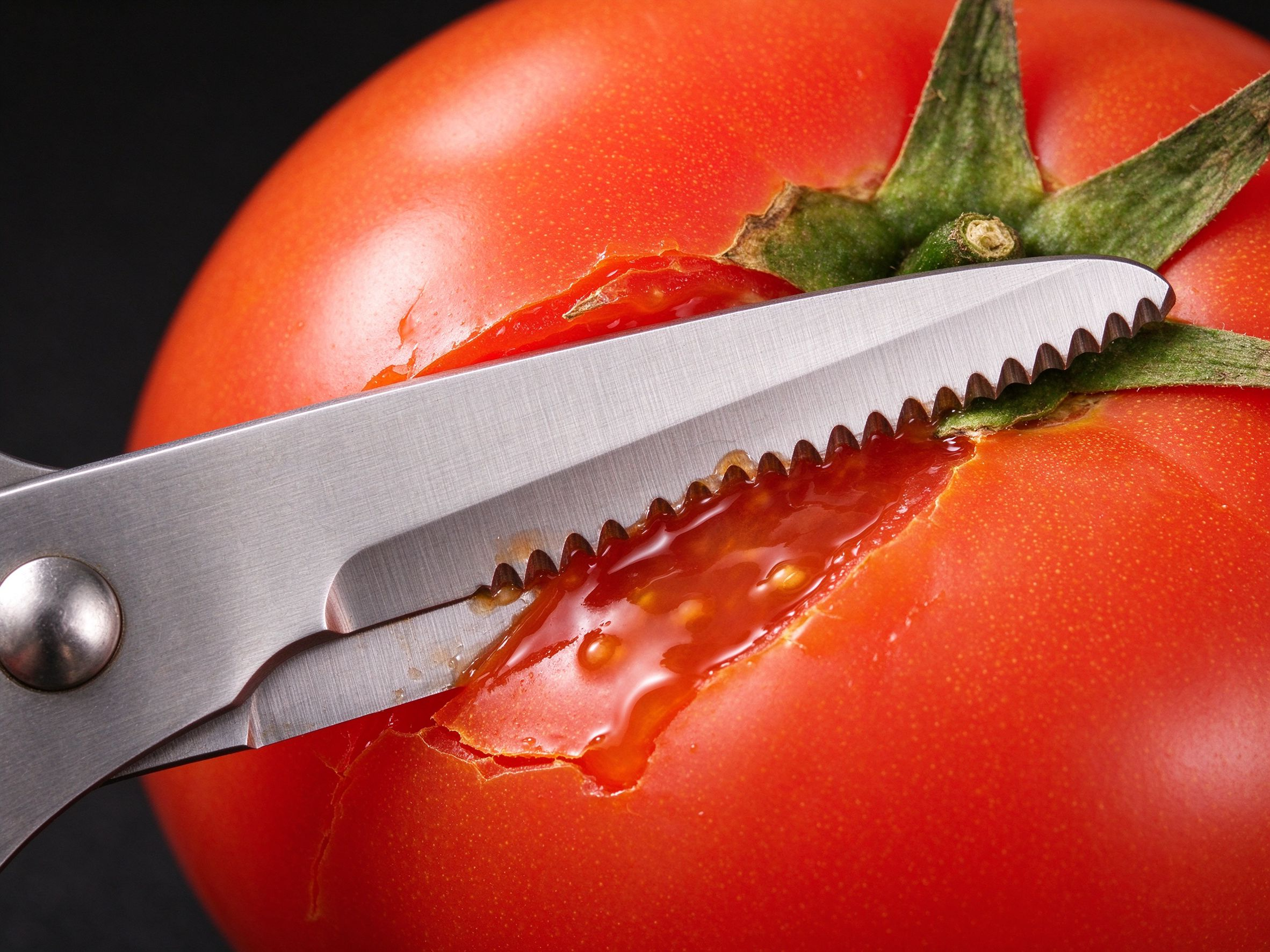
The edge type is the second decision. A serrated kitchen scissors concentrates force on the teeth, which is what makes it grip tomato skin, fish skin, vacuum film and cartons; it also keeps cutting after the points have dulled, because the teeth still catch. A straight edge shears along its full length, leaves a clean line and can be honed back to sharp, but it skates on wet skin unless it is genuinely sharp. For retail ranges, the honest answer is usually one of each, which is why two-piece sets exist. On kitchen scissors sold at a supermarket price, the tooth pitch is where cost tends to be quietly removed.
Two traps are worth naming. First, 304 stainless is food-grade and non-hardenable; it belongs on handles, not blades, and a pair advertised with it as blade steel will not hold an edge. Second, "stainless" describes corrosion resistance, not hardness, so a quotation that says only stainless has told you nothing about life.
The pivot is the least photographed and most consequential part of any kitchen scissors. A riveted pivot is set once at assembly: it cannot be adjusted, cannot be re-tightened, and when the blades begin to separate the pair is finished as a tool. A threaded screw can be set to a torque at the bench, checked as part of QC, and re-tightened by the user when the cut starts to fold rather than shear.
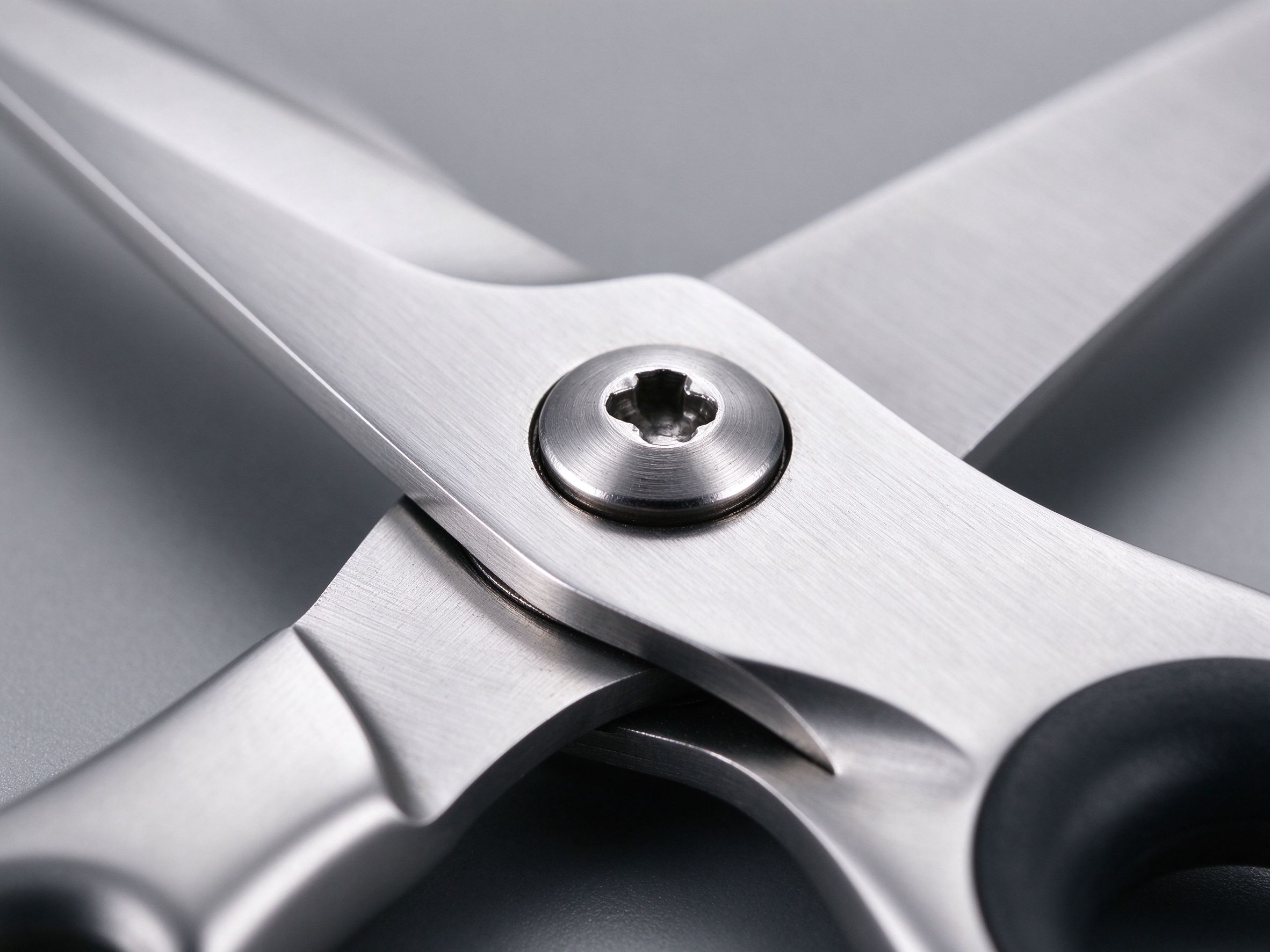
What to write into a specification is not "screw" but the torque value and the acceptance range, plus the play allowed after a set number of open-close cycles. A kitchen scissors that closes with a visible gap at the tip can still pass a visual inspection, which is why the closure test belongs in the same paragraph as the torque value. The cost difference between a rivet and a screw is small; the difference in service life is not.
A kitchen scissors with a plastic handle has an interface where two materials meet, and that interface is where failures live: the handle cracks at the insert, the blade loosens in its moulding, and the pair starts to chew. Full steel construction removes the interface entirely, because blade and handle are one material, one heat treatment and one finishing route. There is nothing to delaminate and no insert to shrink at temperature.
Steel handles carry a trade-off, and an honest supplier will say it: metal conducts heat and a forged shank is heavier than a moulded one. That is why shank geometry matters on kitchen scissors in retail, where the pair is bought without being held. On a well-built pair the hand sits on the shank behind the pivot rather than on the blade root, and the balance point is set slightly forward of the grip so the blades do the work instead of the wrist. This is also where retail returns come from: not from a broken blade, but from a pair that is tiring to use.
Insight has just released three all-steel kitchen scissors. Read as a range rather than as three products, they are also a demonstration of the three decisions above: which edge, which shank, which pivot.
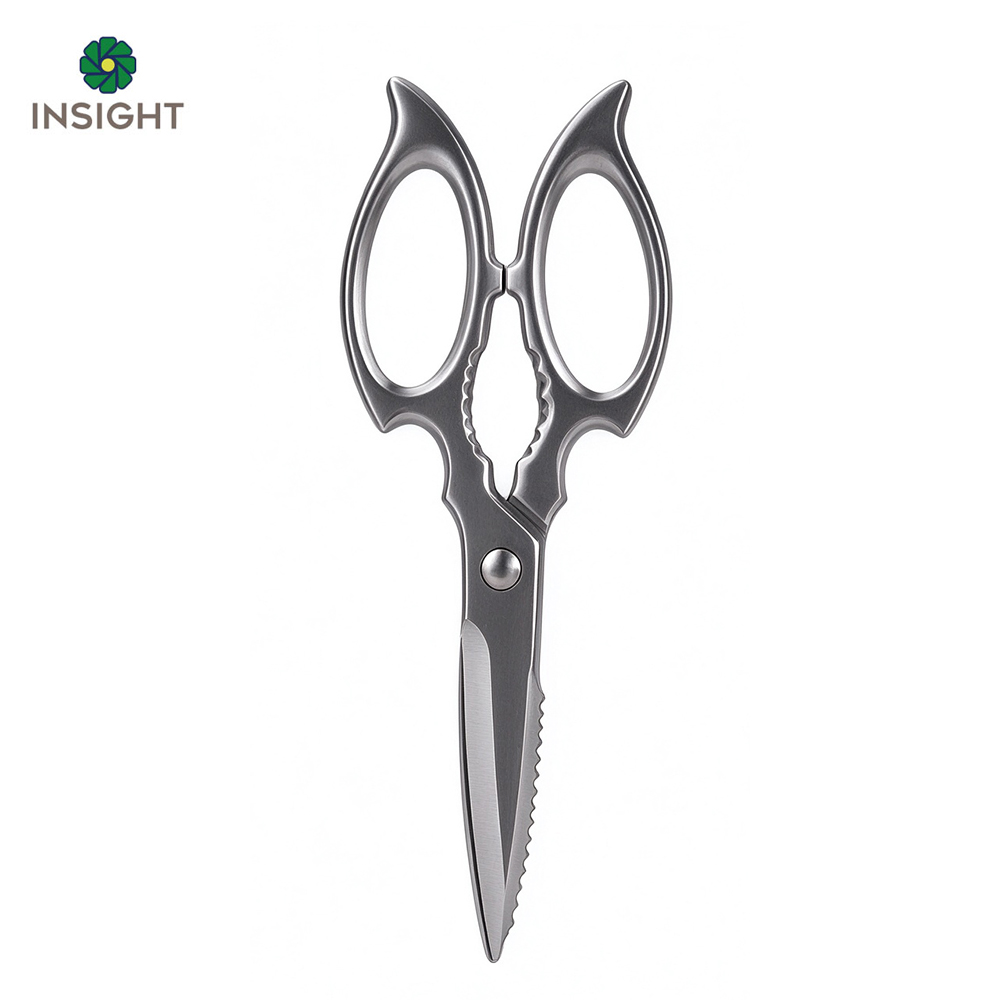
The first design carries serrations on one blade and a shank that flares behind the finger bow. The flare is not styling: on wet, slippery material a hand that slides forward along a straight shank ends up on the blade, and the flare stops the hand where it should stop. The serrations do the other half of the work, biting into tomato skin, fish skin and packaging film instead of skating over it.

The second design is a straight-edge pair with a narrow profile and a polished face. This is the precision tool of the three: snipping herbs without bruising them, trimming pastry, opening a bag cleanly, cutting a line that has to stay a line. A straight edge closes along its full length, so the cut is a shear rather than a series of small tears, and it can be honed back to sharp through a long service life.
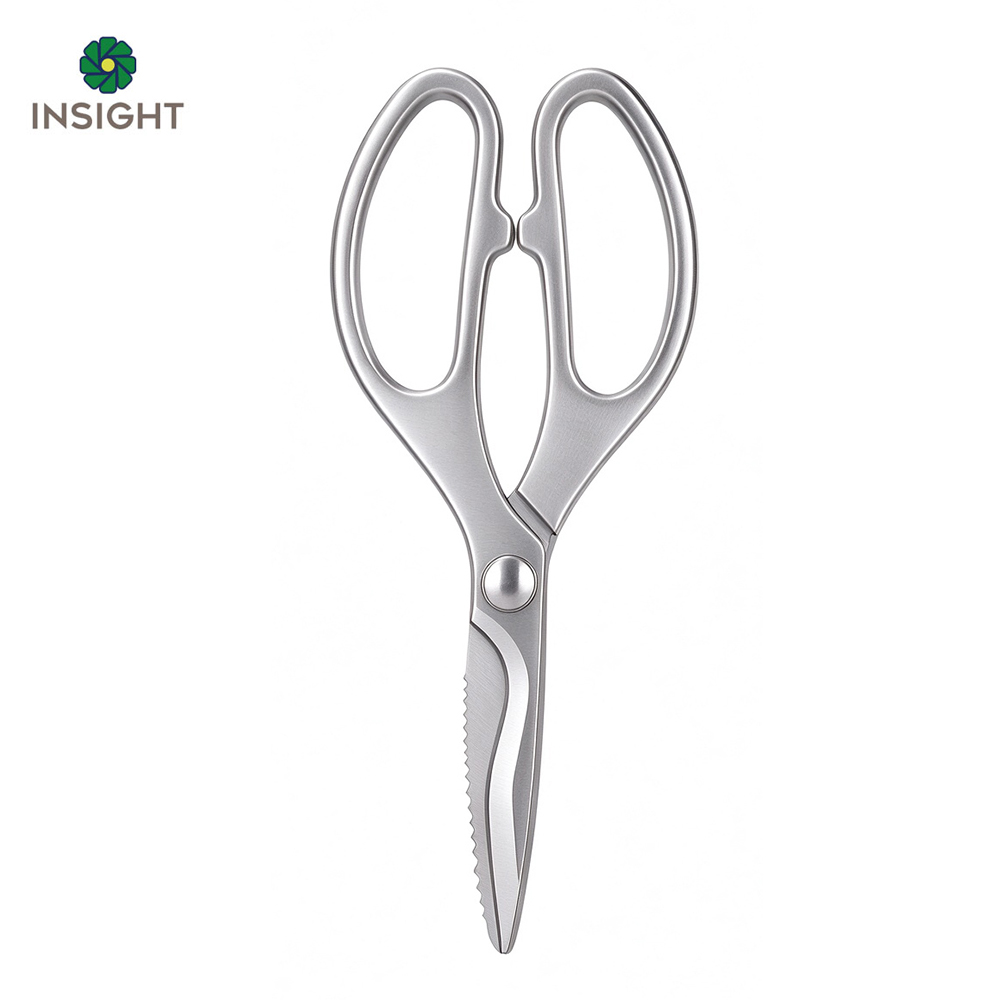
The third design pairs a serrated edge with satin-brushed steel and wide oval handles. It is the all-purpose pair of the range, and the finish is a retail argument rather than a cosmetic one: a satin face does not collect fingerprints the way a mirror polish does, and it still looks presentable after weeks on a hanging peg. Wide bows suit a hand that grips rather than pinches, which is most of the market that buys a kitchen scissors set from a shelf.
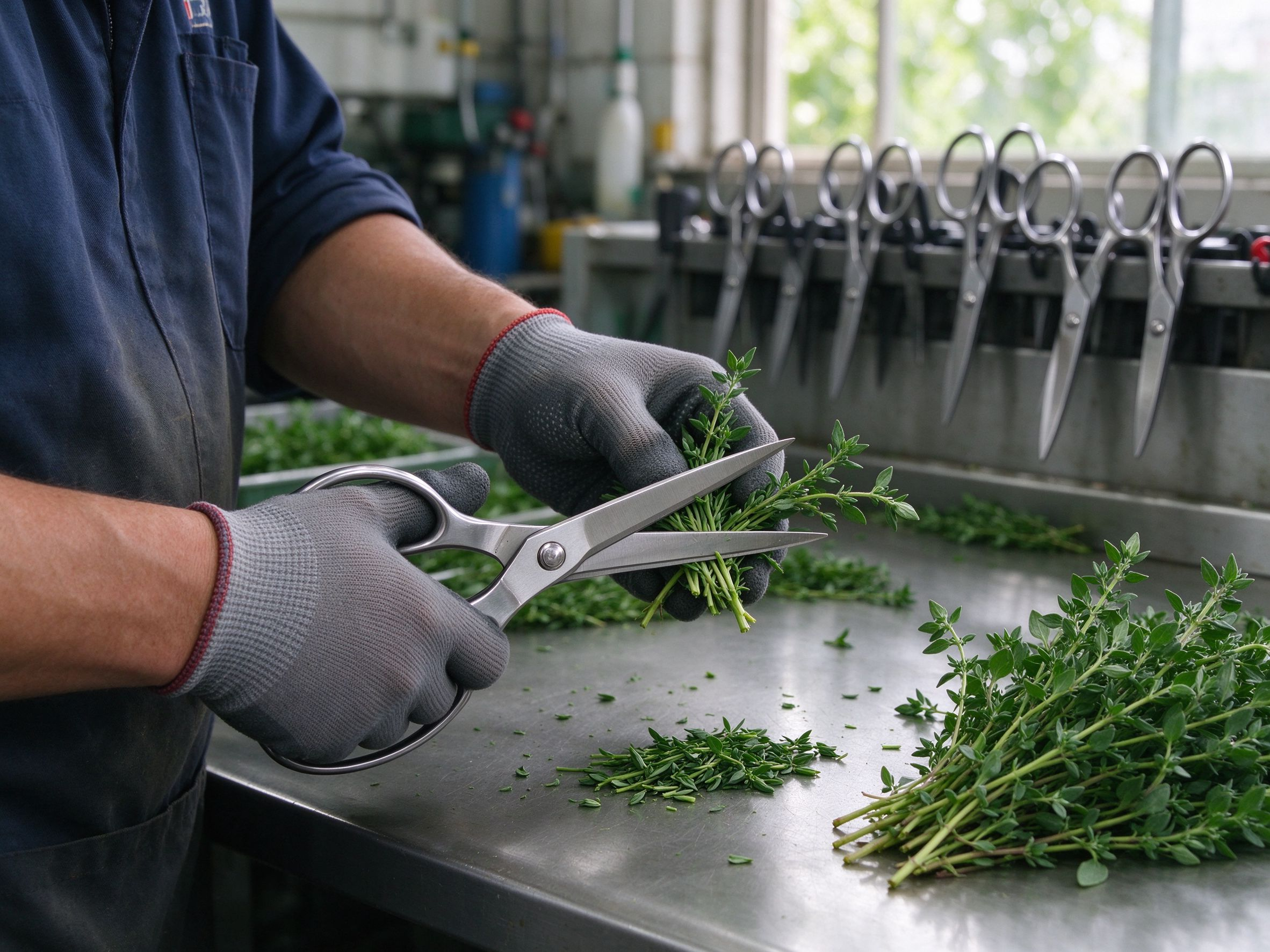
Everything above can be claimed. Only a test can be checked. The protocol we run on a kitchen scissors batch starts with the cut: paper, cloth, cardboard and fresh herbs, cut as a user would, watching for skidding, tearing and a blade that separates at the tip. Then closure along the full length, pivot torque against the value set at assembly, and screw retention after handling.
After the cutting comes the finish and the retail layer: serration burrs under a light, handle deburring where a hand will sit, finish uniformity across the pair, a drop test on the bows, tie tension, print registration and a barcode scan at the distribution centre's scanner rather than at the printer. Corrosion testing is agreed in hours in the specification, because salt-spray time is a cost decision as much as a quality one.
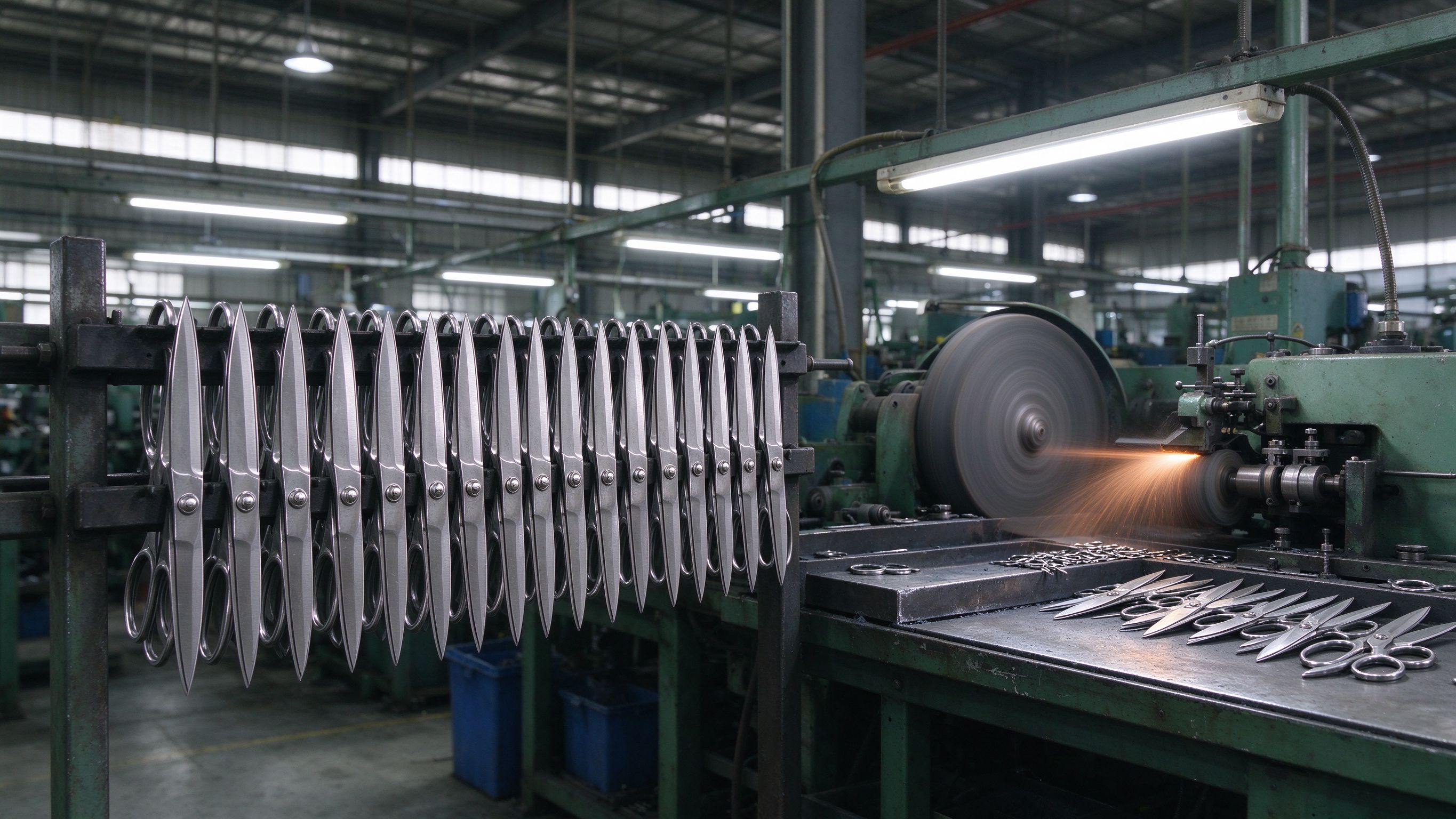
Scissors are a small product with a long process, and kitchen scissors are no exception: blanking, forming, heat treatment, grinding, serration, polishing or satin finishing, assembly and tension setting, carding and packing. At Insight these steps sit inside the same 20,000 square metre plant that produces chef knives, santoku knives, bread knives, paring knives and kitchen tools, at a capacity of roughly five million pieces a month, for brands buying OEM and ODM.
That matters for kitchen scissors in a specific way. A cutlery plant already owns the heat treatment, the grinding discipline and the hardness records that a scissors needs, and it already owns the material chain that sets the grade. The seven systems around it, from supply qualification and in-process control to warehousing, packing, QC, pre-shipment inspection and after-sales, are the reason a pair can be quoted with a hardness window and a batch identity instead of a price and a promise.

It depends on four specifications rather than on price: hardness inside a stated window, an edge that was ground without losing that hardness, a pivot that can be re-set, and a joint that has no material interface to crack. Specify those and a pair should hold daily domestic use for years rather than months.
Match the grade to the price point and the use: 2Cr13 around 48 to 50 HRC for entry ranges, 3Cr13 around 52 to 54 for mainstream retail, and 5Cr15MoV around 55 to 58 where edge retention has to survive heavier work. Never accept 304 as blade steel; it cannot be hardened.
Serrated for general kitchen work, because it grips tomato skin, fish and film; straight for precision work, because it shears cleanly and can be honed. If the budget allows one specification, choose serrated and specify a tooth geometry that still performs after the points dull.
The steel handles it; the variables are pivot tension, finish and marking. Specify the wash condition you expect, test tension and mark legibility after repeated cycles, and write the card copy from the test result rather than the other way round.
Yes. Laser marking, etching and print are available on the blade or the shank, and the card, tie style, hang hole and carton marks are built to your artwork and proofed against the specification before production.


