


Views: 9723 Author: Site Editor Publish Time: 2026-11-10 Origin: Site


Content Menu
Why the Workshop Decides the Edge, Not the Steel
What a Wet-Grinding Workshop Actually Does
Edge Angle: 15, 20, 35 and Why the Number Matters
Holding That Angle Across Five Million Pieces
● What that looks like at Insight
What This Means for Brands, Restaurants and Home Cooks
How a Knife Edge Is Really Made
In Insight Wet Sharpening Workshop
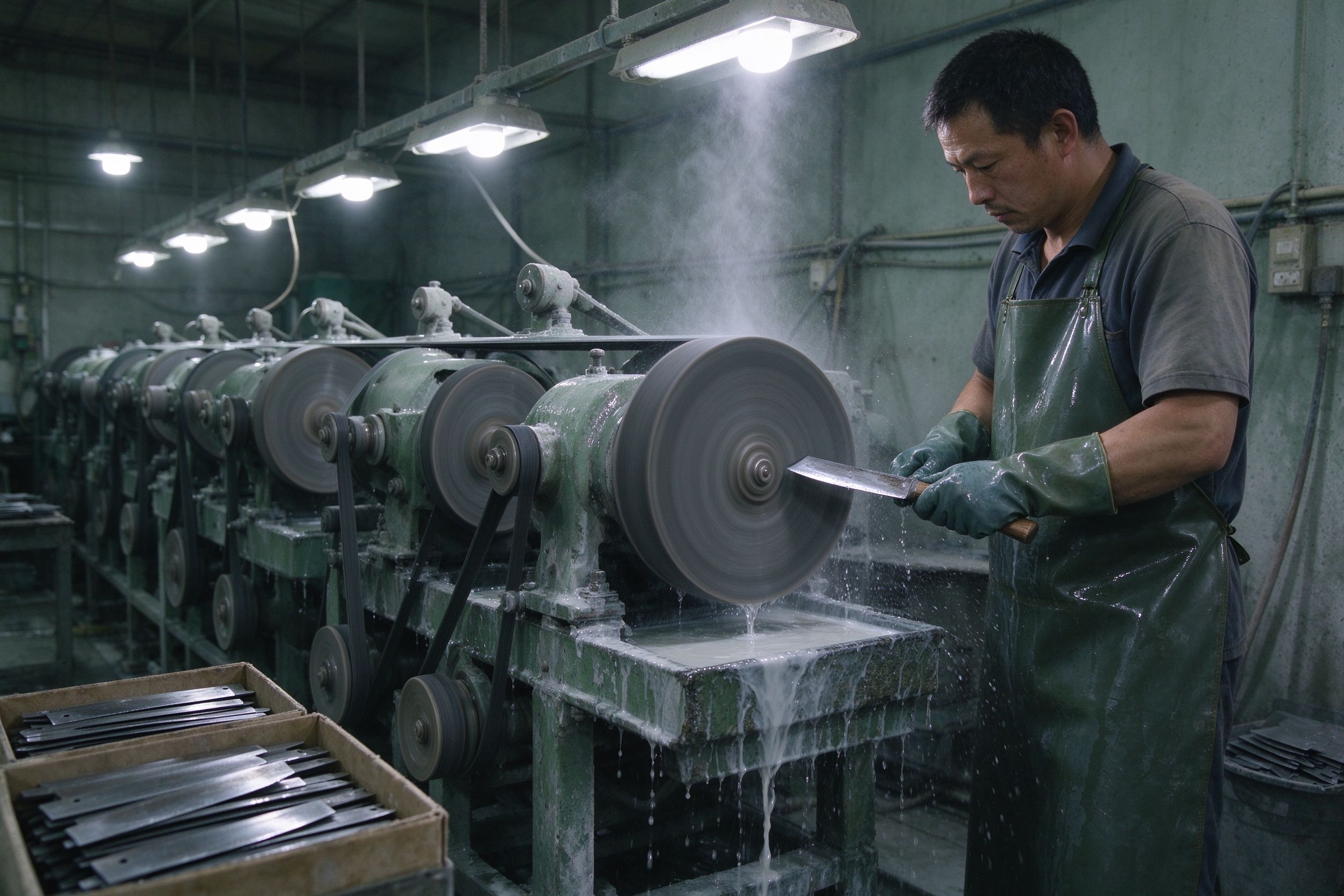
A knife's edge is made in the grinding workshop, not the steel mill. Insight, a Yangjiang manufacturer with 23 years of OEM and ODM experience, opens its wet-grinding line: coolant control, edge angles, batch inspection — and why the top workshop in China is measured in degrees and microns.
A hardened blade blank is not a knife. It becomes one in the grinding workshop. That is where the bevel is formed, the edge angle is set, the apex is established — and where the heat of the process either protects everything the furnace did, or quietly destroys it. Two blades can leave the same heat-treatment batch at the same hardness and behave completely differently in a kitchen, because the last three millimetres of steel were treated differently by a person, a wheel and a stream of water.
This article explains what a wet-grinding workshop does, why water is a tool rather than a convenience, how a specific edge angle is held across millions of pieces, and why we argue that the top workshop in China is measured in microns and degrees, not in square metres.
Grinding sets three things at once, and none of them appears on a specification sheet in a form a buyer can verify from a distance.
The primary bevel determines how much material supports the apex. A wide, thin bevel slices beautifully and folds under a careless hand; a narrow, thick bevel is stable and pushes food apart instead of cutting it. The same steel can be ground into either, which is why two knives of identical grade and hardness can feel unrelated in use.
Grinding concentrates enormous energy into a contact patch only microns wide. In dry grinding, where air is the only coolant, the tip of the edge can cross the tempering range of common knife steels — roughly 150°C to 200°C — in a fraction of a second, dozens of times along a single pass. The visible sign is a straw or blue tint on the bevel. The invisible consequence is a locally softened edge that rolls over instead of biting, and no honing rod will bring it back.
This is the most expensive defect in cutlery, because nothing downstream repairs it. Polishing removes the colour, packaging hides the blade, and the customer discovers the truth three weeks later when a tomato fights back. A workshop that grinds wet is not being careful for the sake of appearances; it is protecting the metallurgy it was paid to deliver.
A modern knife workshop is a sequence of controlled removals, not a single act of sharpening. Each stage has one job, and each stage has a characteristic failure when it is rushed.
1. Blanking and forming. The blade profile is cut or stamped from strip, then straightened. Geometry decided here cannot be rescued later.
2. Hardening and tempering. The blade is brought to austenitising temperature, quenched, then tempered to its target hardness. This is the step buyers ask about — and the one the workshop must not undo.
3. Rough grinding, wet. The primary bevel is established and the bevel width set.
4. Fine grinding, wet. Coarse scratch depth is reduced and the bevel is refined toward its final geometry.
5. Wet honing. The apex is formed — the part that actually separates food.
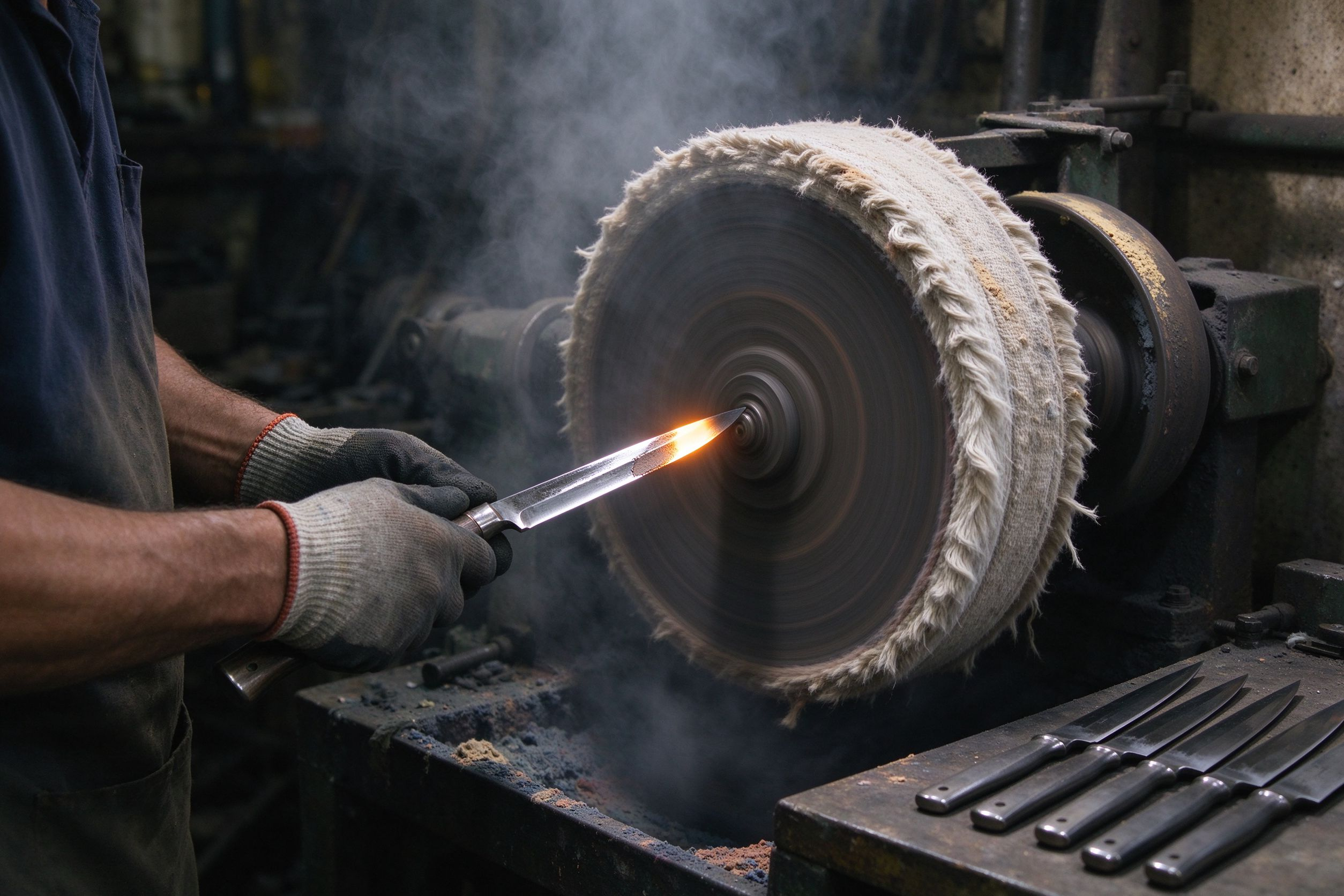
6. Polishing. Friction on the bevel is reduced and the final surface finish is set.
7. Inspection. Angle, apex quality, symmetry and straightness are measured against the specification.
Stage | What it sets | What goes wrong when rushed |
Rough grind | Bevel width and the primary angle | Wavy grind line, uneven bevel, angle drift from blade to blade |
Fine grind | Surface refinement, scratch depth | Deep residual scratches that later act as crack starters |
Wet honing | The apex and its finish | Burned apex, wire edge, or a rounded edge that will not bite |
Polishing | Friction and final appearance | Over-polished edge, geometry softened to look good in photographs |
Inspection | Verification against specification | Out-of-specification angles shipped with no record of the deviation |
The practical lesson for a buyer: a knife workshop is only as good as its weakest transition. A perfect rough grind followed by an overheated hone produces a blade that looks correct and fails early.
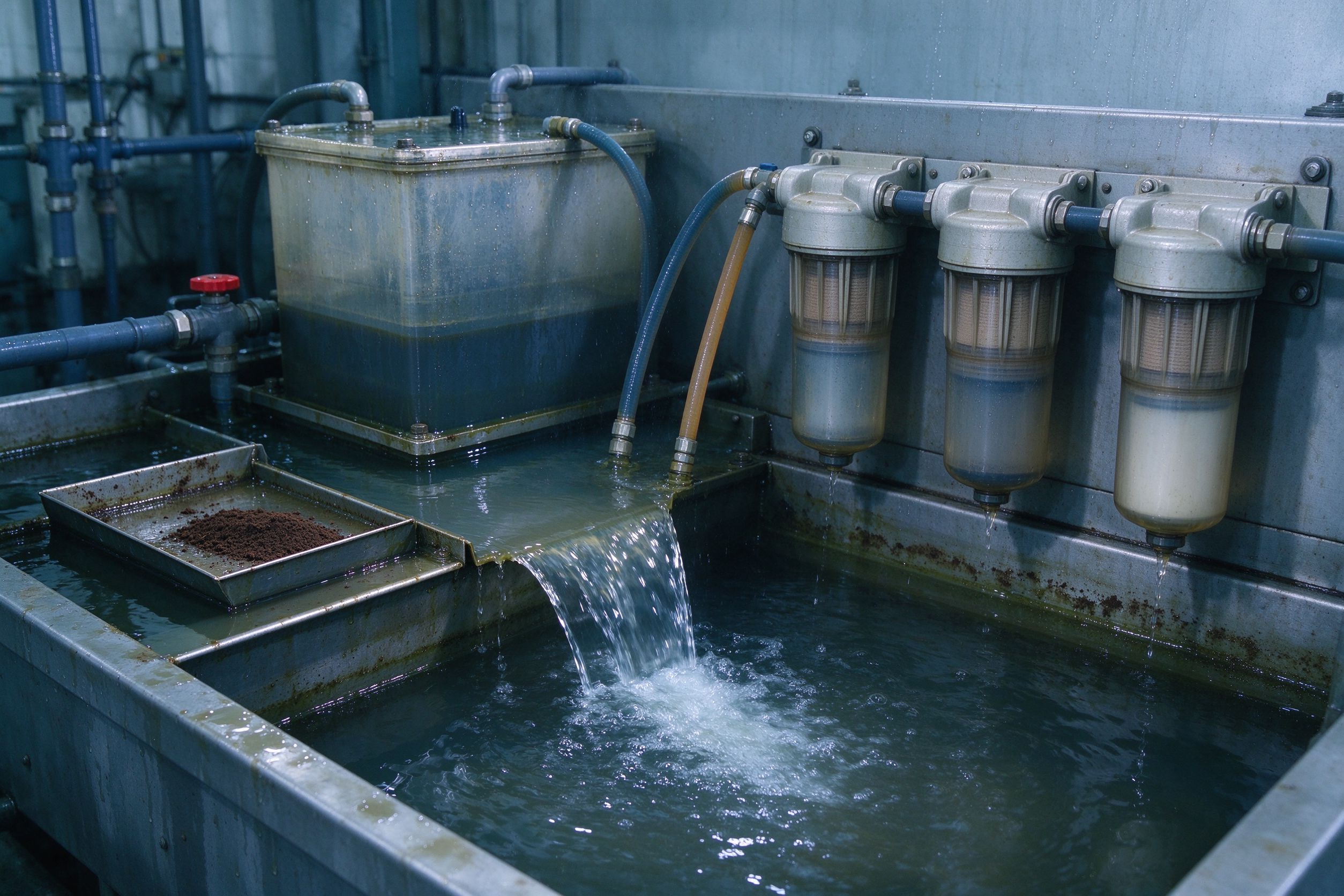
In a serious workshop, coolant is not there to keep the blade cool in a general sense. It does three specific jobs, and each of them fails in a recognisable way when it is done badly.
Coolant has to reach the exact point where the wheel meets steel, not merely wet the blade somewhere upstream. A wheel that is damp but not flooded at the contact patch is still dry grinding where it matters. Flow direction, nozzle position and pressure are set per machine, and they are checked when a wheel is changed — because a wheel wears smaller, the contact geometry shifts, and a nozzle that was correct last month can be aiming at the wrong place today.
Wet grinding produces a slurry of fine steel and abrasive particles. Left in the coolant, it does two harmful things: it abrades the bevel with particles nobody selected, and it changes how aggressively the wheel cuts. Settling tanks, filtration canisters and scheduled cleaning are what keep the fluid doing its job. A workshop with clear, filtered water at the machine is a workshop that understands its own process; murky water is a leading indicator of inconsistent edges.
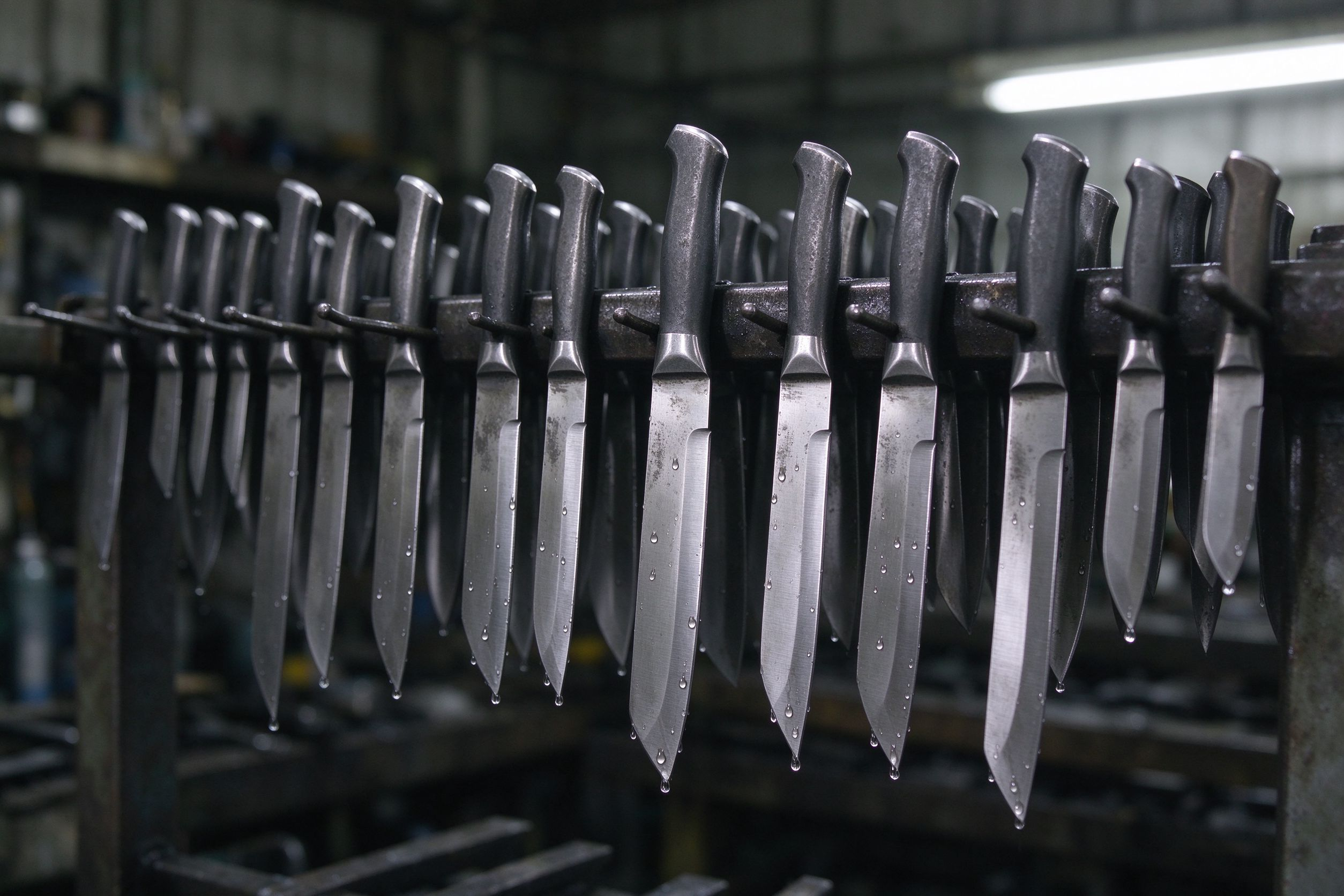
Water and hardened stainless are not a neutral combination. High-carbon and clad blades that stay wet between grinding and assembly develop flash rust at the edge — a defect that is invisible under polish and corrosive in use. Every wet stage therefore needs a drying and protection step: air knives, heated drying, or a thin protective coating applied before the blade moves to the next bench. This unglamorous logistics is where cheap workshops lose quality silently.
Edge angle is the single most-quoted and least-understood number in cutlery. It is usually stated per side, so a blade described as "15 degrees" is typically 30 degrees included — the total angle between the two faces of the edge. Confusing the two produces a specification that cannot be manufactured.
· 10–15° per side, 20–30° included. Slicers and sashimi knives. Minimum force, cleanest separation, most fragile edge.
· 17–20° per side, 34–40° included. Chef knives and santoku. The working compromise for vegetables, protein and everyday board contact.
· 20–22° per side, 40–45° included. Cleavers and bone knives. Durability over penetration, built to survive impact.
Within a single blade the angle is not constant, and it should not be. A well-ground chef knife carries a slightly convex bevel that is thicker toward the heel, where the heavy cutting happens, and finer toward the tip, where precision happens. A dead-flat bevel from heel to tip is not evidence of precision; it is evidence of a grinder following a fixture without a specification.
A second refinement is the micro-bevel: a narrow secondary bevel of 20–25° applied to a 15° primary. It keeps the slicing feel of the thin grind while giving the apex something to land on when it meets a board or a bone. It is one of the cheapest ways to raise durability without changing the knife's character — and it only works when both bevels are ground wet and inspected.
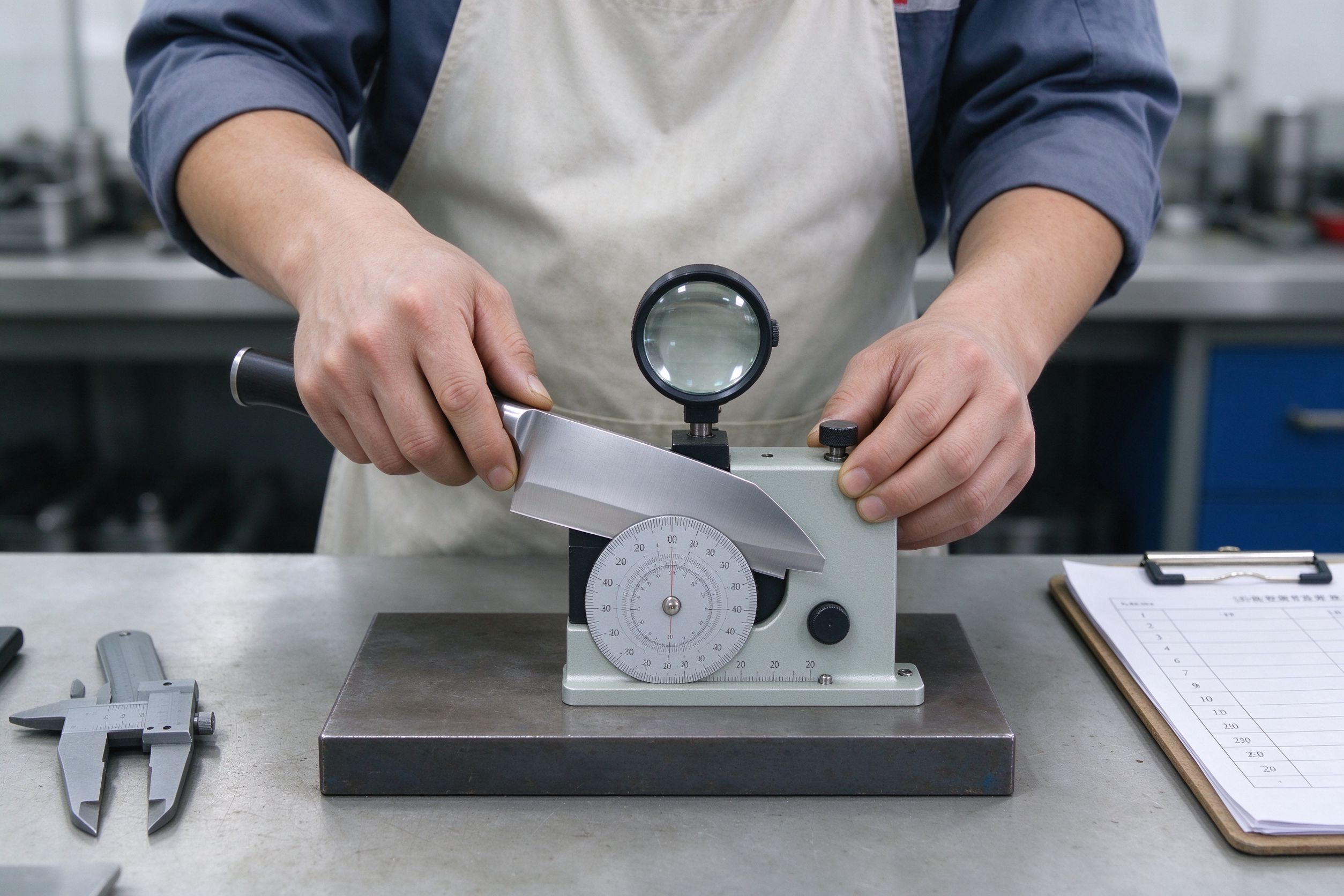
Making one excellent edge is a craft problem. Making the ten-millionth edge identical to the first is a system problem, and it is the real difference between workshops that can serve a global brand and workshops that cannot.
The four controls that keep an angle stable
Wheel condition. A grinding wheel shrinks as it wears, and a smaller wheel changes the effective contact angle for the same fixture setting. Dressing at fixed intervals, and re-setting the fixture afterwards, is what prevents a slow, invisible drift across a production run.
Fixture discipline. Blade protrusion, clamping pressure and feed rate are set per pattern and recorded. Operators do not adjust them by feel; when a pattern changes, the fixture changes with it.
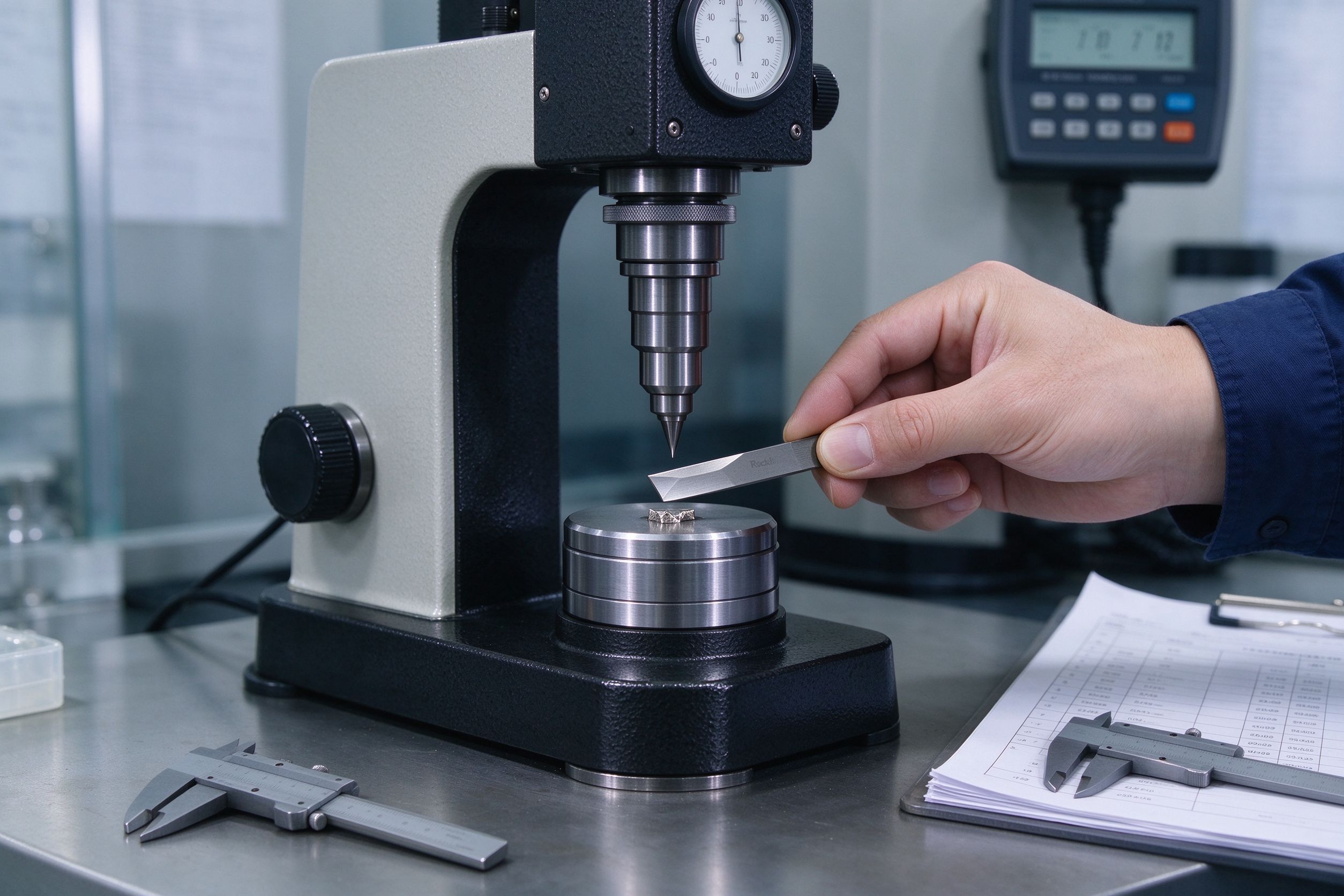
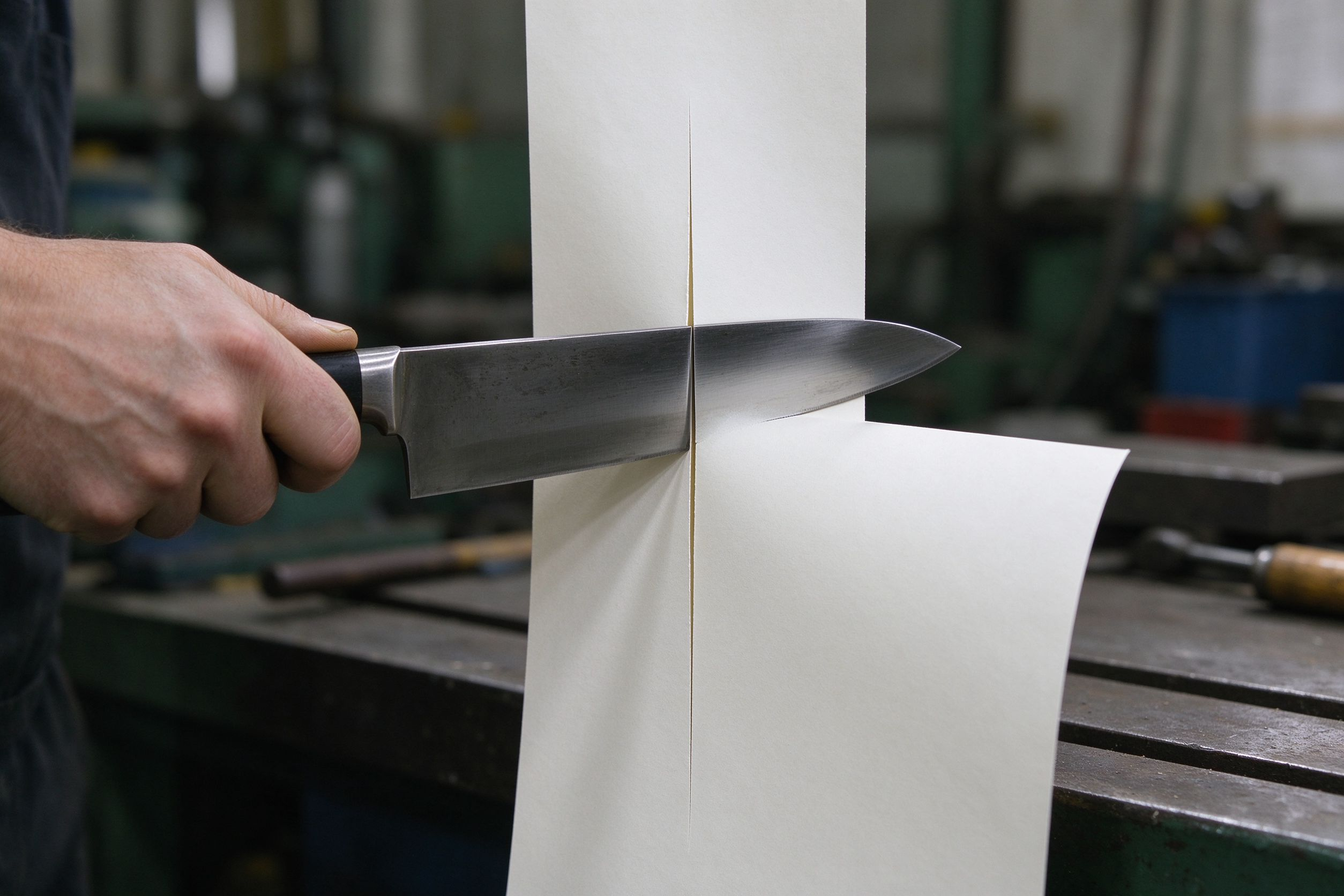
Measurement, not impression. Angle gauges and magnifiers at the bench, hardness checks sampled from every batch on a Rockwell tester, and a destructive check that a machine cannot fake: cutting upright paper, then a ripe tomato. If the blade slides on the tomato skin, the edge is not finished, whatever the gauge says.
Traceability. Every batch is tied to its steel lot and its heat-treatment lot. When a customer reports an edge that failed early, the workshop can go back to the furnace record and the wheel log rather than replacing the order and hoping.
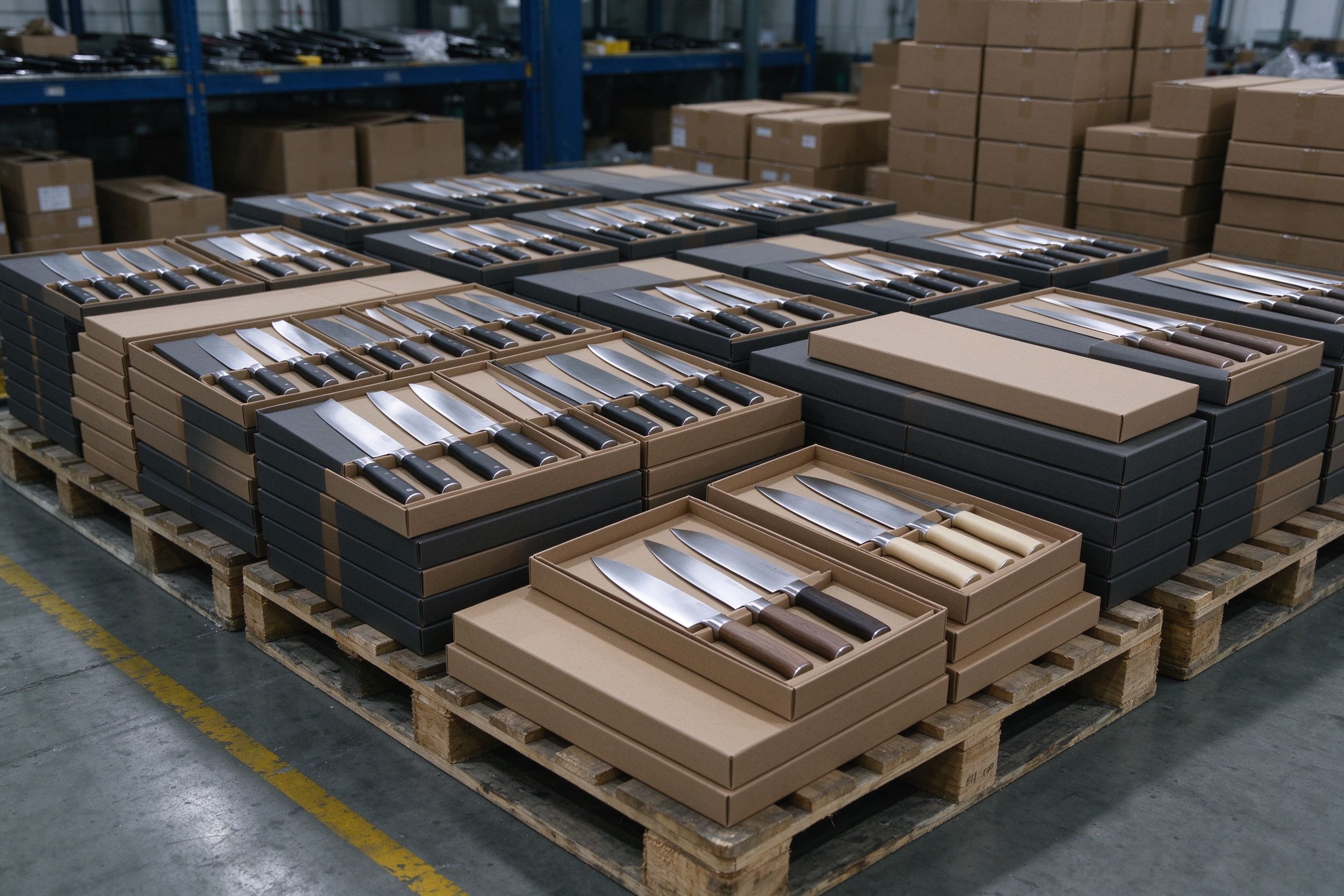
Our wet-grinding hall is organised by pattern family rather than by order: chef knife, santoku, bread knife and paring knife each run on their own fixture set, with their own angle specification and their own inspection routine. That structure is what allows 20,000 square metres of floor and roughly five million pieces a month to produce a repeatable edge rather than a variable one — and it is why a brand can approve one sample, place a reorder a year later, and receive a blade that cuts the same way.
Twenty-three years in this industry teaches one lesson above all others: buyers do not actually pay for steel. They pay for the confidence that the thousandth knife will behave like the one they approved.
For a brand. Edge consistency is a returns problem before it is a marketing problem. A workshop that can hold an angle and document it gives you a specification you can defend in a claim, repeat in a reorder and scale across a range without re-sampling every SKU.
For a restaurant. Volume cooking wears an edge faster than home use, and the failure mode is predictable: the angle is fine but the apex is rounded, so the knife needs pressure. A workshop-level edge with a defined micro-bevel, maintained with a steel and periodic professional sharpening, holds its working sharpness through a full service week.
For a home cook. This is why two knives at the same price can last six months and six years. The difference is rarely the grade printed on the blade; it is whether the bevel was ground under water, at a stated angle, with an apex that was inspected rather than assumed.
Yangjiang Insight Industry And Trade Co., Ltd. has spent more than 23 years designing, manufacturing and selling kitchen knives and kitchen tools, including chef knives, santoku knives, bread knives and paring knives, for brands around the world through OEM and ODM programmes. Our factory covers 20,000 square metres, our monthly capacity reaches approximately five million pieces, and the wet-grinding workshop is where most of the value a brand pays us for is actually created.
Is a wet-ground edge sharper than a dry-ground one?
Not automatically. Wet grinding protects hardness and allows a finer, cleaner apex, which is what most people experience as sharpness. A badly executed wet grind is still a bad edge. What wet grinding reliably prevents is the burned, softened edge that looks fine and dulls early.
Why does an expensive knife sometimes lose its edge so quickly?
Three usual causes, in order of likelihood: an overheated apex from the factory, a rounded edge from too much honing at home, and a glass or ceramic board. The price of a knife says nothing about which of those happened to it.
Can I check an edge angle without a gauge?
Approximately. Look along the bevel in good light and compare its width to the spine thickness: a wide, shallow bevel indicates an acute angle, a narrow one a steeper angle. A jeweller's loupe and a cheap angle gauge give you a number instead of an impression, which is worth the small cost if you buy knives professionally.
Can a workshop match the edge on a sample I send?
Yes, and that is the normal starting point for an ODM programme. Send the sample with the performance you want, and the workshop measures the angle, bevel width and finish, then builds a fixture and specification to reproduce it. What cannot be matched by eye is hardness, which is a heat-treatment question rather than a grinding one.
Does water grinding cause rust on stainless blades?
It can, at the edge, if blades sit wet between stages. Hardened martensitic stainless such as 5Cr15MoV, 8Cr13 or 10Cr15MoV is corrosion resistant rather than corrosion proof. Drying stations and a thin protective coating between grinding and assembly are the standard answer.
What is the difference between grinding and honing?
Grinding forms the bevel and sets the angle. Honing refines the apex and realigns an edge that has rolled in use. A workshop grinds; a cook hones. Using a honing steel to fix a badly ground bevel is how knives lose their geometry a millimetre at a time.
What does the Insight factory actually cover, and can I audit it?
Insight covers 20,000 square metres and produces roughly five million pieces a month across chef, santoku, bread and paring knives plus kitchen tools, with the wet-grinding hall organised by pattern family rather than by order. Design, tooling, grinding, inspection and packing sit under one roof, which is what makes an OEM or ODM specification repeatable from the first sample to the tenth shipment. Buyers can arrange a factory audit, a video walk through of the grinding line or a sample run before committing to volume.


