


Views: 6590 Author: Site Editor Publish Time: 2026-11-17 Origin: Site


Content Menu
Stage One: Loading and Preheating
Stage Five: Straightening and Stress Relief
Why Insight Runs Heat Treatment In-House
● What hardness should a kitchen knife be?
● Why is tempering done twice?
● What causes a knife to warp after heat treatment?
● Can I audit the heat-treatment line before ordering?
● How does Insight keep hardness consistent across five million pieces a month?
A knife's hardness is not bought from the steel mill. It is made in one room, in about ninety minutes, and everything downstream either preserves it or quietly destroys it. Two blades can leave the same mill, be ground on the same machine, and end up years apart in service life, because one went through a correct hardening and tempering cycle and the other went through a rushed one.
Yangjiang Insight Industry And Trade Co., Ltd. has run heat treatment inside its own 20,000 square metre plant for more than 23 years, alongside the grinding, polishing, assembly and packing of chef knives, santoku knives, bread knives, paring knives and kitchen tools — roughly five million pieces a month, for brands buying OEM and ODM. This is a walk through that room: what happens at each stage, what can go wrong, and what a buyer can reasonably ask to see.
Loading looks like labour and is actually process control. Blades are hung or laid with spacing between them so that hot gas reaches every surface, because a blade shadowed by its neighbour heats more slowly and ends up with a different structure from the one beside it. The rack position in the furnace matters for the same reason: the front and the back of a chamber are never at precisely the same temperature.
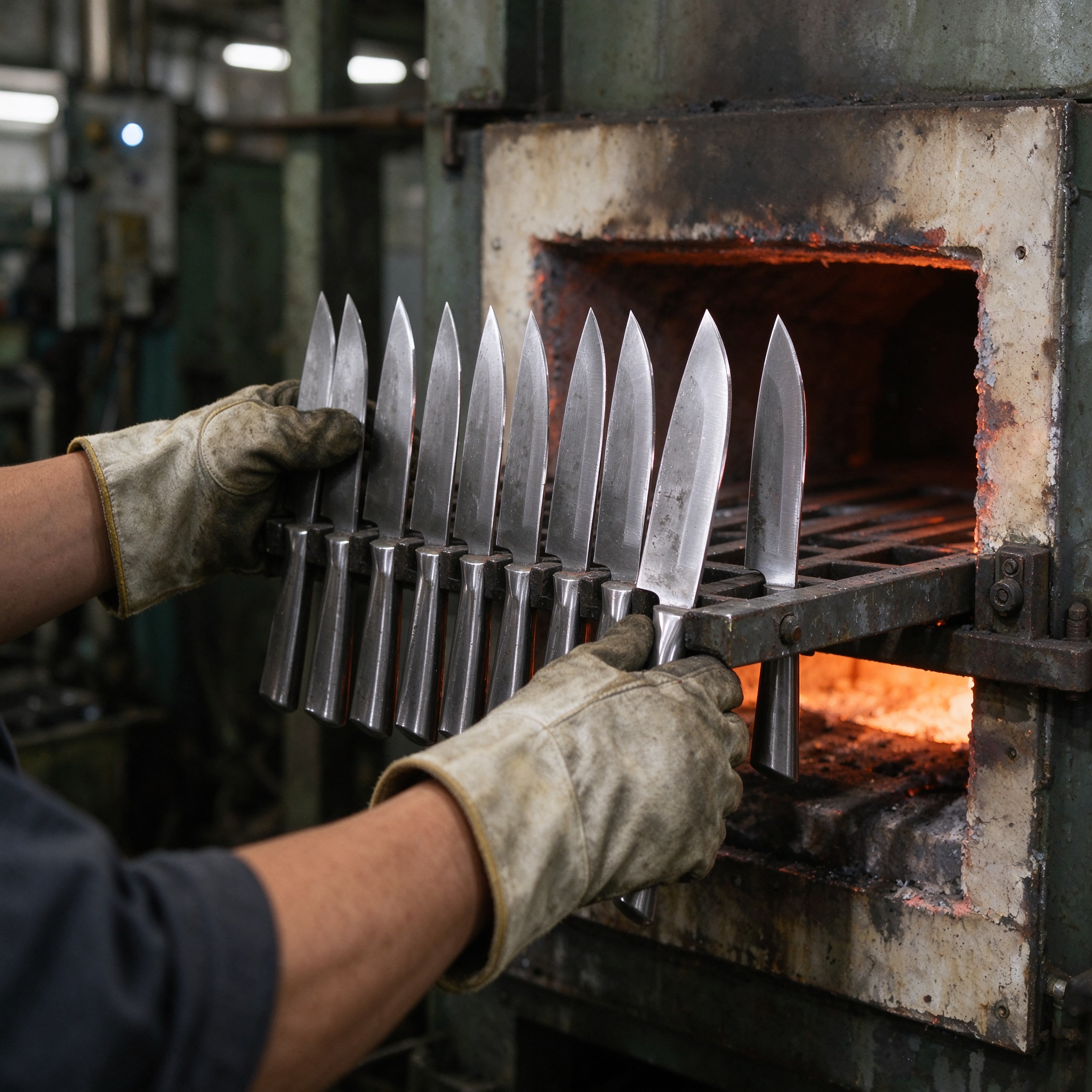
Preheating is the stage most often skipped to save time, and it is the one that prevents the two problems a buyer will actually notice: cracking and distortion. Bringing a thin section up to temperature quickly creates a steep thermal gradient between edge and spine; the edge expands before the spine does, and the resulting stress either warps the blade or, in the worst case, opens a crack that only appears after quenching. A staged ramp costs minutes and saves whole batches.
At temperature, the steel's structure transforms. For the martensitic stainless grades common in kitchen knives, that window sits in the region of 1,000 to 1,050 degrees Celsius depending on grade and carbon content, and the blade must be held there long enough for the transformation to reach the core, not just the skin. Too short a soak gives a soft centre under a hard surface; too long a soak grows the grain and makes the steel brittle in a way no tempering can repair.
The atmosphere matters as much as the temperature. At these temperatures steel oxidises, and a thick scale layer is not only cosmetic: it represents decarburisation, a loss of carbon at the surface, which leaves the outer skin softer than the core. Protective atmosphere, controlled atmosphere furnaces or appropriate wrap are the countermeasures, and the visible result is a blade that comes out of the furnace clean enough to finish without heavy grinding.
Quenching is the moment hardness is actually created, and the moment distortion is created too. The blade must cool fast enough through the transformation range to form martensite rather than softer structures, but not so violently that the thin edge and the thicker spine cool at wildly different rates. Oil is the usual medium for these grades; air or press quenching is used where distortion control matters more than maximum hardness.
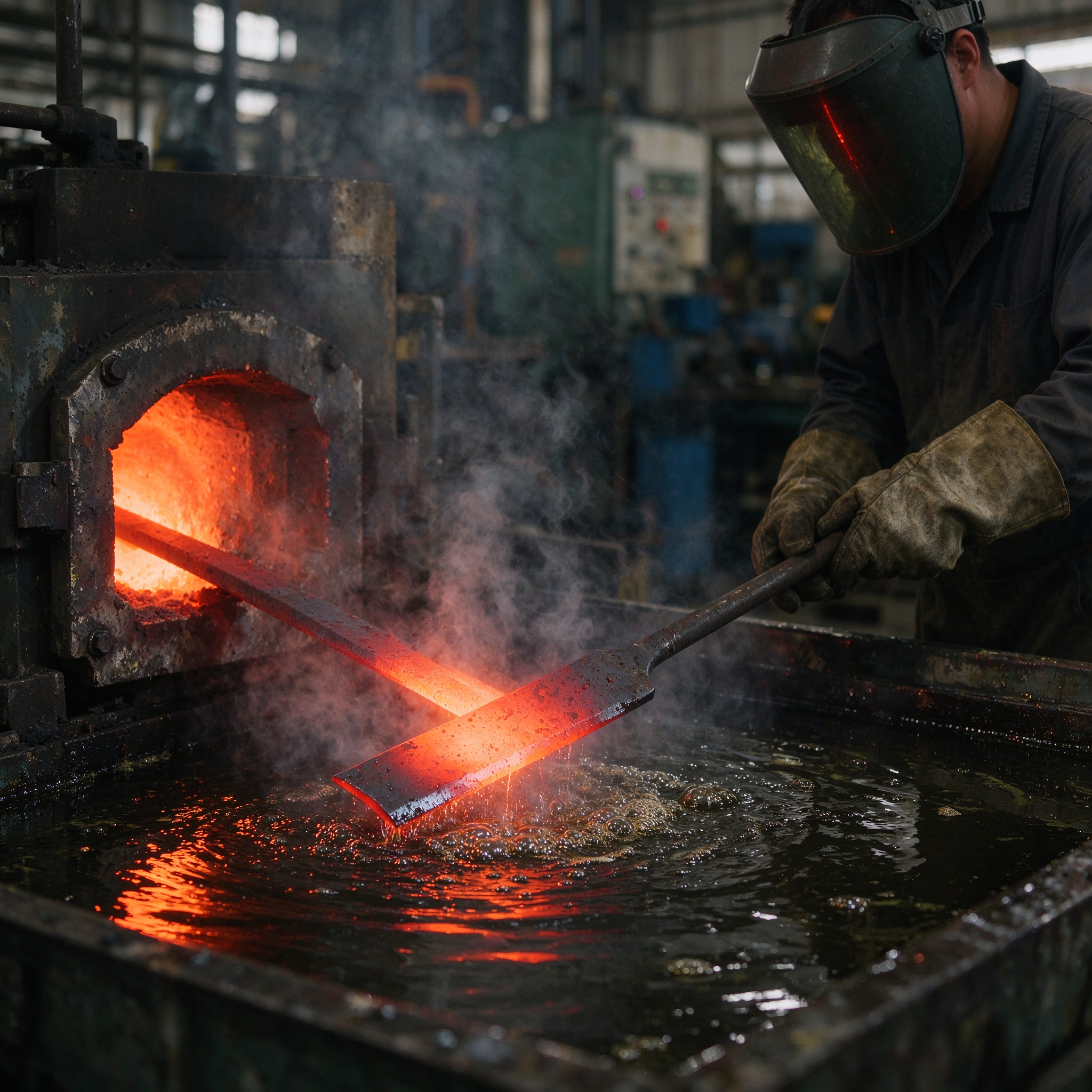
Two variables are set here and rarely discussed with buyers. The first is oil condition: temperature, agitation and contamination all change the cooling curve, and an oil tank that is never checked will produce inconsistent hardness from one shift to the next. The second is the transfer time between furnace and quench, which is measured in seconds. A blade that spends four seconds in the air has already lost the temperature it needed.
Untempered martensite is hard and unreliable. Tempering reheats the blade to a much lower temperature — typically in the 150 to 200 degree range for kitchen cutlery — holds it, and lets the structure relieve internal stress while giving up a little hardness in exchange for toughness. That trade is the entire point: a 58 HRC blade that chips is worth less than a 55 HRC blade that holds.
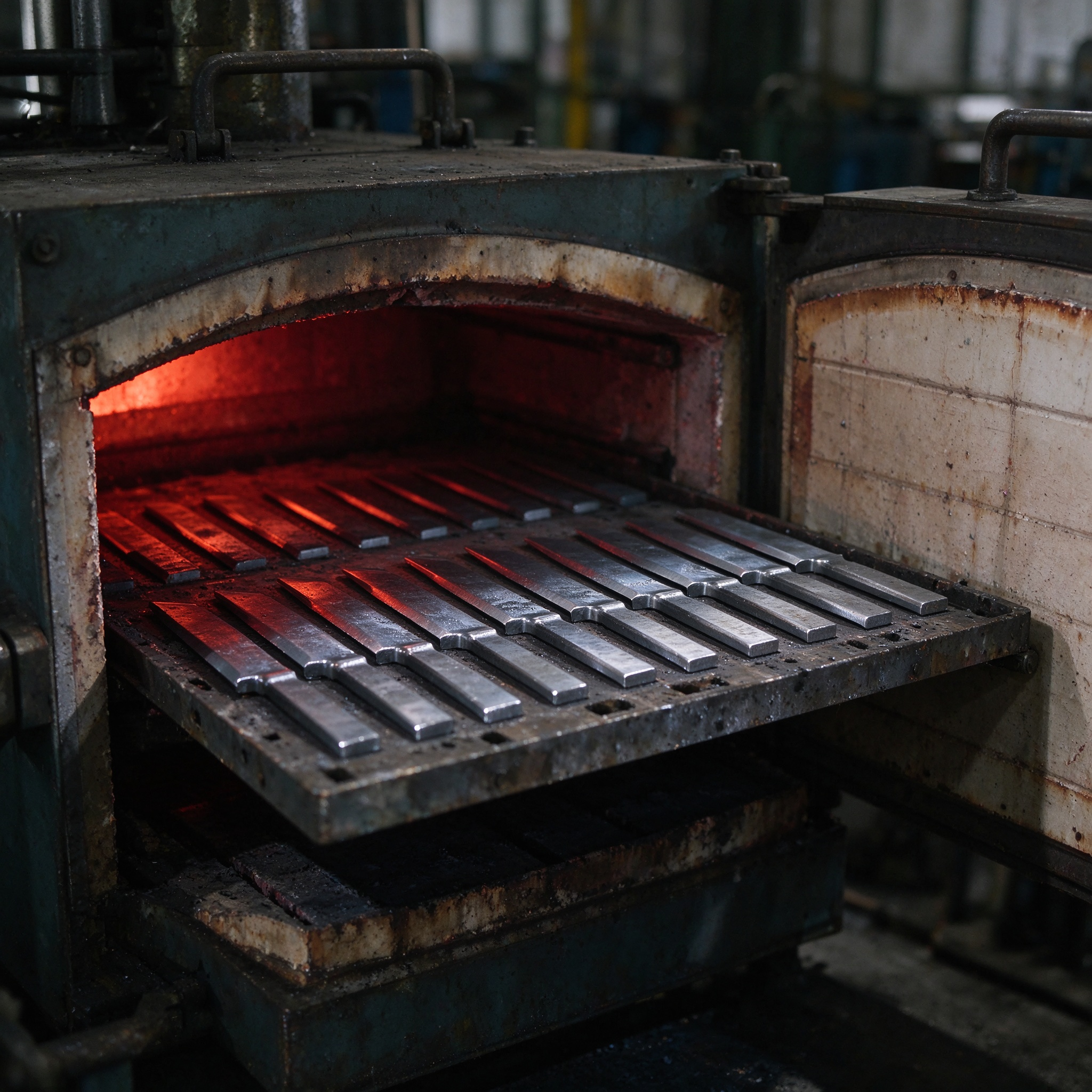
Tempering is often done twice, and the reason is structural rather than ceremonial. The first cycle tempers the martensite formed during quenching; the second catches the fraction of retained austenite that transforms during cooling from the first cycle, which would otherwise sit in the blade as an unstable region that changes dimension and hardness over time. Two cycles of an hour each are common, and the cost of the second one is small against the cost of inconsistency.
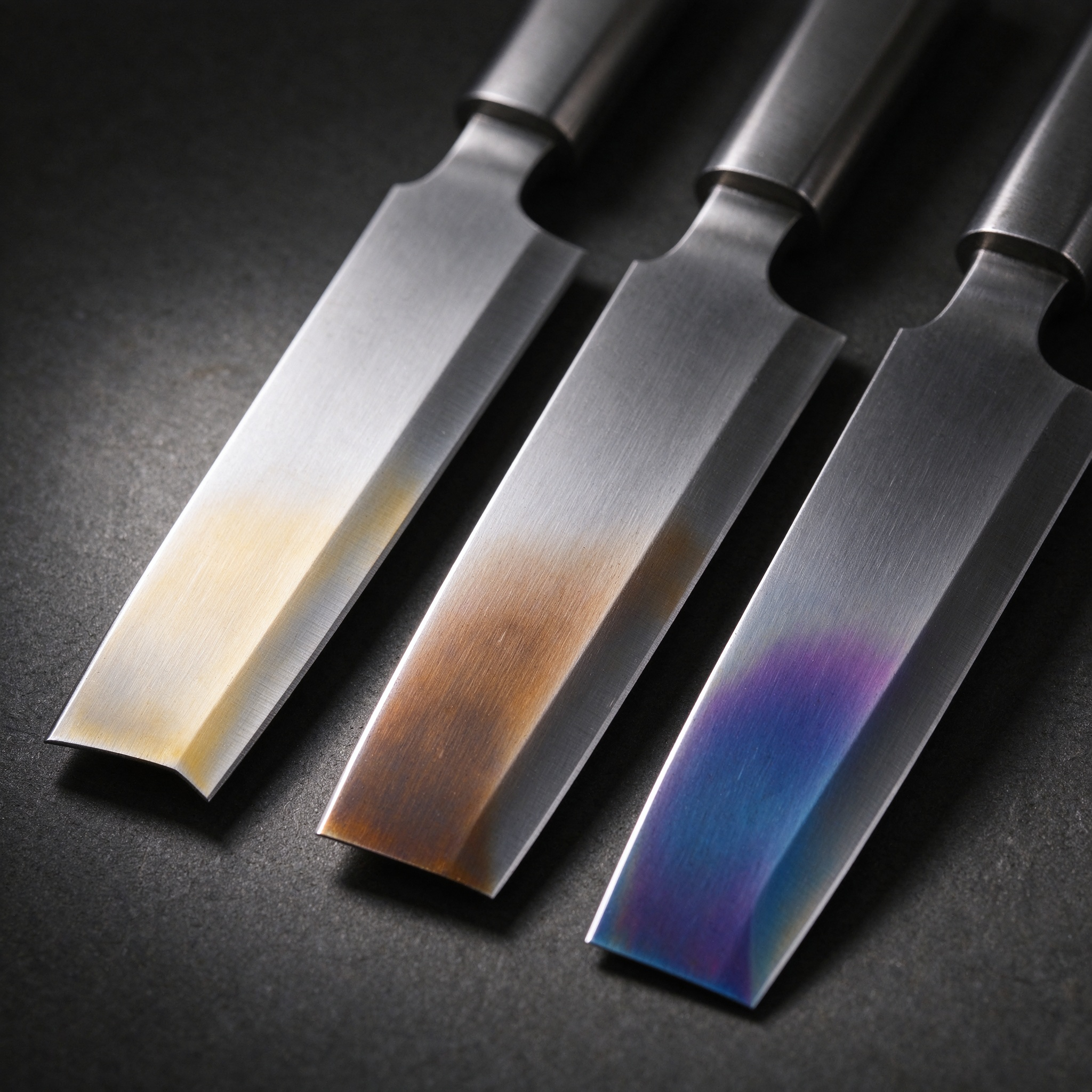
Temper colour is the old, cheap thermometer, and it is still useful as a sanity check. A polished surface heated to tempering range oxidises into a sequence of colours — pale yellow, straw, brown, purple, blue — as temperature rises. An operator who knows the sequence can see at a glance whether a blade was actually tempered in the intended range or overshot it.
Quenching bends things. A blade that was flat at loading comes out with a slight bow, and the amount depends on geometry, thickness distribution and how the part sat in the quench. Straightening is therefore a normal step, not a defect: the blade is checked against a flat plate and corrected with a press or a soft hammer while it still has some residual temper.
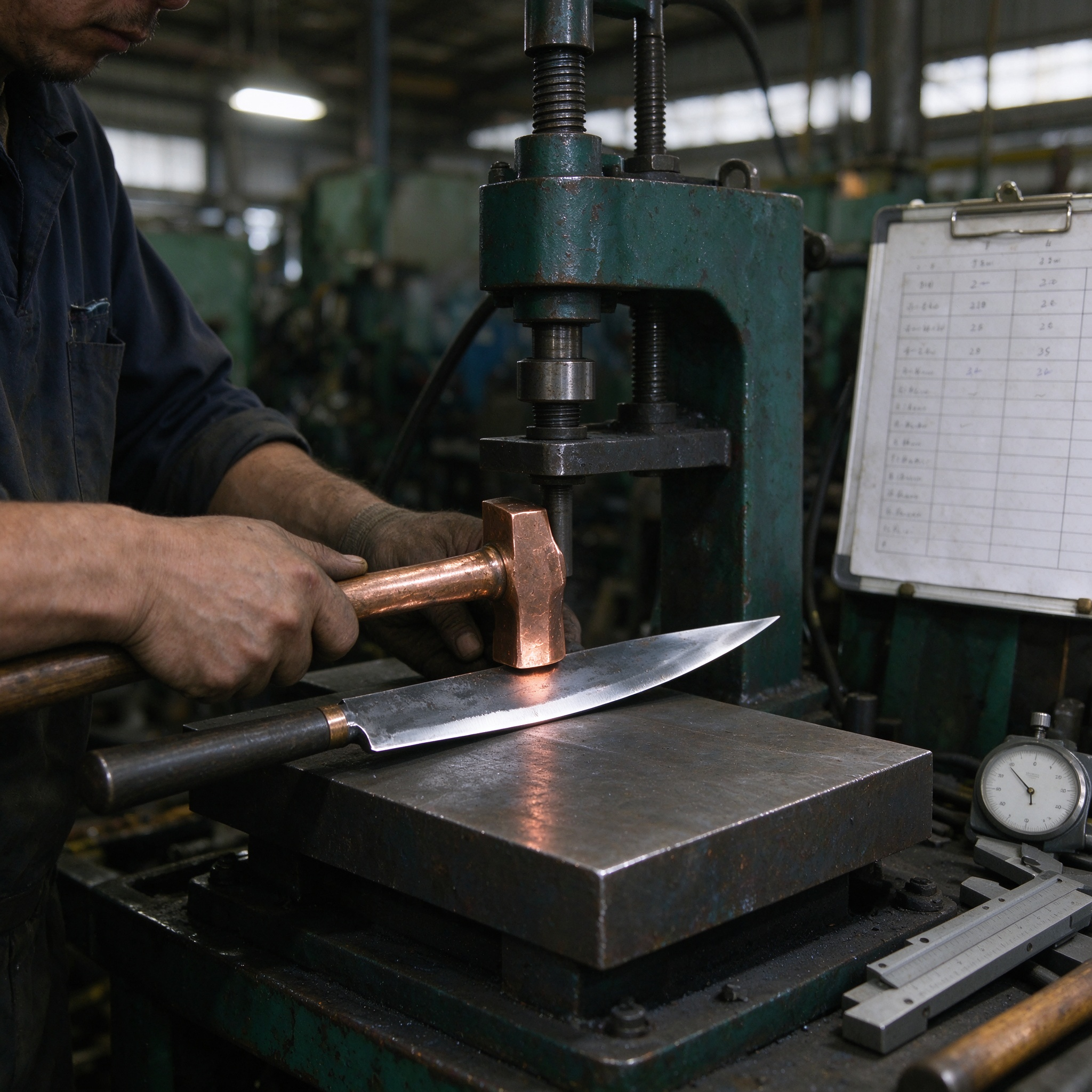
What separates a controlled workshop from a lucky one is that straightening is measured and recorded, and that blades which cannot be corrected within tolerance are scrapped rather than pushed through to grinding. A straightened blade that carries hidden stress will move again after grinding, and the customer will find the warp on the shelf, not the factory.
Hardness is a number, and a number can be measured. In practice the check is a benchtop hardness tester used on a sample from each batch, at points that represent the blade rather than a convenient corner of a test coupon: near the edge, mid-blade and at the spine where geometry allows, so that the difference between surface and core becomes visible instead of averaged away.
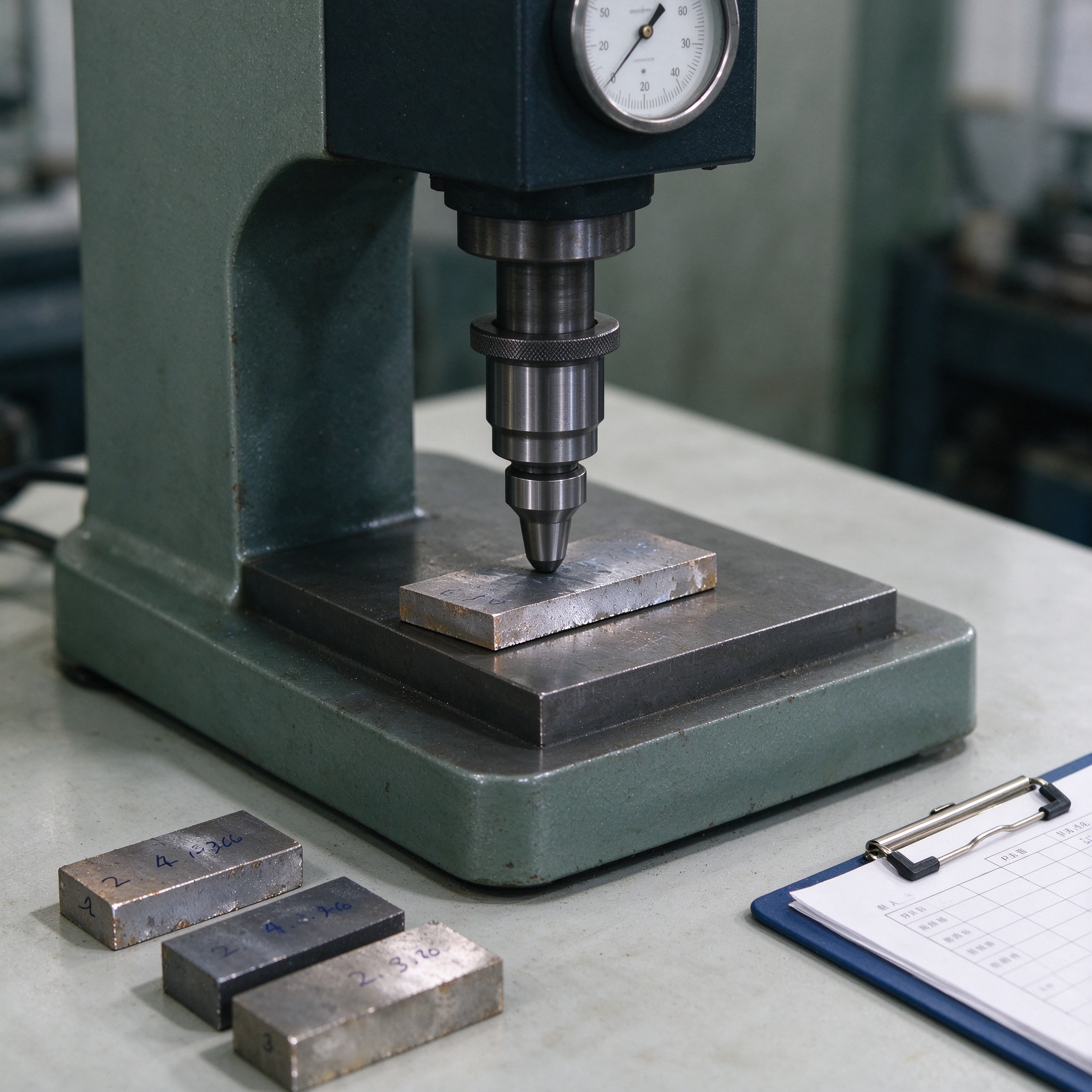
Records are the other half. Each load carries its own identity — grade, furnace, cycle, operator shift, quench bath, temper program, hardness results — and that identity follows the blades into the carton. When a customer reports an edge that rolled two months later, the question of which cycle produced it has an answer, and so does the question of whether that cycle was in range.
Outsourcing heat treatment is common and it works, until a batch comes back soft and nobody can say which furnace it came from. Insight keeps the hardening and tempering line inside the same plant that grinds, polishes and assembles chef knives, santoku knives, bread knives, paring knives and kitchen tools, at a capacity of roughly five million pieces a month.
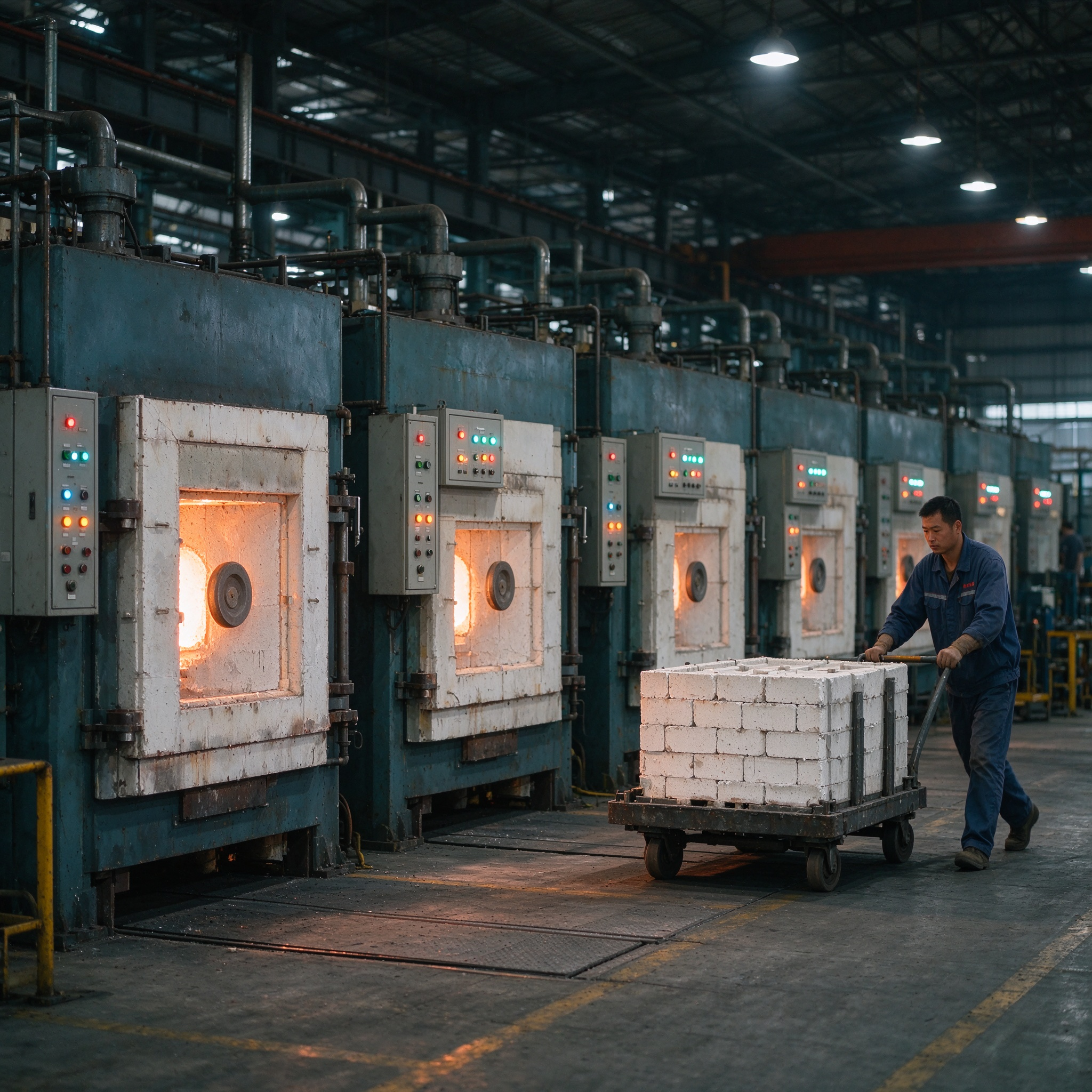
The practical gain is handover control. The grind sits twenty metres from the tempering furnace, so the edge that leaves heat treatment is the edge that meets the wheel, and the temperature of that contact can be controlled by the same quality system that recorded the cycle. It is also the reason a hardness question can be answered with a batch record instead of a reassurance, and why the seven systems around production — supply qualification, in-process control, warehousing, packing, QC, pre-shipment inspection and after-sales — can all point at the same number.
Most kitchen knives sit between 54 and 58 HRC. Below that the edge rolls under normal board contact; above it the blade becomes harder to sharpen and less forgiving of bone and ice. The right number depends on the grade, the edge angle and the way the knife will be used.
The first cycle relieves stress in the martensite formed during quenching. The second stabilises retained austenite, which would otherwise transform later and change the blade's hardness and dimensions. Two shorter cycles are more reliable than one long one.
Uneven heating or cooling, asymmetric blade geometry, and stress built up in earlier forming steps. Preheating, controlled quench agitation and a measured straightening step manage it; hiding the warp until after polishing does not.
Yes. A buyer can see the furnace loading practice, the quench setup, the temper programme, the hardness sampling and the batch records, and can request a sample batch tested in their own lab against the agreed window. Insight has hosted that kind of visit for OEM and ODM programmes for years.
By treating hardness as a recorded property rather than a promise: a defined cycle per grade, furnace loads with spacing discipline, oil condition checks, sampling at fixed points per batch, and a batch identity that follows the blades into the carton. Volume only stays consistent when the process is written down.


