
- Home
- Products
- About Us
- OEM/ODM
- VR
- Resources
- Contacts


Views: 670 Author: Site Editor Publish Time: 2026-07-16 Origin: Site


Content Menu
● 1. Core Practical Functions of Kitchen Knives in Daily Food Preparation
>> 1.1 Realize Diversified Cutting and Shaping of Ingredients
>> 1.2 Improve Daily Cooking Efficiency and Save Time Cost
>> 1.3 Protect Food Nutrition and Improve Dining Taste
● 2. Classification and Scenario-Based Application of Kitchen Knives in Daily Life
>> 2.1 Multipurpose Chef’s Knife: The Core Tool for Daily Household Cooking
>> 2.2 Paring Knife: Fine Processing for Fruits and Vegetables
>> 2.3 Cleaver: Specialized Processing for Hard Ingredients
● 3. In-Depth Life Value of Kitchen Knives Beyond Cutting Functions
>> 3.1 Cultivate Independent Cooking and Healthy Living Habits
>> 3.2 Enhance Family Dining Atmosphere and Life Ritual
>> 3.3 Reflect the Pursuit of High-Quality Daily Life
● 4. Safe Use and Daily Maintenance of Kitchen Knives
>> 4.1 Standard Safe Use Rules for Daily Operation
>> 4.2 Simple and Efficient Daily Maintenance Methods
● 5. Frequently Asked Questions about Daily Use of Kitchen Knives
In every household and professional culinary space worldwide, kitchen knives stand as the most fundamental and indispensable tool among all cooking utensils. Unlike sophisticated kitchen appliances that focus on single or automated functions, kitchen knives rely on manual operation to deliver flexible, precise, and efficient food processing solutions, running through every link of daily food preparation, family meal making, and even daily food finishing. Many people overlook the importance of high-quality kitchen knives, treating them as ordinary cutting tools and ignoring how their performance, types, and usage methods reshape daily cooking experiences, improve food quality, and even optimize living efficiency. As a professional Chinese manufacturer focusing on kitchen knife OEM services, Yangjiang Insight Industry & Trade Co., Ltd has long been committed to crafting high-performance, durable, and user-friendly kitchen knives for global brands, wholesalers, and producers. Based on in-depth industry experience and user demand research, this article comprehensively explores the diverse and irreplaceable roles of kitchen knives in daily life, covering practical functions, culinary value, life optimization significance, and daily maintenance logic.
Daily diet is the most basic part of human life, and almost all homemade meals start with ingredient processing. Kitchen knives undertake the core cutting work in this process, turning whole, bulky, or unprocessed raw ingredients into standardized, cookable, and taste-friendly food materials. Different types of kitchen knives correspond to diversified cutting tasks, solving various ingredient processing problems in daily cooking and forming the basic guarantee for smooth meal production.

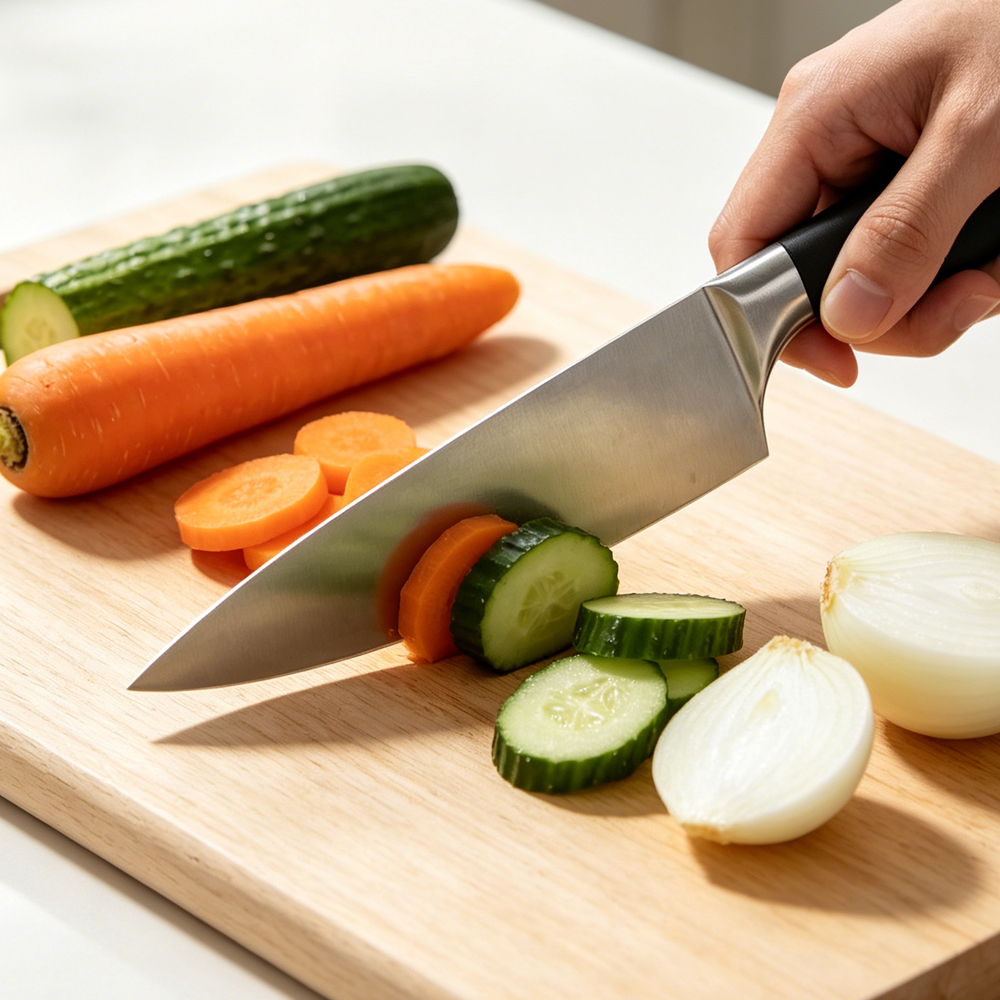
The most intuitive role of kitchen knives is to complete diversified cutting and shaping of ingredients, including chopping, slicing, dicing, mincing, peeling, trimming, and carving. In daily family cooking, vegetables such as onions, carrots, and cabbages need to be sliced or diced for stir-frying; meat such as beef, pork, and chicken needs to be sliced or shredded for quick cooking; fruits need to be peeled and cut into pieces for direct consumption or fruit platters. A qualified kitchen knife can complete these cutting tasks smoothly, ensuring uniform ingredient specifications.
Uniform ingredient cutting directly affects the cooking effect of food. Ingredients with consistent thickness and size can be heated evenly during stir-frying, boiling, or roasting, avoiding the problem of partial overcooking and partial undercooking that often occurs with uneven manual cutting. Meanwhile, neat ingredient shapes also improve the appearance of daily meals, turning ordinary home-cooked dishes into delicate and appetizing meals, enhancing the sense of ritual and happiness of daily diet. For daily simple food processing such as mincing garlic, chopping ginger, and cutting herbs, small and flexible kitchen knives can achieve fine processing, meeting the flavor adjustment needs of daily cooking.
In fast-paced modern life, most people have limited spare time for cooking after work and study. High-quality kitchen knives become an important tool to optimize cooking efficiency and save daily time costs. Dull and unbalanced knives require repeated force and multiple cutting attempts to complete ingredient processing, which not only wastes time but also increases cooking fatigue. In contrast, well-crafted kitchen knives with sharp blades and scientific ergonomic design can cut through ingredients smoothly with one single movement, greatly reducing the time spent on food preparation.
For family users who need to prepare three meals a day, the efficiency improvement brought by high-performance kitchen knives is particularly obvious. Batch processing of ingredients such as cutting vegetables for stews, portioning meat for multiple meals, and trimming fruit materials can be completed quickly with professional kitchen knives. This efficient food preparation mode shortens the overall cooking cycle, allowing people to spend less time on kitchen work and more time on rest, family communication, and hobby cultivation. In addition, efficient cutting avoids repeated operations and redundant movements, reducing the physical consumption of daily cooking and making kitchen work more relaxed and comfortable.
Excellent kitchen knives do not only cut ingredients but also effectively protect the nutritional structure and original taste of food. Sharp blades can complete cutting with minimal damage to ingredient cells, avoiding the crushing and squeezing of food caused by dull knives. When vegetable and fruit cells are completely preserved, the loss of internal water, vitamins, and trace elements is greatly reduced, maintaining the fresh and crisp taste of plant-based ingredients. For meat ingredients, clean and smooth cutting surfaces prevent the loss of meat juice and fat, locking the tender texture and original flavor of meat.
In daily life, many people find that vegetables cut with dull knives are prone to oxidation, discoloration, and wilting in a short time, and meat dishes taste dry and tough after cooking. This is largely due to the damage of ingredient cell structures caused by unprofessional cutting. High-quality kitchen knives effectively avoid this problem through precise cutting, ensuring that daily meals retain maximum nutritional value and original taste. Long-term adherence to using qualified kitchen knives for ingredient processing can subtly improve the quality of daily diet, making ordinary home-cooked food healthier and more delicious.
Different types of kitchen knives have unique structural designs and functional positioning, corresponding to different daily cooking scenarios and ingredient processing needs. Reasonable matching of kitchen knife types with usage scenarios can maximize the practical value of knives and further optimize daily cooking experience. Understanding the daily application scenarios of different kitchen knives helps users select targeted tools, avoid the inconvenience of single-tool multi-purpose, and form a scientific daily kitchen tool usage habit.
The chef’s knife is the most versatile and commonly used kitchen knife in daily families, and it is also the core tool that almost every family is equipped with. It features a wide blade, moderate length, and balanced overall structure, which can adapt to most daily ingredient processing tasks, including chopping vegetables, slicing meat, dicing fruits, chopping herbs, and even cutting soft bones. For ordinary family daily cooking that does not involve complex professional cuisine production, a high-quality chef’s knife can meet more than 80% of daily cutting needs.
The ergonomic design of modern chef’s knives fully considers the long-term use needs of family users. The non-slip and comfortable handle can effectively reduce wrist pressure during long-term cutting, avoiding soreness and fatigue caused by frequent kitchen work. The precise blade polishing technology ensures lasting sharpness, reducing the frequency of daily sharpening and maintenance. Whether it is simple daily stir-fry ingredients or slightly complex stew and barbecue ingredient processing, the chef’s knife can deliver stable and efficient cutting effects, becoming an indispensable helper for daily family meals.
The paring knife is a small-sized precision kitchen knife, specially designed for fine ingredient processing tasks in daily life. Its short, slender, and sharp blade is suitable for peeling fruits and vegetables, removing fruit pits, trimming vegetable roots and damaged parts, and cutting small-sized fruit platters. In daily life, many delicate food processing tasks that cannot be completed by large chef’s knives rely on paring knives to achieve fine operation.
Daily scenes such as peeling apples and pears, removing strawberry stems, trimming broccoli florets, and cutting decorative fruit shapes all require the flexible operation of paring knives. The small and lightweight body of the paring knife allows users to control the cutting angle and strength freely, realizing ultra-fine processing of ingredients. For users who pay attention to the delicacy of daily diet and like making creative home-style snacks and fruit platters, the paring knife is an essential auxiliary tool to enrich daily dining forms.
The cleaver is characterized by a thick blade and strong hardness, mainly used for cutting hard ingredients that are difficult to handle by ordinary chef’s knives in daily life, such as chopping bones, cutting frozen meat, and splitting hard rhizome vegetables. In daily family diet, when cooking bone soup, braised pork ribs, and other dishes, the cleaver can quickly and safely complete bone chopping and ingredient splitting work, solving the processing pain points of hard ingredients.
Professional household cleavers focus on safety and durability in design. The thickened blade body is not easy to deform or damage under force, and the stable grip structure avoids sliding during cutting, ensuring the safety of daily use. Different from commercial heavy-duty cleavers used in professional kitchens, household cleavers are lightweight and easy to store, fully adapting to the frequency and intensity of daily family use, and making up for the functional defects of ordinary kitchen knives in hard ingredient processing.
The role of kitchen knives in daily life is not limited to basic ingredient cutting and processing. As a long-term reusable kitchen tool, high-quality kitchen knives also bear multiple values such as optimizing life quality, cultivating cooking hobbies, inheriting dietary culture, and ensuring family cooking safety. These implicit values subtly affect people’s daily living habits and dietary cognition, becoming an important part of high-quality family life.
A complete set of high-quality kitchen knives provides basic tool support for family independent cooking. With convenient and efficient cutting tools, people are more willing to try homemade meals instead of relying on takeout and processed food for a long time. Independent homemade cooking can control the amount of oil, salt, and seasoning in food, avoid various additives and excessive calories in commercial takeout, and help form a healthy daily diet habit.
In the process of using professional kitchen knives to process ingredients and make meals, people can gradually master cooking skills, cultivate interest in cooking, and turn daily meal making from a trivial chore into a relaxing and decompressing life hobby. For teenagers, learning to use kitchen knives correctly is also a kind of life skill education, which helps cultivate their hands-on ability and independent living awareness, laying a foundation for adapting to independent life in the future.
Daily family meals are an important carrier of family communication and emotional connection, and kitchen knives, as the core tool of meal making, indirectly promote the construction of warm family atmosphere. Neat and delicate ingredient processing and delicious homemade meals made with professional kitchen knives make daily dining more ceremonial. Family members gather around the dining table to enjoy carefully made meals, enhancing emotional communication and family cohesion in daily trivial time.
In daily festivals and family gatherings, kitchen knives play a more important role. Making rich and delicate festival dishes and creative platters through precise cutting can create a strong festive atmosphere and make family gatherings more warm and memorable. The small kitchen tool carries the sense of happiness in daily life, turning ordinary three meals a day into warm moments that record family life.
With the continuous improvement of people’s living standards, the public’s demand for kitchen tools has changed from basic usability to high-quality experience. A set of well-made, durable, and ergonomic kitchen knives is a concrete embodiment of the pursuit of refined daily life. High-quality kitchen knives are comfortable to operate, stable in performance, and long in service life, avoiding the frequent replacement of inferior knives and the poor experience of difficult cutting, dull blades, and easy rusting.
Choosing high-standard kitchen knives means paying attention to every detail of daily cooking life. It reflects a positive and rigorous life attitude, making every meal production more refined and every daily life detail more quality. As a professional kitchen knife OEM manufacturer, Yangjiang Insight Industry & Trade Co., Ltd always adheres to high-standard production technology and quality control, providing global customers with high-quality kitchen knife products that meet the refined living needs of modern people.
To give full play to the daily value of kitchen knives, safe use and scientific daily maintenance are essential. Correct usage habits can avoid kitchen safety risks, and standardized maintenance can prolong the service life of kitchen knives, maintain stable cutting performance, and ensure long-term efficient service in daily life. Mastering basic use and maintenance skills is an indispensable part of daily kitchen tool management.
Kitchen knives are sharp tools, and non-standard operation is prone to scratching and cutting accidents. In daily use, it is necessary to form standardized operation habits: keep hands dry and stable when cutting ingredients, avoid sliding hands caused by water and oil on the surface of ingredients; cut ingredients downward along the stable cutting board, do not cut in the air or use excessive force; place the knife flat after use, do not place the blade upward or in a disorderly stacked state to avoid accidental scratching; keep the blade away from the edge of the table to prevent the knife from falling and hurting people.
For family users with children and the elderly, it is more important to standardize the use and storage of kitchen knives. It is necessary to place kitchen knives in special knife holders or closed storage cabinets to prevent children from touching them by mistake and ensure the safety of daily kitchen use. Standardized use habits can maximize the safety of kitchen knives in daily life and avoid unnecessary safety hazards.
Good daily maintenance can keep kitchen knives sharp and durable for a long time. After daily use, the blade should be cleaned in time to remove food residues and oil stains, and dried with a clean cloth to avoid long-term moisture leading to blade rust and corrosion. It is not recommended to soak kitchen knives in water for a long time or clean them with strong corrosive detergents, so as to protect the blade material and surface polishing layer.
Regular simple sharpening is also a key part of daily maintenance. Long-term cutting will make the blade slightly dull, and regular sharpening with a sharpening rod can restore the sharpness of the blade, ensuring stable cutting effect every time. In addition, classified storage of different kitchen knives can avoid blade friction and collision damage caused by disorderly placement, protect the blade edge and handle structure, and prolong the overall service life of kitchen knives.
In daily life, many users have various confusions about the selection, use, and maintenance of kitchen knives. The following sorts out 5 common questions and professional answers to help users use kitchen knives more scientifically and efficiently and give full play to their daily practical value.
Q1: Is a sharp kitchen knife safer than a dull one in daily use?
A1: Sharp kitchen knives are safer for daily use. Dull blades require users to apply greater force during cutting, which is easy to cause hand sliding due to excessive force and unstable operation, leading to cutting accidents. Sharp knives can complete cutting with small force and stable movement, with high operation controllability and low risk of accidental injury. Meanwhile, sharp cutting can reduce ingredient extrusion damage and improve cooking quality.
Q2: How many types of kitchen knives do ordinary families need to equip for daily use?
A2: Ordinary families only need three core types of kitchen knives to meet all daily cooking needs: a versatile chef’s knife for most vegetable and meat cutting tasks, a small paring knife for fine peeling and trimming, and a household cleaver for chopping bones and hard ingredients. This simple combination covers all daily ingredient processing scenarios, avoiding redundant tool stacking and waste.
Q3: How to judge whether a kitchen knife is suitable for daily household use?
A3: A qualified household kitchen knife needs to meet three core standards: first, the blade is sharp and durable, not easy to rust and deform; second, the overall weight is balanced, the handle fits the hand shape, and long-term use does not cause fatigue; third, the safety design is reasonable, the blade edge is smooth without burrs, and the handle is non-slip and stable. It does not need excessive professional performance, but it must be practical, safe, and easy to maintain.
Q4: Do kitchen knives need regular sharpening in daily use?
A4: Yes, regular sharpening is necessary. Kitchen knives will gradually become dull after long-term cutting of ingredients. Dull knives reduce cooking efficiency and affect food cutting quality. It is recommended to use a sharpening rod for simple sharpening every one to two weeks of daily use, and professional fine sharpening every six months to maintain the best cutting performance.
Q5: What is the correct daily storage method for kitchen knives?
A5: The best daily storage method is to use a special knife holder or sealed knife box for classified placement. Avoid random stacking with tableware and kitchen utensils to prevent blade collision damage and scratching other utensils. Keep the storage environment dry and ventilated to avoid blade rust caused by moisture. At the same time, place it out of the reach of children to ensure family safety.


