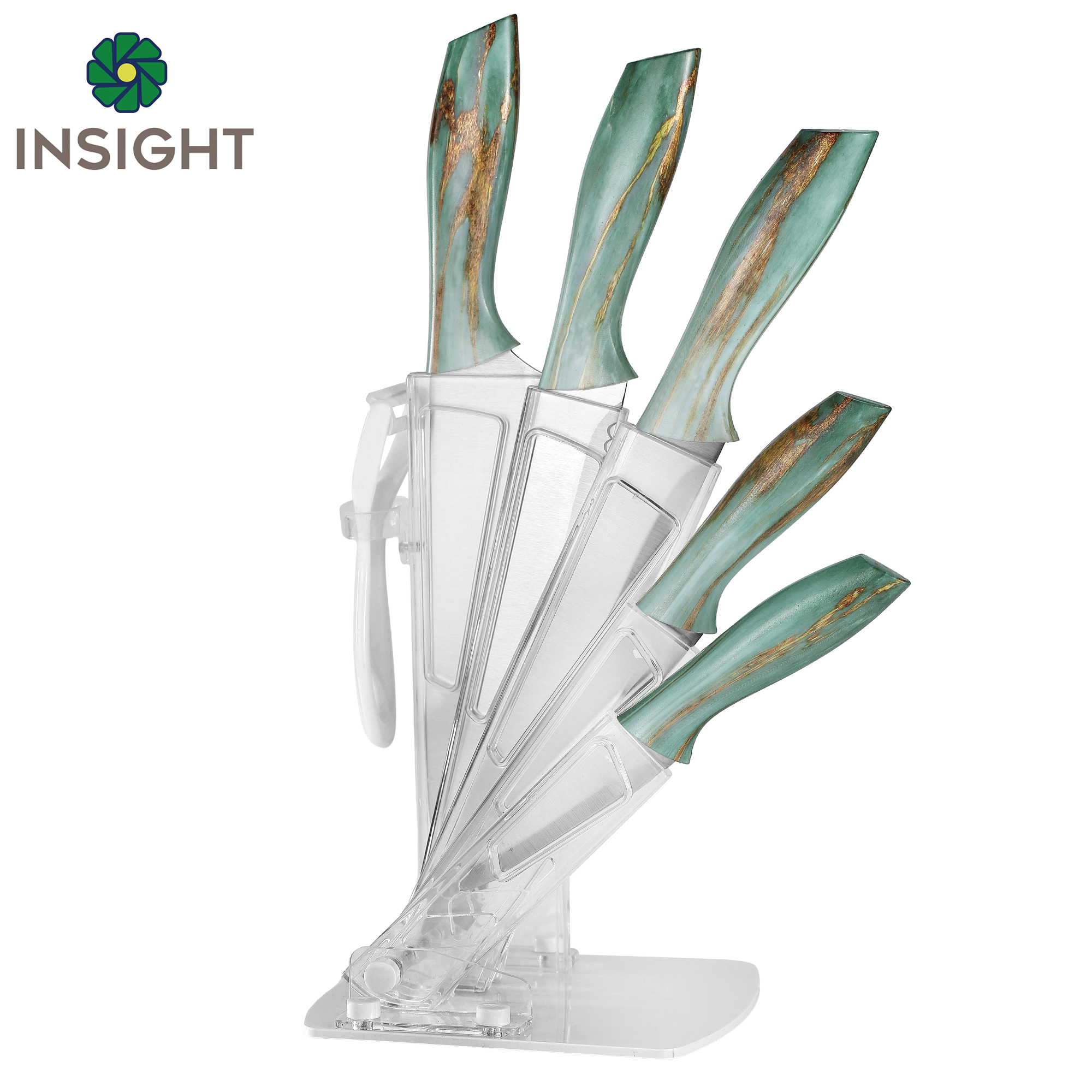
Insight Kitchen Knife
| Availability: | |||||||||
|---|---|---|---|---|---|---|---|---|---|
| Model Number: S7-014-J2P Usage: Kitchen Tools Blade Material: 3Cr13 Blade Thickness: 1.2-1.5mm Handle Material: Plastic Number: 7 Pieces Length: 3.5-8 Inch Style: Plastic Handle Package: Color Box OEM & ODM: Accepted | |||||||||
Anti-Rust Stainless Steel Knife Set with Block for Home & Kitchen

About this item:
This knife set includes 1 x 8" Chef's Knife, 1 x 8" Slicer Knife, 1 x 8" Bread Knife, 1 x 5" Utility Knife, 1 x 3" Paring Knife, 1 x Peeler, 1 x Plastic Knife Block. It keeps knives organized, neat and saves space, fulfilling all your kitchen needs.
Knife material is high-quality high carbon 3Cr13 stainless steel. It's hand-polished for a sharper and sturdier blade, with a 15-degree angle for precise cutting.
PP knife handles have non-slip dimples for a firm grip, enhancing comfort and reducing wrist tension.
INSIGHT KITCHEN KNIFE put heart into making every knife and kitchen tool.
Hot tags: anti-rust stainless steel knife set, kitchen knife, insight kitchen knife, kitchen knife set, knife set, kitchen knife supplier, best kitchen knife, chef knife set, knife block, best cooking knives, buy, wholesale, customized, high quality, manufacturers, factory, suppliers, made in china
For pure artistic intricate fruit carving detail and contest presentation points: Damascus paring knife is superior, as long as you manage constant blade wiping against fruit acid. For all-day timed competitions with high-acid, hard-pit fruits and zero tolerance for rust spots: High-end stainless steel paring knife (powder metallurgy grade) is the more reliable competition workhorse. Basic cheap stainless parers are never recommended for professional carving contests due to poor edge retention.
For left-handed professional cooks requiring all-day comfort, full kitchen versatility, and precise, drift-free cutting: Custom left-hand tailored chef knife outperforms factory high-carbon santoku by a significant margin. Factory high-carbon santokus are a budget, short-term specialist vegetable tool but suffer inherent ergonomic and grind drawbacks that create consistent friction for left-handed professionals during daily heavy service. </p>
Its built-in hollow dimples are purpose-engineered to prevent high-moisture vegetables like cucumbers from suctioning to the blade. The straight, compact edge delivers clean, non-stuck thin cucumber slices with zero extra effort. Classic chef knives are optimized for large ingredients, heavy chopping and rocking cuts—their smooth curved blade is inherently prone to cucumber slice adhesion.
- Field dressing / skinning large game: Outdoor Knife > Cleaver - Chopping bones / breaking down carcass: Cleaver > Outdoor Knife - All-around field portability & daily hunting use: Outdoor Knife is the better single-tool pick.
- Best Overall: Damascus Santoku (7-inch) for most prep cooks—lighter, sharper, less fatigue, and excellent edge retention. Ideal for vegetable-forward, high-volume kitchens. - Best for Heavy-Duty: Solid High-Carbon Chef Knife (8-inch) if you regularly process large meats or dense ingredients and have dedicated sharpening staff. Would you like a concise, at-a-glance comparison table summarizing the key differences for quick reference?
1. Daily regular maintenance for all >60 HRC cutlery → Ceramic sharpening stick (top pick) 2. Occasional mild edge repair → Diamond sharpening stick 3. Rare severe blade damage needing full reshaping → High-grade adjustable electric sharpener (last resort); budget electric completely ruled out
- Traditional crispy cubed siu yuk: Damascus Cleaver Winner - Fine uniform plated roast pork belly slices: Damascus Slicer Winner
# High-Carbon Santoku Knife vs Stainless Steel Chef Knife: Precision Vegetable Julienne Cutting ## Core Definition Recap - **Santoku Knife**: Originated in Japan, short wide blade (~13–18cm), flat spine + nearly straight cutting edge, granton dimples common, classic high-carbon steel build for most
Yangjiang Insight Industry successfully developed a 0.4mm ultra-thin S/S301 double-sided edge blade for a Korean automation equipment manufacturer. By redesigning heat treatment and edge alignment processes, the project achieved stable mass production, solving critical issues of deformation and edge inconsistency in high-speed systems.
A European retail brand resolved severe chef knife rust and durability issues by partnering with Yangjiang Insight. Through cryogenic heat treatment and a 10-stage QC system, return rates dropped from 5% to 0.1%, achieving long-term product stability and 200% order growth.
This article explores the critical role of packaging design for knife products on Amazon. It emphasizes that packaging is an extension of the brand, influencing perceived quality, trust, and customer satisfaction. By analyzing trends in high-selling products, the text provides actionable strategies—such as visual clarity, enhanced unboxing experiences, and the strategic use of sustainable materials—to help sellers increase conversions and foster brand loyalty.
This article examines the regulatory requirements for knife imports under California's Proposition 65. It outlines the necessity of managing lead and cadmium exposure, emphasizing the importance of third-party laboratory testing to determine if warning labels are required. The text provides guidance on costs, labeling strategies, and the importance of supply chain due diligence to mitigate legal risks in the California market.
This article examines the critical distinctions between factories and trading companies in international sourcing. It outlines their unique business models, highlighting that while factories provide direct production access and potential cost savings, trading companies offer superior service, product consolidation, and logistical flexibility. By providing actionable advice on how to verify supplier identity through site visits and documentation, the article guides businesses in choosing the right supply chain partner to achieve their specific operational and financial goals.
This guide provides a comprehensive overview of the Harmonized System (HS) classifications for knives and cutlery, focusing on headings 8211, 8212, and 8215. It clarifies the distinction between cutting knives, razors, and serving implements, while offering best practices for accurate customs declarations. By understanding these codes, importers and exporters can ensure regulatory compliance, optimize duty payments, and prevent logistical delays in global trade.
This article explores the philosophy of "adding a little sugar to life," an insight-driven approach to modern existence. In a world dominated by relentless optimization and productivity, the author argues for the importance of intentional, small-scale rituals that provide warmth and contentment. By balancing life's inherent bitterness with deliberate, personalized moments of joy, individuals can reclaim their time and mental well-being. The text advocates for moving beyond result-oriented thinking to embrace the intrinsic, unmeasured value of simple pleasures, ultimately fostering resilience and grace within the mundane routines of daily life.
This article provides an essential guide for importers on navigating US FDA compliance for kitchen knives. It details the legal responsibility of ensuring that food-contact materials are safe, emphasizing the importance of migration testing, supply chain management, and maintaining comprehensive documentation to prevent border detentions and protect consumer health.
This article reflects on the triumphant conclusion of the recent Canton Fair, highlighting key trends such as sustainability and digital innovation. It emphasizes the importance of the upcoming Labor's Day holiday as a necessary period for rest and reflection for the global business community, ultimately looking forward to continued growth and collaboration in the international trade sector.
This article discusses the factors behind the company's recent success in the competitive knife market, emphasizing the role of quality craftsmanship, operational reliability, and strategic customer relationship management. By maintaining high product standards and optimizing supply chain logistics to handle surging global orders, the company has successfully scaled its operations. The narrative highlights the transition to frequent container shipments as a testament to sustained brand growth and outlines future strategies, including a commitment to sustainable innovation and continued responsiveness to international market demands.
The article highlights the successful conclusion of Phase 2 of the Canton Fair for Yangjiang Insight. It emphasizes the importance of the fair as a platform for demonstrating product innovation in kitchen knives and building international partnerships. The text covers the team's engagement with global buyers, the feedback received, and their commitment to future R&D and quality, marking the event as a catalyst for growth and future collaborations.
The energy of the second day of Phase 2 is an excellent sign, as this phase specifically highlights consumer goods, kitchenware, and gifts, making it the ideal environment for showcasing high-quality kitchen knives wintrue pakcggz.gov. Continued engagement and proactive follow-ups will be key to turning this initial interest into successful, lasting business relationships.