
- Home
- Products
- About Us
- OEM/ODM
- VR
- Resources
- Contacts


Views: 214 Author: Insight Publish Time: 2026-03-19 Origin: Insight


Content Menu
● How to correctly use a knife for cooking?
>> Understanding the Importance of Knife Safety
>> The Guiding Hand: The Claw Technique
>> Essential Cutting Techniques
>> Maintenance: Sharpening and Honing
>> Conclusion
>> Article Summary (300 characters)
Mastering the use of a kitchen knife is the single most important skill a home cook can develop. Whether you are a beginner just starting your culinary journey or a home enthusiast looking to improve your efficiency, understanding how to handle a knife correctly transforms the act of cooking from a chore into a seamless, enjoyable experience. Beyond speed, proper technique ensures consistency in your food, which in turn leads to more even cooking and better flavor development. More importantly, using a knife properly is the cornerstone of kitchen safety. A controlled knife is a safe knife, whereas a poorly handled one—no matter how dull—is a liability.

The most common misconception in the kitchen is that a dull knife is safer than a sharp one. In reality, a dull blade is far more dangerous. Because it lacks the precision to cut through food easily, a dull knife requires the cook to apply significantly more pressure. This increased force makes the knife prone to slipping off the surface of the food, which is the primary cause of accidental cuts. A sharp knife, conversely, glides through ingredients with minimal effort, allowing for superior control.
Safety also relies on the environment in which you work. Always ensure your cutting board is stable; if it slides on your countertop, place a damp paper towel or a non-slip mat underneath it. Furthermore, respect the tool. A knife is not a screwdriver or a can opener. Use it exclusively for its intended purpose—cutting, slicing, chopping, and mincing ingredients—to maintain the integrity of the blade and your own safety.
How you hold your knife dictates the control you have over the blade. Many beginners make the mistake of wrapping all four fingers around the handle, leaving the thumb to act as a secondary support. This "hammer grip"is inherently unstable and limits your maneuverability.
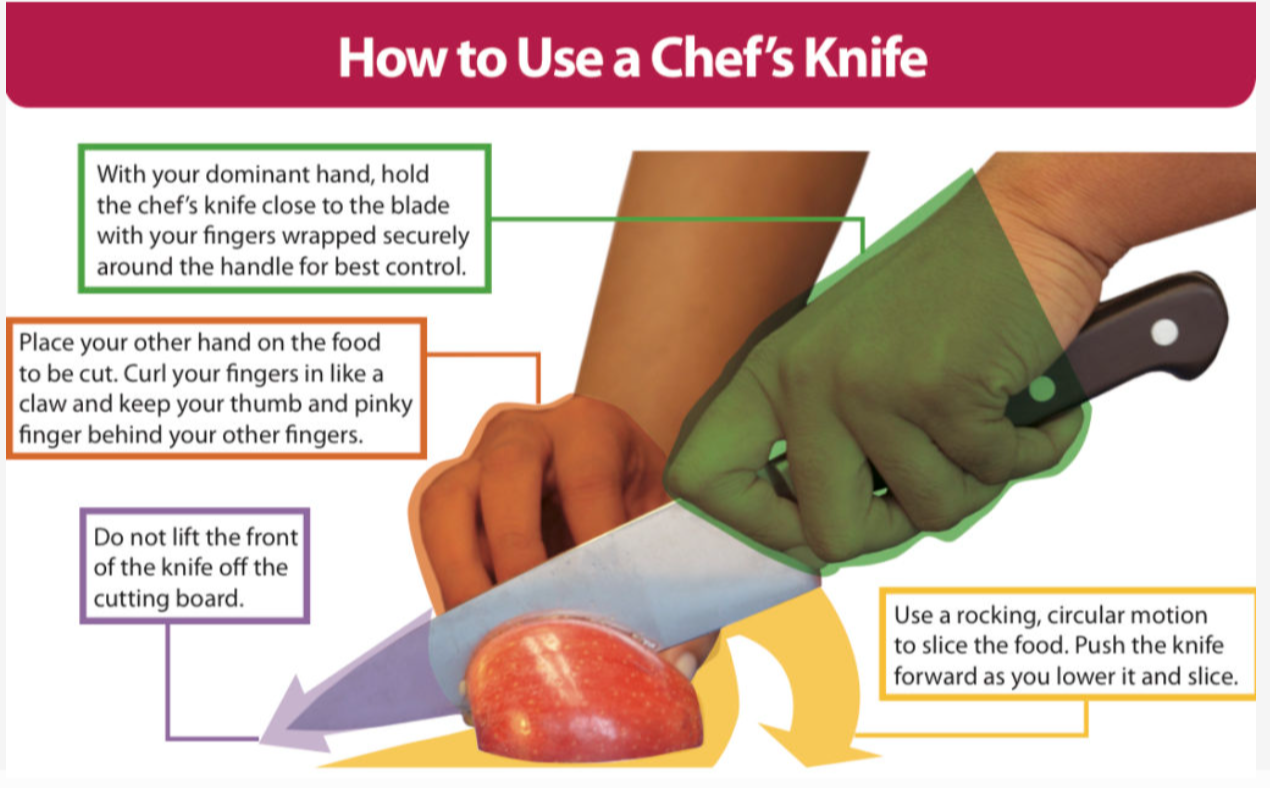
Instead, the gold standard is the"pinch grip".To execute this, place your thumb and index finger on the blade itself, pinching the base of the spine just in front of the handle. Your remaining three fingers should curl naturally around the handle. This technique effectively turns the knife into an extension of your arm, providing you with a much higher degree of leverage and stability. It allows for precise, fluid movements rather than jerky, uncontrolled hacking. When you use the pinch grip, you will notice that the knife feels more balanced, reducing fatigue during long prep sessions.
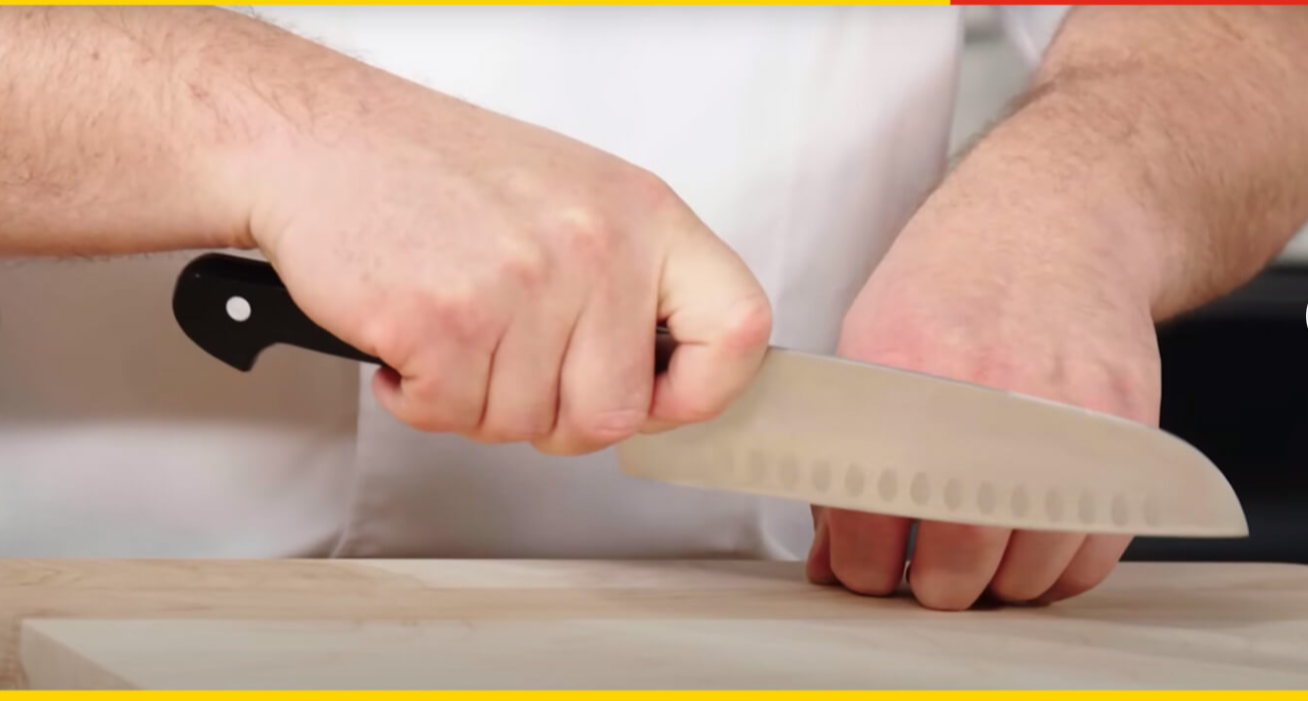
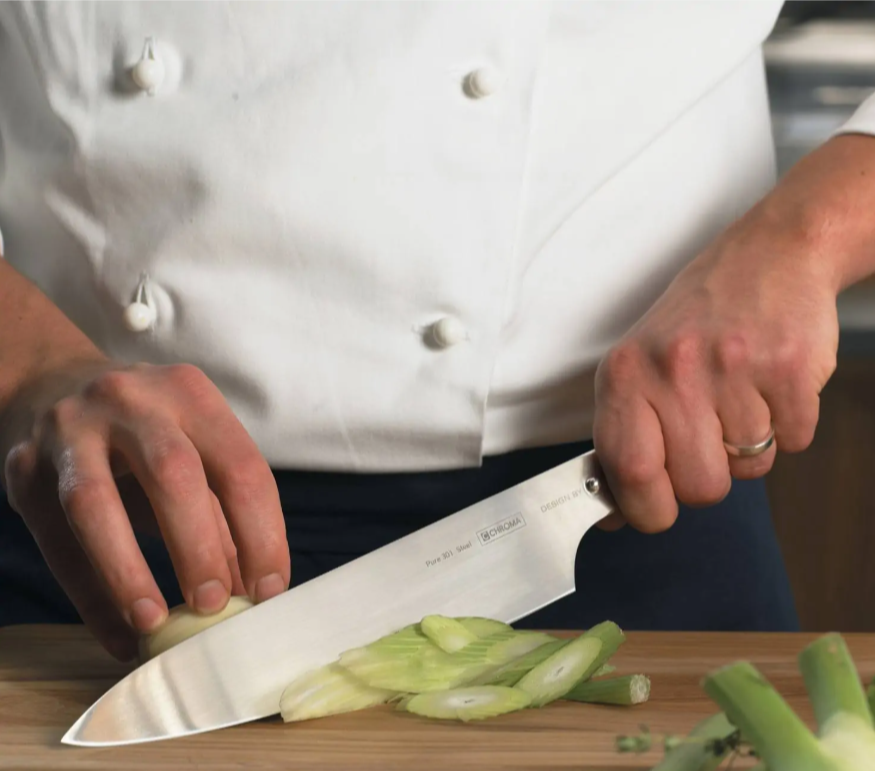
While the hand holding the knife does the cutting, the hand holding the food is equally important for safety. To prevent injury to your fingertips, you must adopt the"claw technique"; Instead of holding food with your fingers extended—which puts them directly in the path of the blade—tuck your fingertips inward so your knuckles are facing the knife blade.
Your knuckles then act as a safe guide for the side of the knife blade. As you move the knife along the food, you keep the flat side of the blade pressed gently against your knuckles. By sliding your claw hand backward as you slice, you ensure that your fingertips are always safely shielded behind your knuckles. With a little practice, this movement becomes second nature, allowing you to slice rapidly without ever looking at your fingertips.
Once you have mastered the grip and the claw, you can begin to refine your cutting techniques. The most versatile movement is the rocking motion, which is ideal for herbs, onions, and garlic. Keep the tip of the chef's knife in contact with the cutting board at all times. Pivot the knife on its tip, moving the heel up and down in a rhythmic, rocking arc. This motion allows for clean, precise slices without having to lift the blade completely off the board.
For firmer vegetables or large items, you may use a straight-down chopping motion or a horizontal slicing motion. The key here is to always ensure you are using the appropriate knife for the job. A large chef's knife is a workhorse for most tasks, but a paring knife is essential for delicate work like peeling or coring small fruits. Never force a blade to do something it wasn't designed for, as this can damage the edge and compromise your safety.
A knife is only as good as its edge. Over time, the microscopic edge of the blade becomes misaligned due to contact with the cutting board and the resistance of food. This is where honing comes in. Using a honing rod regularly—ideally before every significant prep session—straightens the edge of the blade, keeping it keen and efficient. It does not remove metal; it simply realigns the steel.
Sharpening, however, is a different process that involves actually removing a small amount of metal to create a new, acute edge. Depending on how frequently you cook, you should sharpen your knives on a whetstone or a reputable mechanical sharpener a few times a year. Proper maintenance also includes cleaning. Always hand-wash your knives with mild soap and warm water, and dry them immediately. Never put a quality kitchen knife in the dishwasher, as the high heat, detergent, and banging against other utensils can severely dull and damage the blade and handle.
How you store your knives significantly impacts their longevity. Throwing them loose into a drawer is a recipe for disaster; the blades will strike other metal tools, causing chips and dulling, and you risk cutting yourself whenever you reach in. A magnetic wall strip is an excellent, space-saving solution that keeps blades visible and safe. Alternatively, a knife block or in-drawer tray provides individual slots for each tool, protecting the edges. Regardless of the method, the goal is to prevent the sharp edge from coming into contact with other hard surfaces.
Becoming proficient with a kitchen knife is a journey, not a destination. By focusing on the fundamentals—the pinch grip for control, the claw technique for safety, and consistent maintenance to keep your edges sharp—you will find that your time in the kitchen becomes significantly more productive and rewarding. A sharp, well-maintained, and properly used knife is the most essential tool in any cook's arsenal. With dedication and practice, you will develop the muscle memory required to handle even the most complex prep work with confidence, efficiency, and ease.
1. How often should I hone my kitchen knife?
It is recommended to hone your knife before every major cooking session or at least once a week if you cook frequently. Honing realigns the edge, keeping it sharp for longer periods between professional sharpenings.
2. Can I use a glass cutting board?
No, you should avoid using glass, stone, or ceramic cutting boards. These surfaces are too hard and will cause your knife edge to dull or chip almost immediately. Wood or high-quality plastic cutting boards are the best choices as they provide a gentle surface that protects the blade.
3. What is the difference between a chef's knife and a paring knife?
A chef's knife is a multipurpose tool used for chopping, slicing, and dicing larger ingredients like vegetables and meat. A paring knife is a small, maneuverable tool designed for intricate tasks such as peeling, trimming, and small-scale cutting.
4. Should I ever put my kitchen knives in the dishwasher?
You should never put kitchen knives in the dishwasher. The intense heat, harsh detergents, and the motion of the dishwasher can damage the handle materials, dull the sharp edge, and even lead to rust or corrosion on the blade. Always hand-wash and dry immediately.
5. How do I know when it is time to sharpen my knife?
A good indicator is the paper test: hold a piece of paper vertically and attempt to slice downward through it with your knife. If the blade tears the paper rather than cutting through it cleanly and effortlessly, it is time to sharpen your blade.


