
- Home
- Products
- About Us
- OEM/ODM
- VR
- Resources
- Contacts


Views: 265 Author: Insight Publish Time: 2026-03-06 Origin: Insight


Content Menu
● What's the Meaning of Using a Champagne Knife to Open Champagne
>> The Historical Origins of Sabrage
>> The Physics Behind the Blade
>> Symbolism and Social Significance
>> The Art of Mastery and Responsibility
>> Cultural Evolution and Modern Context
>> Conclusion
The practice of opening a bottle of champagne with a knife—a dramatic, skillful, and often misunderstood ritual—is known globally as sabrage. While it might appear to be a reckless display of bravado, the history and technical precision behind this act elevate it from a mere party trick to a sophisticated art form. To understand the meaning of using a champagne knife, one must delve into the origins of the technique, the physics that make it possible, and the psychological impact it brings to a celebration.

To appreciate the meaning behind sabrage, we must travel back to the Napoleonic era. Legend has it that after the French Revolution, officers of the French cavalry, the Hussars, would celebrate their victories by decapitating bottles of champagne with their heavy, curved sabers. Napoleon Bonaparte himself, who famously noted that "Champagne! In victory one deserves it; in defeat one needs it," is often associated with the popularization of this practice.
At the time, this was not necessarily a refined culinary technique but rather a display of military prowess and high spirits. Using a weapon to open a luxury beverage served as a powerful symbol of celebration, dominance, and the indulgence of the elite. Over the centuries, this practice evolved from a battlefield victory ritual into a ceremonial method of opening sparkling wine, often reserved for weddings, galas, and special occasions where a sense of theater is desired.
At its core, sabrage is not about hacking the bottle open with force; it is about exploiting the physics of the glass bottle. Champagne bottles are designed to withstand significant internal pressure, typically around six atmospheres—roughly the same pressure found in a commercial bus tire. This pressure is the key to the entire operation.
The neck of a champagne bottle is constructed with a thick lip, and the glass seam runs vertically along the side of the bottle. Where the seam meets the lip, there is a structural weak point. When the blade of the champagne knife strikes this specific point at the correct angle, it creates a clean fracture. The pressure inside the bottle does the actual work, forcing the cork and the glass collar to break away from the neck instantly, leaving a smooth edge behind. Therefore, the knife is merely a tool to apply concentrated stress to the weakest point of the glass structure.
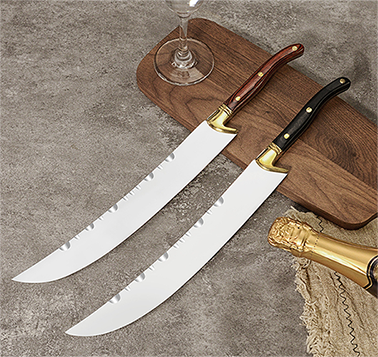
The meaning of using a champagne knife transcends simple mechanics; it is fundamentally about the staging of a moment. When a host brings out a specialized sabering knife—or even a heavy kitchen knife—the atmosphere in the room shifts. There is a palpable sense of anticipation as the audience falls silent, waiting to see if the performer can execute the feat flawlessly.
It transforms a mundane task, like opening a beverage, into an intentional, high-stakes ceremony. It signals that the occasion is momentous enough to warrant such theatrics. By choosing to open the bottle this way, the individual is making a statement about the significance of the event. It adds a layer of heritage and flair that a standard corkscrew simply cannot provide. Furthermore, it reinforces the identity of the person performing the task as someone capable, confident, and appreciative of tradition.
It is essential to recognize that mastering the use of a champagne knife requires patience, respect, and safety. The practice is strictly intended for sparkling wines that are under high pressure. Attempting this on still wines or improperly chilled bottles can result in the bottle shattering rather than shearing cleanly.
The meaning of the act also lies in the discipline required to learn it. A skilled practitioner understands the importance of the bottle's temperature, the angle of the strike, and the trajectory of the flying cork. This discipline shifts the act from being a dangerous gamble to a controlled demonstration of skill. In modern culinary circles, learning to saber a bottle is often viewed as a rite of passage for sommeliers and wine enthusiasts, representing an dedication to the craft of wine service.
In the contemporary landscape, the use of a champagne knife has migrated from the battlefield to high-end hospitality and private luxury events. While the military connotations have faded, the association with "special occasion" remains stronger than ever. It has become a hallmark of luxury, frequently performed at grand openings, milestone anniversaries, and exclusive celebrations where the presentation is as vital as the product itself.
Despite its modernization, the act retains a sense of danger and adrenaline that captures human attention. It challenges the conventional way we interact with our environment. We are conditioned to open bottles by removing a cork with a tool or by hand; taking a knife to the glass requires us to abandon our typical behaviors and embrace a more unconventional, historically charged method of engagement.
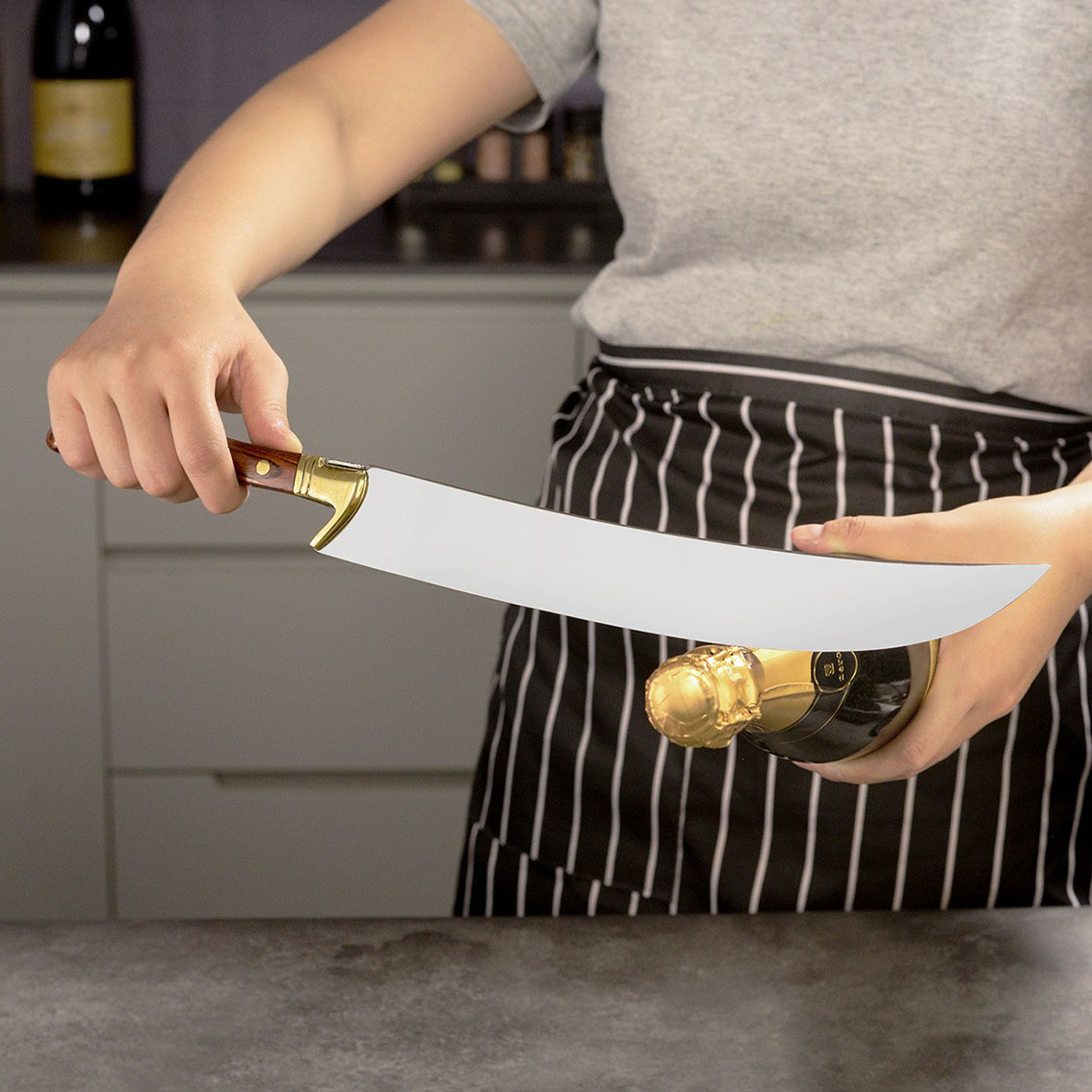
Using a champagne knife to open champagne is a multifaceted ritual that blends historical narrative, applied physics, and the human desire for spectacle. It serves to elevate the consumption of wine, turning the act of service into a memorable performance that anchors a celebration. Whether one views it as a tribute to Napoleonic traditions, an exploration of glass mechanics, or simply a way to add excitement to a gathering, the practice remains a testament to the enduring human love for ceremony and skill. Through the sharp edge of a blade, the popping of a cork becomes a story of triumph and refinement, reminding us that sometimes, the way we celebrate is just as meaningful as the wine we pour.
Is it safe to open a champagne bottle with a knife?
When performed correctly with a properly chilled bottle and the right technique, it is relatively safe. However, it requires caution, as it involves pressurized glass and a sharp edge.
Does any knife work for sabering?
While a specialized champagne saber is ideal due to its weight and dull edge, any heavy, non-serrated kitchen knife can be used effectively by a skilled individual.
Why does the bottle not shatter?
The pressurized carbon dioxide inside the bottle pushes outward with great force; hitting the structural seam creates a clean break along the weakest point of the lip, causing the neck to fly off rather than shattering the body.
Do you lose a lot of champagne when sabering?
If done properly, only a minimal amount of foam escapes, and the pressure within the bottle prevents any glass shards from entering the liquid due to the velocity of the exiting cork and neck.
What kind of wine can be used?
Only sparkling wines that are pressurized, such as Champagne, Crémant, or Prosecco, can be opened this way. Still wines, which lack this internal pressure, cannot be sabered.


