
- Home
- Products
- About Us
- OEM/ODM
- VR
- Resources
- Contacts


Views: 8877 Author: Site Editor Publish Time: 2026-09-21 Origin: Site


Content Menu
● 1. Why Serrated Steak Knives Dominate the Global Cutlery Market
● 2. Professional Classification of Serrated Steak Knives by Knife Factory Manufacturing Standards
● 3. Core Manufacturing Craftsmanship of High-Quality Serrated Steak Knives
● 4. How Serrated Design Affects Steak Knife Service Life and Maintenance
● 5. Common Misunderstandings When Buying Serrated Steak Knife Sets
● FAQs About Serrated Steak Knife Craftsmanship & Factory Production
Yangjiang Insight Industry And Trade Co.,Ltd. is a professional and experienced knife factory with more than 23 years of expertise in the research, development, manufacturing, and global sales of full-series kitchen cutlery and cooking accessories. Operating a standardized 20,000-square-meter production plant and maintaining a stable monthly output of up to 5 million pieces, our knife factory specializes in crafting premium steak knifes, chef knives, santoku knives, bread knives, paring knives, and various customized kitchen tools. We provide high-quality OEM and ODM manufacturing solutions for countless well-known kitchenware brands around the world, adhering to strict production standards and user-oriented product optimization. Among all types of dinner cutlery, the serrated steak knife has always been the best-selling and most widely used style in global household and light commercial markets. Most consumers choose serrated steak knives for their effortless cutting performance and long-lasting sharpness, yet few people truly understand the professional craftsmanship behind serrated blades, why they outperform straight-edge alternatives for steak cutting, and how industrial manufacturing standards affect their overall service life. This in-depth SEO article will comprehensively elaborate on serrated steak knife craftsmanship, performance advantages, classification standards, durability principles, and professional selection logic from the perspective of a professional knife factory, helping users fully understand core cutlery manufacturing knowledge.
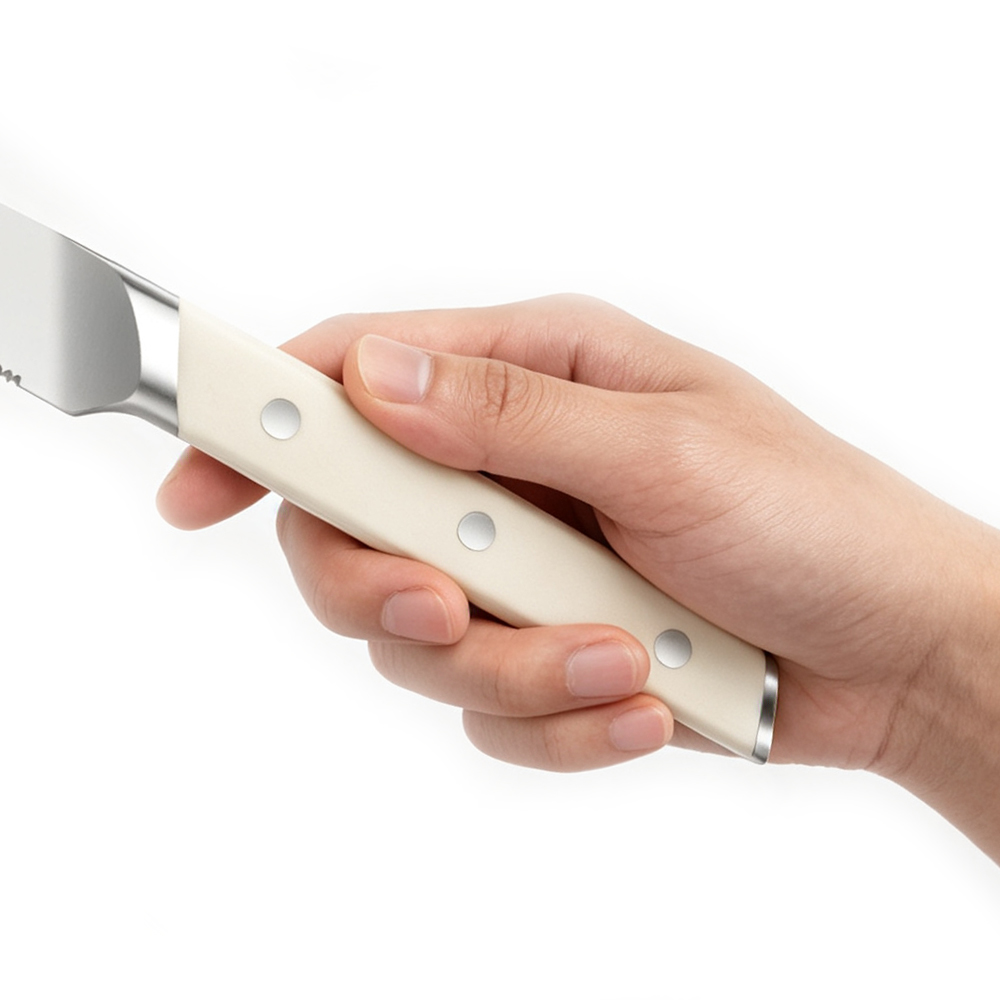
In the global civilian cutlery market, serrated steak knifes have maintained an absolute dominant market share for decades, far exceeding straight-edge steak knives in sales volume and user penetration rate. According to long-term market data tracked by ourknife factory, more than 85% of household steak knife set orders in European, American, and Southeast Asian markets adopt serrated blade designs, which has become a fixed market demand trend. The core reason for this phenomenon lies in the unique structural advantages of serrated blades that perfectly match steak cutting characteristics.
Steak and grilled meat have special food textures featuring tough surface skin, elastic muscle fibers, and tender internal fat. When using a straight-edge steak knife to cut cooked steak, users need to apply continuous and stable pressure to complete the slicing action. If the blade is slightly dull or the force is uneven, it will easily squeeze the steak, destroy the complete meat texture, and cause juice loss, greatly affecting the dining taste. In contrast, the serrated blade of a professional steak knife adopts a tooth-shaped cutting structure, which relies on the biting and sliding cutting principle of serrations to quickly pierce the tough steak surface and cut off dense meat fibers without squeezing the food.
Another key advantage of serrated steak knifes is their extremely low maintenance threshold. Ordinary straight-edge kitchen blades are prone to wear after frequent contact with food and tableware, requiring regular manual grinding or professional maintenance to restore sharpness. However, the serrated structure produced by a formal knife factory has strong wear resistance. The tiny tooth-shaped edges can maintain effective cutting performance for several years of daily use, basically realizing "no grinding for life", which is extremely suitable for modern families pursuing convenient and efficient kitchen tools.
Many consumers mistakenly believe that all serrated steak knifes are the same, with only differences in appearance and price. In fact, professional knife factorys have strict standardized classifications for serrated steak knives according to serration density, tooth shape design, blade radian, and polishing technology, and different grades of serrated craftsmanship bring completely different cutting experiences and durability.
First, according to serration density, mainstream serrated steak knifes are divided into coarse serration, medium serration, and fine serration models. Coarse serration steak knives have large tooth spacing and deep tooth grooves, with strong cutting force, which are suitable for cutting thick steak, crispy roasted meat with hard crust, and tough frozen cooked meat. This type of blade is mostly used in cost-effective civilian mass-produced products and commercial catering supporting cutlery. Medium serration is the most versatile specification optimized and produced by our knife factory for global household users, balancing cutting force and cutting fineness, suitable for all kinds of conventional steak, lamb chops, and grilled meat, and is the mainstream configuration of 6-piece household steak knife sets.
Fine serration steak knifes feature dense and tiny tooth shapes, with smooth and neat cutting sections. They will not produce fiber burrs when cutting tender beef and fat-marbled steak, meeting the high-end refined dining needs. This process requires higher precision polishing equipment and manual calibration technology, so it is mostly used in mid-to-high-end customized cutlery sets and brand gift box products.
Second, according to tooth shape structure, serrated steak knives are divided into symmetric serration and asymmetric serration. Asymmetric serration craftsmanship is a high-end manufacturing technology adopted by professional knife factorys. The single-sided inclined tooth shape makes the cutting angle more accurate, the cutting resistance smaller, and the meat incision flatter, which is a key technical difference distinguishing high-quality products from inferior ordinary serrated knives.
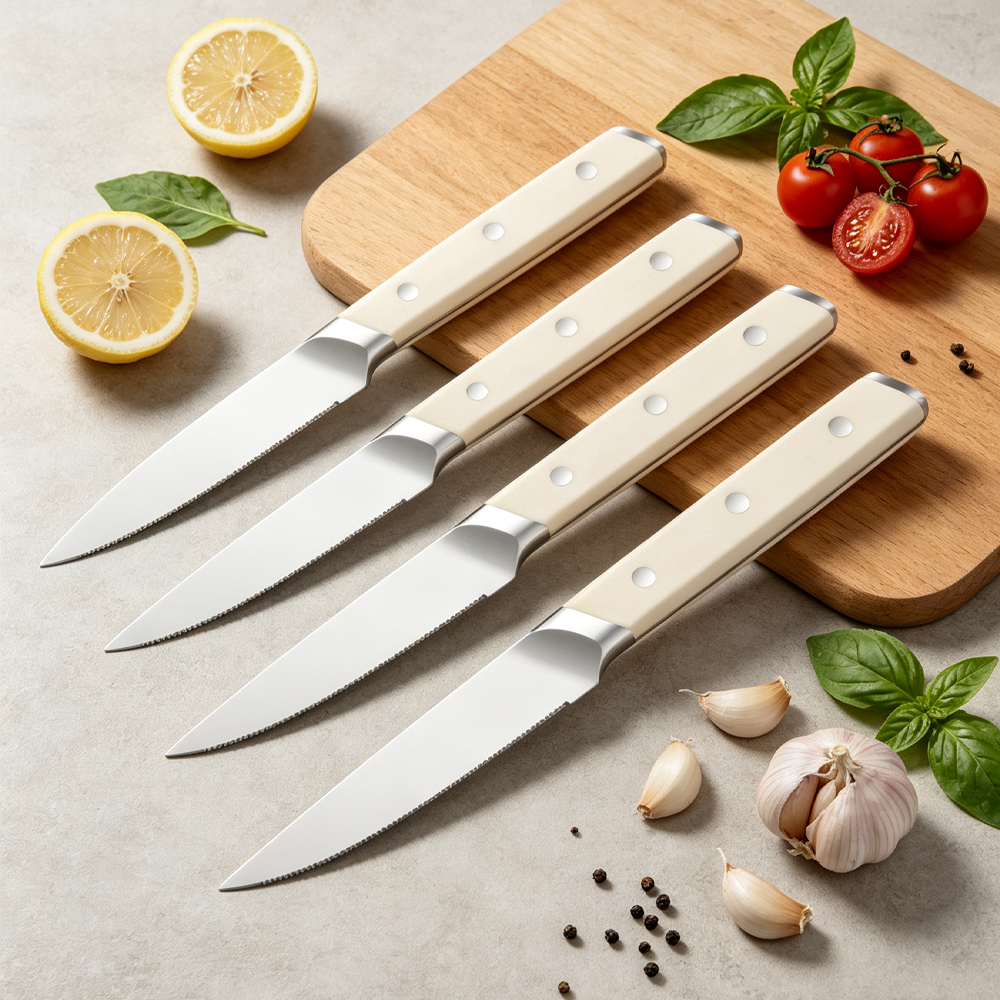
The excellent performance of premium serrated steak knifes comes from the precise and standardized manufacturing process of professional knife factorys. Every production link from blade forming, serration stamping, heat treatment to fine polishing directly determines the final quality of the steak knife. Many inferior serrated steak knives on the market have problems such as easy tooth breakage, unsmooth cutting, and fast sharpness attenuation, all of which are caused by non-standard production processes.
Serration precision stamping is the first core process. Formal knife factorys adopt integrated precision die stamping technology to ensure that each tooth shape of the steak knife is uniform in size, consistent in depth, and neat in edge. Small workshop products use simple manual cutting tools to make serrations, resulting in irregular tooth shapes, different depths, and burrs on the edge, which not only affect the cutting effect but also easily scratch hands and damage food texture. Our factory’s customized precision molds can control the serration error within 0.1mm, ensuring the consistency of each batch of products.
Vacuum heat treatment is the key process to ensure serration toughness and hardness. After serration forming, the steak knife blade needs to undergo professional high-temperature quenching and tempering treatment to make the serrated edge reach the optimal hardness range. This process can effectively avoid tooth breakage and edge collapse during hard object cutting, and greatly improve the wear resistance of the blade. Without professional heat treatment, the serrated edge is too soft and easy to wear, or too hard and brittle, unable to adapt to long-term daily use.
Multi-angle fine polishing is the final finishing process of high-quality serrated steak knifes. Professional knife factorys adopt three-stage polishing: rough polishing to remove burrs, medium polishing to shape the tooth surface, and fine polishing to smooth the edge. The polished serrated blade has no residual sharp corners, smooth tooth groove transition, and will not hang meat fibers during cutting, realizing labor-saving and smooth cutting experience. Inferior products only have simple surface polishing, with rough tooth grooves and obvious burrs, which seriously affect the use effect.
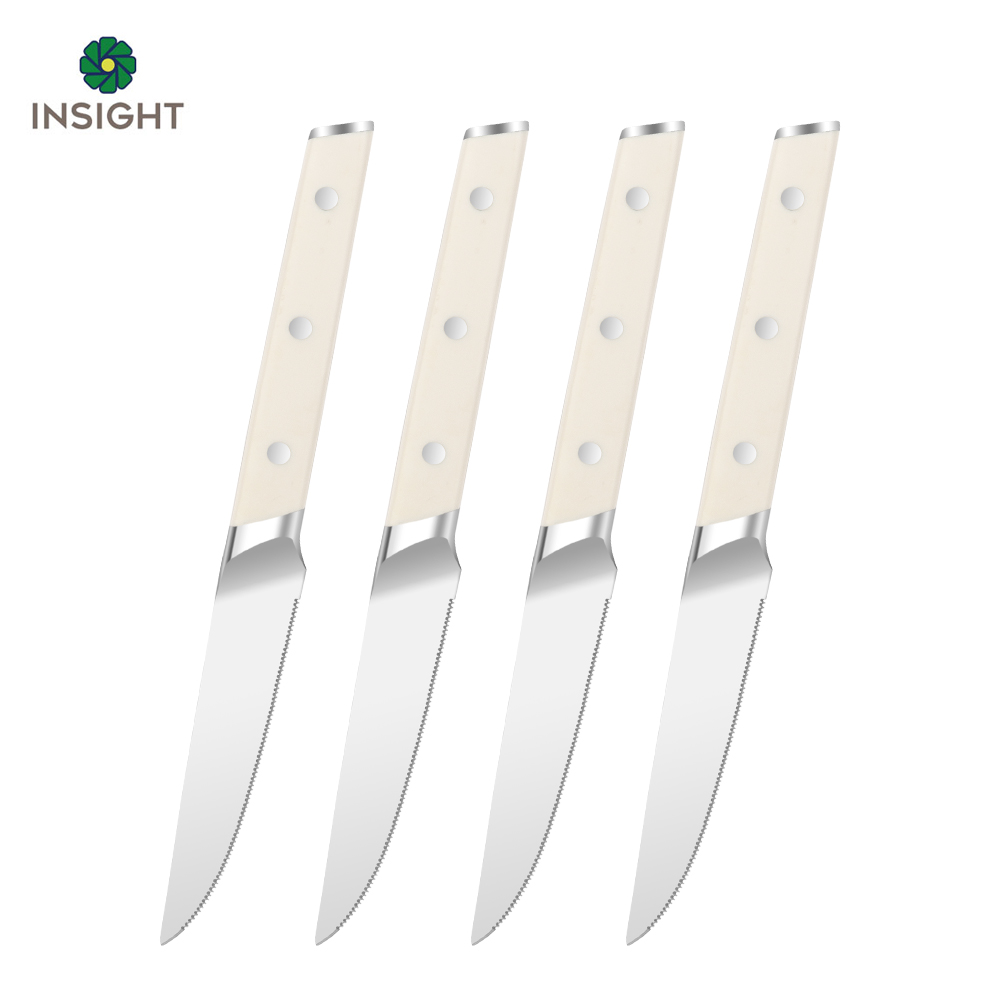
The unique structural design of serrated steak knifes determines their different durability and maintenance logic compared with straight-edge knives. For ordinary users, understanding the durability advantages and maintenance taboos of serrated blades can effectively extend the service life of cutlery sets and maintain stable cutting performance for a long time.
The serrated tooth-shaped structure has natural wear resistance advantages. The cutting point of the steak knife is concentrated on the tip of each serration. During daily cutting, the contact area between the blade and the food is small, and the wear degree is uniform. Unlike straight-edge blades, which have overall edge wear and rapid sharpness decline, serrated blades can maintain effective cutting performance for a long time. According to the durability test data of our knife factory, qualified serrated steak knives can maintain good sharpness after 3-5 years of daily household use, which is far longer than the service life of ordinary straight-edge steak knives.
However, serrated steak knifes also have unique maintenance taboos. The biggest misunderstanding of users is using ordinary flat sharpening stones to polish serrated blades. Ordinary flat sharpening stones will smooth the tooth-shaped structure of serrations, destroy the original cutting angle, and directly lead to the failure of the serrated blade. Different from straight-edge knives that can be polished repeatedly, serrated steak knives produced by formal knife factorys do not need daily polishing. Only when individual serrations are damaged after long-term use, professional special serration tools can be used for local repair.
In addition, serrated steak knifes need to avoid long-term immersion in acidic and alkaline liquids. Residual meat juice, vinegar, and detergent will corrode the tiny tooth gaps. Regular cleaning and drying can effectively avoid blade oxidation and tooth gap rust, ensuring long-term stable product performance.
In years of market research and brand OEM service, our knife factory has summarized many common consumer purchasing misunderstandings about serrated steak knifes. These wrong cognitions often lead users to buy low-performance, short-service-life products, resulting in poor dining experience.
The first misunderstanding is "the deeper the serration, the better the performance". Many consumers think that deep tooth grooves mean stronger cutting force. In fact, excessive serration depth will reduce the overall toughness of the blade edge, easily causing tooth breakage and edge collapse. Professional knife factorys will match the most scientific serration depth and spacing according to the blade thickness and steel hardness to balance cutting performance and structural stability.
The second misunderstanding is "all stainless steel serrated steak knives are the same". Ordinary low-grade stainless steel has poor hardness and wear resistance. Even with fine serration design, the blade will quickly become dull after short-term use. Only high-quality high-carbon stainless steel matched with professional heat treatment technology can give full play to the advantages of serrated structure, which is also the core quality standard that formal knife factorys adhere to in mass production.
The third misunderstanding is "denser serrations always cut better". Excessively dense serrations are suitable only for tender thin-cut steak, but poor for thick-cut steak and hard-crust grilled meat, which are easy to cause tooth gap blockage and laborious cutting. Medium-density serrations with balanced design are still the most practical choice for universal household use.
Q1: Why are most commercial and household steak knives serrated instead of straight-edged?
A1: Serrated steak knifes have stronger adaptability to steak’s tough fiber and crust texture, delivering labor-saving and non-squeezing cutting effects. Meanwhile, they feature ultra-long sharpness retention and zero daily maintenance, which fits the usage habits of ordinary consumers and commercial catering scenarios. As a professional knife factory, our mass data verifies that serrated steak knives have higher user satisfaction and wider market applicability than straight-edge styles.
Q2: Can serrated steak knives be sharpened when they become dull?
A2: Qualified serrated steak knifes produced by standard knife factorys hardly become dull in daily use. If slight wear occurs after years of use, special serration sharpening tools are required for repair instead of ordinary flat sharpening stones, which will damage the serration structure. In most cases, daily cleaning and maintenance are enough to maintain their cutting performance.
Q3: What is the difference between factory-made serrated steak knives and small-workshop products?
A3: Regular knife factory products adopt precision die stamping, standardized heat treatment and multi-stage fine polishing, with uniform serration size, stable blade hardness, no burrs, and strong durability. Small-workshop serrated steak knives have irregular tooth shapes, unprocessed blade edges, unstable hardness, and are prone to tooth breakage and rapid dulling, with huge differences in safety and service life.
Q4: Are fine serrated steak knives more high-end than coarse serrated ones?
A4: Not absolutely. Fine serrated steak knifes are suitable for tender thin-cut meat and refined dining, while coarse serrated ones excel in cutting thick steak and hard-crust grilled food. High-end positioning depends on overall material, craftsmanship and design, not merely serration density. Our knife factory provides customized serration schemes for different market positioning demands.
Q5: How to judge the quality of a serrated steak knife at a glance?
A5: High-quality serrated steak knifes have uniform and neat serrations, smooth tooth groove transition, no burrs on the blade edge, balanced overall weight, and firm handle assembly. The blade surface is smooth and delicate without scratches and rust spots. All products from formal knife factorys have consistent batch quality and perfect surface finishing.
Q6: Why are 6-piece serrated steak knife sets the mainstream factory output?
A6: Based on global household dining scenarios and supply chain economics, our knife factory takes 6-piece sets as the mainstream mass production specification. This configuration matches the mainstream family dining number, meets daily and guest reception needs, and is most suitable for standardized packaging, logistics and shelf sales, achieving the best balance between market demand and production cost


