
- Home
- Products
- About Us
- OEM/ODM
- VR
- Resources
- Contacts


Views: 890 Author: Site Editor Publish Time: 2026-09-07 Origin: Site


Content Menu
● 1. Why Damascus Kitchen Knives Need Specialized Maintenance
● 2. Daily Cleaning Rules for INSIGHT KITCHEN KNIFE Damascus Blades
>> 2.1 Clean Immediately After Each Use
>> 2.2 Adopt Mild Cleaning Methods
>> 2.3 Handling Stubborn Residues Correctly
● 3. Complete Drying Maintenance to Prevent Oxidation and Rust
● 4. Scientific Storage Methods to Protect Blade Integrity
>> 4.1 Avoid Random Stacking and Collision
>> 4.2 Choose Breathable and Dry Storage Tools
>> 4.3 Keep Storage Environment Dry and Ventilated
● 5. Professional Sharpening and Edge Maintenance Skills
>> 5.1 Distinguish Between Honing and Sharpening
>> 5.2 Standard Sharpening Steps for Damascus Blades
>> 5.3 Post-Sharpening Inspection
● 6. Blade Oil Maintenance for Long-Term Anti-Rust Protection
● 7. Common Maintenance Mistakes to Avoid
● 8. Frequently Asked Questions About Damascus Kitchen Knife Maintenance
Article Introduction
Brought to you by Yangjiang Insight Industry And Trade Co.,Ltd., a 23-year professional kitchen knife manufacturer with 20,000㎡ factory and 5 million monthly output, this ultimate guide elaborates on full maintenance tips for INSIGHT KITCHEN KNIFE Damascus kitchen knives. It covers scientific daily cleaning, thorough drying, standardized storage, professional sharpening, anti-rust oil maintenance and common taboo mistakes, solving core pain points like blade rust, dullness and pattern fading. With practical, easy-to-operate steps and targeted FAQs, it helps users fully retain the sharp cutting performance and unique layered pattern of premium Damascus cutlery for long-term durable use.
Introduction Character Count: 298 characters
Yangjiang Insight Industry And Trade Co.,Ltd. is a professional kitchen knife manufacturer with over 23 years of industry experience, specializing in the design, production, and wholesale of premium kitchen cutlery and kitchen tools. Covering a 20,000-square-meter production plant and boasting a monthly production capacity of up to 5 million pieces, our factory provides reliable OEM and ODM services for global kitchenware brands. Our core product line includes premium INSIGHT KITCHEN KNIFE series, covering chef knives, santoku knives, bread knives, paring knives, and assorted kitchen accessories. Damascus kitchen knives, as the flagship product of INSIGHT KITCHEN KNIFE, are widely favored by professional chefs and home cooking enthusiasts worldwide for their unique layered pattern, exceptional hardness, ultra-sharp cutting performance, and durable service life. However, Damascus steel is a composite metal material with special structural characteristics, and its exquisite texture and superior cutting ability can only be maintained with scientific and daily careful maintenance. Many high-quality Damascus blades lose their luster, develop rust spots, or become dull prematurely due to incorrect daily use and careless maintenance. To help every user maximize the service life and retain the perfect cutting experience of their premium cutlery, this comprehensive guide will elaborate on all-round maintenance knowledge for INSIGHT KITCHEN KNIFE Damascus kitchen knives, covering daily cleaning, drying, storage, sharpening, rust prevention, and taboo operations.
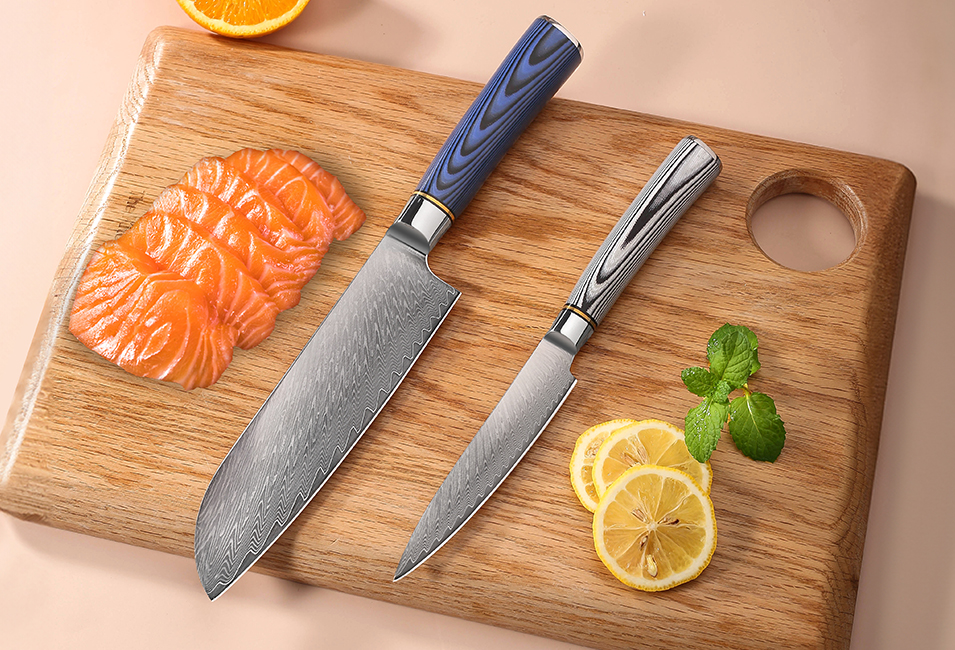
Different from ordinary stainless steel kitchen knives, Damascus kitchen knives adopted by INSIGHT KITCHEN KNIFE are forged by stacking and folding multiple layers of high-carbon steel and soft stainless steel. This unique forging process creates the stunning wave pattern on the blade surface while endowing the knife with dual advantages of high hardness and good toughness. High-carbon steel ensures ultra-sharp cutting edges and long-lasting sharpness, while soft steel layers effectively prevent blade cracking and improve impact resistance. Nevertheless, the high-carbon steel component in Damascus blades is more susceptible to oxidation and corrosion compared to full stainless steel cutlery. Humid environments, residual food acid, long-term water soaking, and improper cleaning methods will all damage the blade surface and internal structure.
A well-maintained INSIGHT KITCHEN KNIFE Damascus kitchen knife can maintain its original sharpness and beautiful pattern for more than a decade, even with daily use. On the contrary, a lack of standardized maintenance will lead to gradual rusting of the blade, blurring of the layered texture, passivation of the cutting edge, and in severe cases, tiny cracks on the blade body, directly shortening the service life of the premium cutlery. Therefore, targeted and standardized daily maintenance is the core key to retaining the performance and aesthetic value of Damascus kitchen knives.

Cleaning is the most basic and critical step in Damascus knife maintenance, and correct cleaning habits can avoid 80% of blade damage problems. As a professional manufacturer of premium kitchen cutlery, INSIGHT KITCHEN KNIFE summarizes scientific cleaning standards suitable for all Damascus kitchen knives, abandoning rough cleaning methods that damage the blade.
Never leave a Damascus kitchen knife uncleaned after cutting ingredients. Food residues such as fruit acid, vegetable juice, meat protein, and seasoning salt will form corrosive substances on the blade surface after air drying. These acidic and alkaline substances will continuously erode the high-carbon steel layers of INSIGHT KITCHEN KNIFE Damascus blades, causing surface oxidation, dark spots, and even fine rust dots. It is recommended to rinse and clean the knife immediately after finishing cooking, without leaving it in a sink filled with water for soaking. Even short-term soaking will make moisture penetrate the tiny gaps between Damascus steel layers, inducing hidden corrosion problems.
For daily cleaning of INSIGHT KITCHEN KNIFE Damascus kitchen knives, please use warm water (30-40℃) and neutral mild dish soap, matched with soft sponges, cotton cloths or microfiber cleaning cloths. It is strictly forbidden to use hard brushes, steel wool, abrasive cleaning powder and corrosive detergent. Hard abrasive tools will scratch the delicate patterned surface of the Damascus blade, destroy the smooth polishing layer, and make the blade more prone to oil stains and rust in subsequent use. Strong acidic or alkaline detergents will chemically react with the steel layer, damaging the blade structure and fading the unique pattern.
For dried and stubborn food residues on the blade, do not scrape them hard with hard tools. You can wrap the blade with a warm water-soaked paper towel or soft cloth, let it stand for 2-3 minutes to soften the residues, and then wipe it gently. After cleaning, rinse the blade thoroughly with running water to ensure no detergent residue remains on the blade surface and the junction of blade and handle, avoiding residual chemical components from corroding the cutlery for a long time.
Cleaning without thorough drying is equivalent to no maintenance, and residual moisture is the primary cause of Damascus knife rusting. After cleaning any INSIGHT KITCHEN KNIFE Damascus kitchen knife, you must dry the whole knife immediately, including the blade, handle, and the gap between blade and handle. Use a dry, soft lint-free cotton cloth to wipe off surface moisture repeatedly until the cutlery is completely dry without any wet traces.
In humid coastal areas or rainy seasons, the air humidity is high, and the surface of dried blades is still easy to absorb moisture and oxidize. For long-term stored or infrequently used INSIGHT KITCHEN KNIFE Damascus cutlery, you can regularly wipe the blade surface with dry microfiber cloth to remove floating moisture and fingerprints. Fingerprints contain tiny sweat and oil components, which will form oxidation marks on the blade after long-term placement, affecting the appearance and performance of the cutlery.
Many users ignore the importance of storage, and unreasonable storage is easy to cause blade edge damage, pattern wear and moisture erosion. Combined with years of cutlery production and testing experience, INSIGHT KITCHEN KNIFE has sorted out the most suitable storage solutions for Damascus kitchen knives.
Do not place Damascus kitchen knives together with other metal tableware such as iron spoons and stainless steel knives at will. Hard collision and friction between metals will scratch the Damascus pattern on the blade surface, cause edge chipping and passivation, and destroy the flatness of the blade. Independent storage is the basic principle of protecting premium Damascus cutlery.
It is recommended to store INSIGHT KITCHEN KNIFE Damascus knives in wooden knife blocks, magnetic knife racks or dedicated knife sheaths. Wooden knife blocks have good air permeability, which can keep the knife body dry and avoid moisture accumulation. Magnetic knife racks can fix the blade independently, prevent edge friction, and facilitate daily access. It should be noted that do not store Damascus knives in airtight plastic boxes or damp leather sheaths for a long time. Airtight environments will lock moisture, cause blade oxidation and mildew, and leather materials will release trace corrosive components after damp, damaging the blade.
The storage position of Damascus kitchen knives should be far away from humid areas such as kitchen sinks and steam outlets. Keep the surrounding environment dry and well-ventilated to avoid long-term exposure to humid air. For users who do not use kitchen knives for a long time, they can wrap the dried blade with oil-absorbing paper and place it in a dry cabinet to isolate moisture in the air.
The ultra-sharp cutting performance of INSIGHT KITCHEN KNIFE Damascus kitchen knives is its core advantage, and regular scientific sharpening can keep the blade in the best cutting state. Damascus blades have high hardness, so they have higher requirements for sharpening methods and tools than ordinary kitchen knives. Wrong sharpening will damage the blade edge and even destroy the layered structure.
Many users confuse honing with sharpening, but they are two completely different maintenance steps. Honing is suitable for daily routine maintenance, which uses a honing rod to calibrate the slightly tilted blade edge, restore edge flatness, and make cutting smoother. For frequently used INSIGHT KITCHEN KNIFE Damascus knives, honing once every 3-5 uses is enough. Sharpening is a deep maintenance measure, which uses a whetstone to grind off a tiny layer of metal on the blade edge to completely restore sharpness when the knife is obviously dull. It is recommended to sharpen Damascus kitchen knives every 3-6 months according to the frequency of use.
First, choose a professional dual grit whetstone (coarse grit 800# for repairing blunt edges, fine grit 1500#-3000# for fine polishing). Soak the whetstone in clean water for 5-10 minutes until no bubbles emerge. Hold the INSIGHT KITCHEN KNIFE blade at a fixed angle of 15-20 degrees with the whetstone surface, push and pull the blade along the length direction of the whetstone evenly, do not grind horizontally. Grind both sides of the blade alternately with consistent times to ensure uniform edge force. After coarse grinding, use fine grit whetstone for fine polishing to make the blade edge smooth and sharp, and finally wipe the blade clean with a soft cloth to remove grinding residues.
After sharpening, you can use the paper cutting test to check the sharpness: hold a piece of ordinary printing paper and cut it vertically with the blade. A qualified sharp INSIGHT KITCHEN KNIFE Damascus blade can cut the paper smoothly without jamming or tearing. If the paper is torn unevenly, it means the edge is not polished in place and needs secondary fine grinding.
To further enhance the oxidation resistance ofINSIGHT KITCHEN KNIFE Damascus kitchen knives, regular blade oiling maintenance is essential, especially in humid environments or for cutlery stored for a long time. Blade oil can form a dense protective film on the Damascus steel surface, isolate air and moisture, and effectively prevent rust and oxidation.
It is necessary to choose special food-grade mineral oil for kitchen knives, never use edible oils such as olive oil and peanut oil. Edible oils are easy to oxidize and deteriorate after long-term placement, forming sticky oil stains and peculiar smells, which will breed bacteria and corrode the blade. The oiling cycle is once a week for frequently used cutlery in humid areas and once a month for daily normal environments. For Damascus knives that are not used for more than half a month, oil sealing maintenance must be done before storage. When oiling, take a small amount of mineral oil on a soft cotton cloth, wipe the blade evenly back and forth, and let the oil layer fully cover the blade surface. After standing for 5 minutes, wipe off excess oil with a clean cloth to avoid oil accumulation.
In daily use, many unintentional operation habits will cause irreversible damage to INSIGHT KITCHEN KNIFE Damascus kitchen knives. Summarized below are the most common maintenance taboos to help users avoid operational errors:
First, do not use Damascus knives to cut hard objects such as bones, frozen meat, nuts and metal cans. Damascus blades are sharp and tough but not resistant to violent impact. Cutting hard objects will easily cause edge chipping, blade bending and layered cracking. Second, never put Damascus kitchen knives in the dishwasher for cleaning. High-temperature water flow and strong detergent in the dishwasher will damage the blade pattern and corrosion-resistant layer, and random collision in the dishwasher will scratch the blade. Third, do not expose the blade to high temperature for a long time. Long-term baking near high-temperature stoves will cause thermal expansion and contraction of the steel layer, affecting the blade toughness and hardness. Fourth, avoid wiping the blade with dirty cloths containing oil stains and impurities, to prevent foreign particles from scratching the blade surface.
After years of serving global customers, INSIGHT KITCHEN KNIFE has sorted out 5 most frequently asked questions about Damascus knife maintenance, with professional and detailed answers for your reference:
Q1: Do INSIGHT KITCHEN KNIFE Damascus kitchen knives rust easily? A: No. Premium INSIGHT KITCHEN KNIFE Damascus blades adopt optimized composite forging technology, with excellent anti-oxidation performance. Normal use and standardized maintenance will not cause rust. Rust usually only occurs in cases of long-term water soaking, un-dried storage, long-term placement in humid environments or residual corrosive food residues.
Q2: How to remove slight rust spots on Damascus blades? A: For slight surface rust spots, you can use a soft cotton cloth dipped in a small amount of professional knife rust remover or food-grade polishing powder, wipe the rusty area gently in one direction, then clean the blade with warm soapy water, dry it completely and perform oil maintenance. Do not use hard abrasive tools to polish vigorously, so as not to damage the blade pattern.
Q3: How often do I need to sharpen my INSIGHT KITCHEN KNIFE Damascus knife? A: It depends on the use frequency. For daily family use, honing calibration is recommended every 3-5 uses, and deep sharpening with a whetstone every 3-6 months. For professional catering frequent use, deep sharpening every 1-2 months is more appropriate. Timely sharpening can protect the blade structure and maintain optimal cutting performance.
Q4: Can Damascus kitchen knives be cleaned with boiling water? A: It is not recommended. Short-term boiling water scalding will not damage the blade, but long-term high-temperature soaking will cause uneven thermal expansion of the multi-layer steel structure of Damascus blades, resulting in subtle changes in blade performance and blurring of the pattern. Daily cleaning with warm water below 40℃ is the safest choice.
Q5: How to keep the Damascus blade pattern bright for a long time? A: On the basis of standardized cleaning, drying and anti-rust maintenance, avoid scratching the blade with hard objects and corrosive substances. Regularly wipe the blade with a dry microfiber cloth to remove fingerprints and floating dust, and perform oil maintenance regularly. Long-term standardized maintenance can keep the INSIGHT KITCHEN KNIFE Damascus blade pattern clear and bright permanently.


