


Views: 8936 Author: Site Editor Publish Time: 2026-11-26 Origin: Site


Content Menu
Why Specialisation Beats a Generalist Floor
Team of Heat Treatment, Owner of Hardness
Team of Grinding and Sharpening, Machine Plus Hand
Team of Handle Fabrication, Cutting to Fitting
Team of Polishing and Finishing, Where the Knife Is Judged
The Handover: Cards, Counts and Labels
● Why split a knife factory into process teams instead of one assembly line?
● Is the edge finished by machine or by hand?
● What finishes can a knife have?
● Can Insight take a private-label programme on these lines?
Yangjiang Insight Industry And Trade Co., Ltd. builds every knife through four process teams, and the way those teams are divided is the reason a five-million-piece month holds the same standard from the first carton to the last. Not because the people are interchangeable, but because they are not: each station has an owner, and each owner is measured on one thing.
Insight has designed, produced and sold chef knives, santoku knives, bread knives, paring knives and kitchen tools for more than 23 years, in a 20,000 square metre plant shipping roughly five million pieces a month for OEM and ODM brands. This is how the production side of that plant is organised, team by team, and what the organisation actually prevents.
A generalist floor looks efficient on paper: anyone can do any step, so nobody is a bottleneck. In cutlery it fails for a simple reason — the four critical steps in a knife have almost nothing in common. Hardening a blade is a thermal problem with a recipe; grinding an edge is a geometry problem with a feel; shaping a handle is a fitting problem with a tolerance; polishing is a surface problem with a finish.
Ask one person to do all four and you get a floor where every step is done adequately and none is done well. Ask four teams, each owning one of them, and three things happen at once:
· Accountability has an address. A hardness drift, an edge that will not hold, a handle that sits proud, a finish that blotches — each has a team, not a supervisor's guess.
· Skill compounds instead of resetting. A grinder who does nothing but edges for years develops a feel that cannot be written into a work instruction.
· Problems surface at the station. The team that owns the step is the first to see a change in the material, because it is the only thing they look at all day.
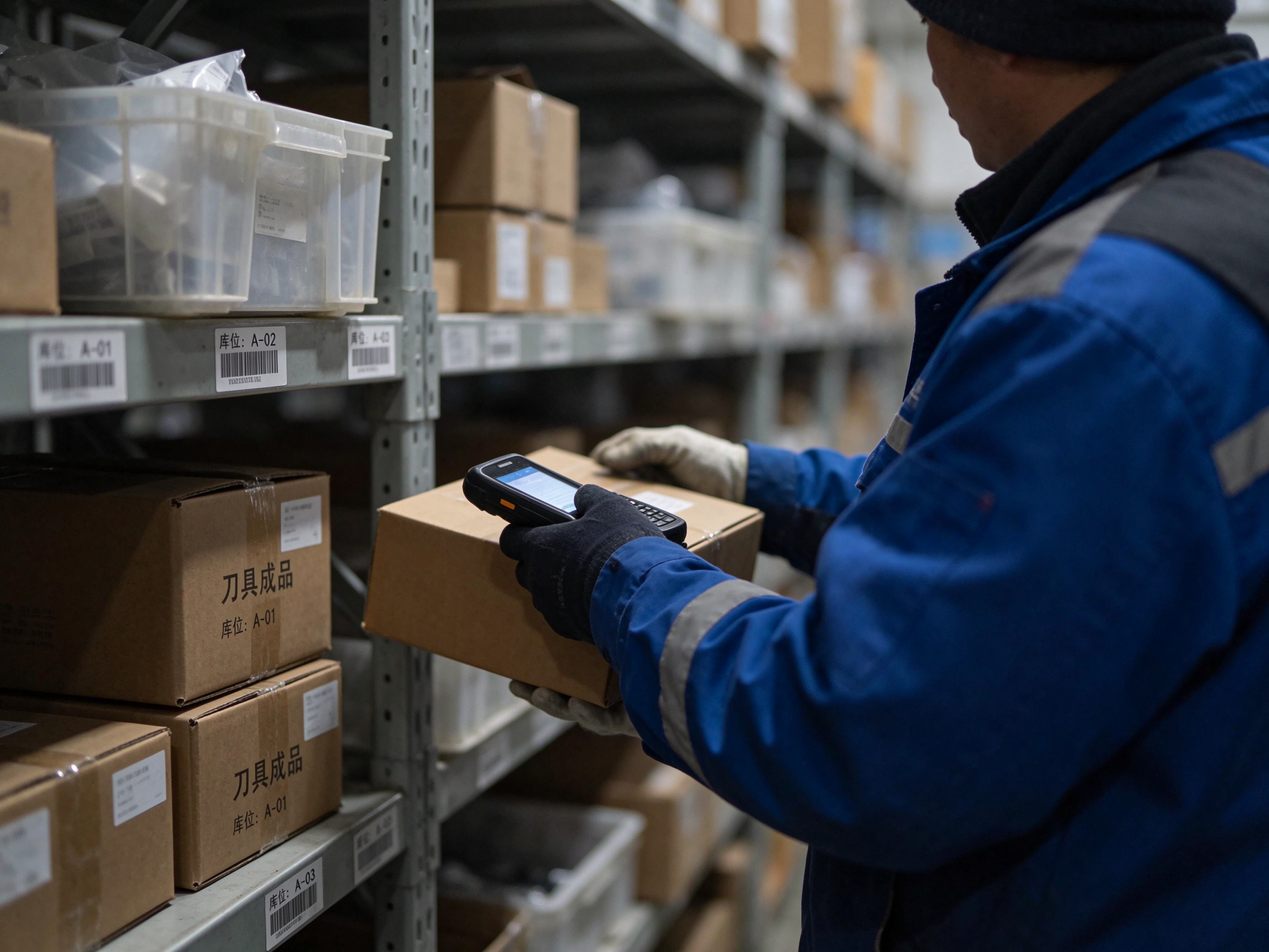
Four teams, one knife, four different failure modes to prevent. The table is the version we give a buyer who asks why one factory can hold a tolerance that another cannot.
Team |
Owns |
What the buyer feels if it slips |
Heat treatment |
Hardness consistency across every blade in a batch |
An edge that dulls in weeks, or chips on the first bone contact |
Grinding and sharpening |
Machine rough grinding plus hand finishing of the edge |
An uneven bevel, a burr, a knife that pulls instead of cuts |
Handle fabrication |
Wood, G10 and Micarta: cutting, shaping, fitting |
A handle that sits proud at the bolster or moves after washing |
Polishing and finishing |
Brushed, stone-washed and sandblasted surfaces |
A finish that blotches under retail light or wears off in a month |
The heat treatment team has one sentence in its job description: hold the hardness window for every batch, and prove it. A knife that leaves this team with a soft patch will pass every visual check and fail in the customer's hand, so the team works to a record rather than to a look.
In practice that means three habits that a generalist floor rarely keeps:
One recipe per steel family. The austenitising temperature, soak time, quench and temper are fixed per grade, and a change of grade is a change of card.Sample hardness on every batch. Not once per shift and not once per order — per batch, logged, with the tester's initials.Temper twice where the spec demands it. A single temper leaves retained stress in a thin blade; the second cycle is what stops a knife from warping after its first wash.
The window itself is set per knife family, not per plant. A chef knife and a bread knife can come off the same steel and leave heat treatment with different targets, because a serrated bread knife needs toughness to survive hard crusts while a chef knife trades a little toughness for edge retention. Setting one number for every knife is how factories get blades that are either brittle or soft.
The team also owns straightening, which nobody outside the plant associates with heat treatment. A blade that comes out of quench with a slight bow has to be corrected before grinding, or the grinder inherits a geometry problem that no amount of skill fixes.
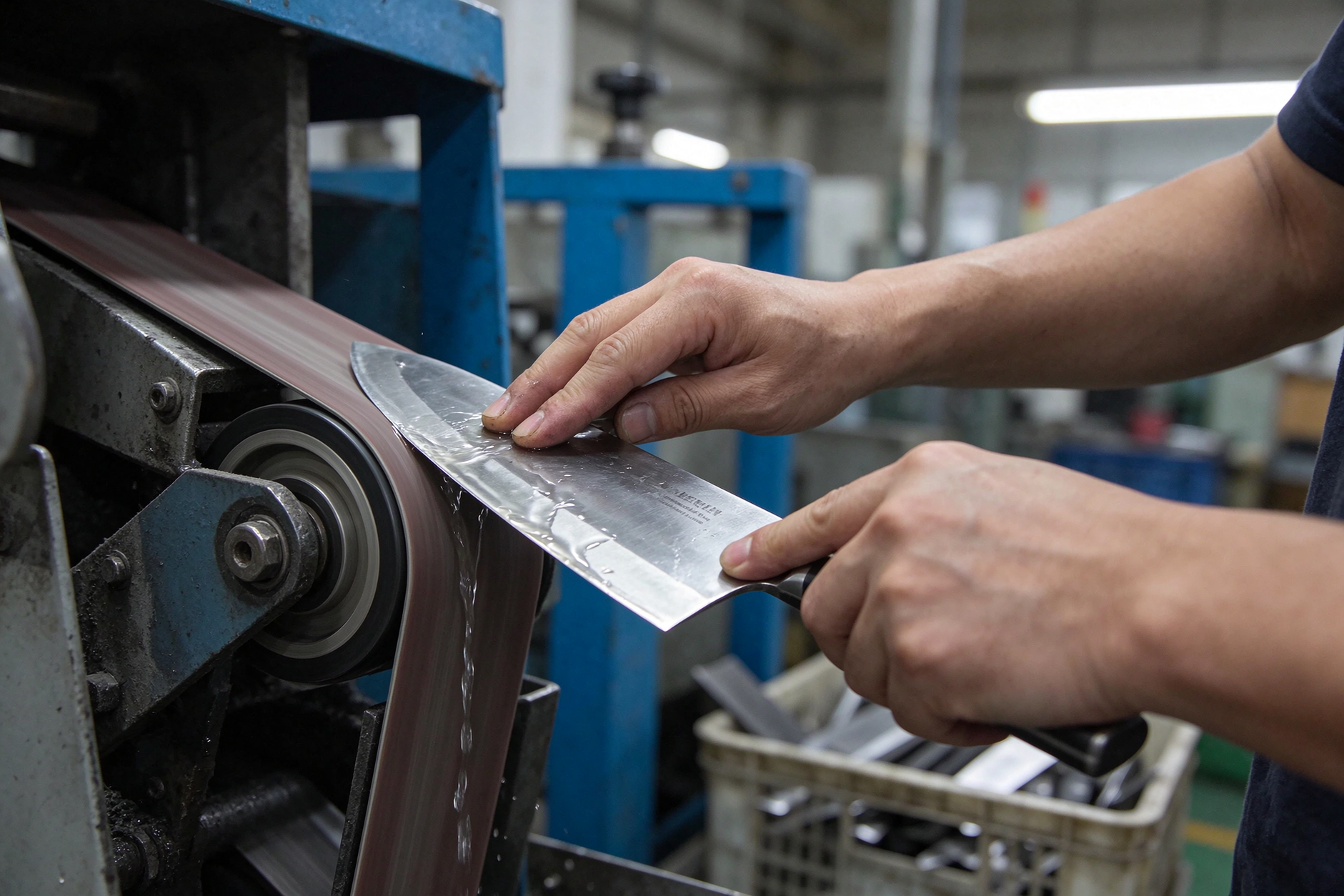
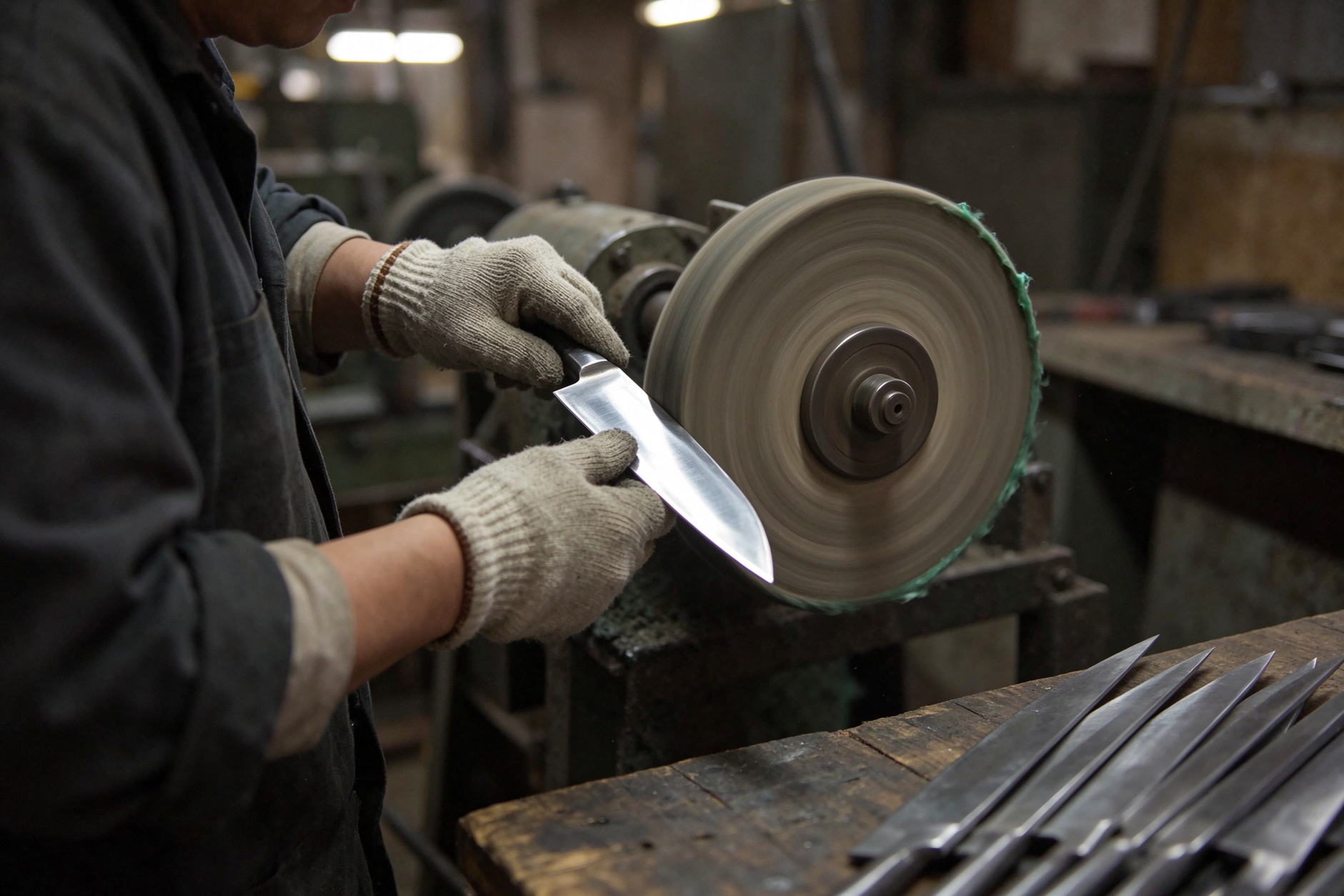
This team is deliberately built in two halves. The first half is machine rough grinding on cooled abrasive belts, where the bevel is established and the stock is removed; the second half is hand finishing by craftsmen who take the edge from "sharp" to "cuts cleanly through a tomato skin without bruising the flesh".
The division matters because the two halves fail differently. A machine step that runs hot will soften the hardened edge the previous team just certified; a hand step that presses too hard will round the bevel and undo the geometry. Splitting them puts a different person in charge of each risk, and gives the finishing craftsman a blade that is already correct rather than one that has to be rescued.
Edge angle follows the same logic at the finishing station: a paring knife is taken to a narrower included angle than a cleaver-style chopper, and a santoku keeps a flatter bevel than a chef knife because its cutting motion is a straight push rather than a rocking slice. One angle for every knife would be simpler to schedule and wrong for half the range.
For a buyer, the visible result is consistency at the tip. A knife ground only by machine tends to lose its angle near the point, where the belt has less contact; a hand finish restores that last thirty millimetres, which is exactly where a cook looks when judging a new blade.
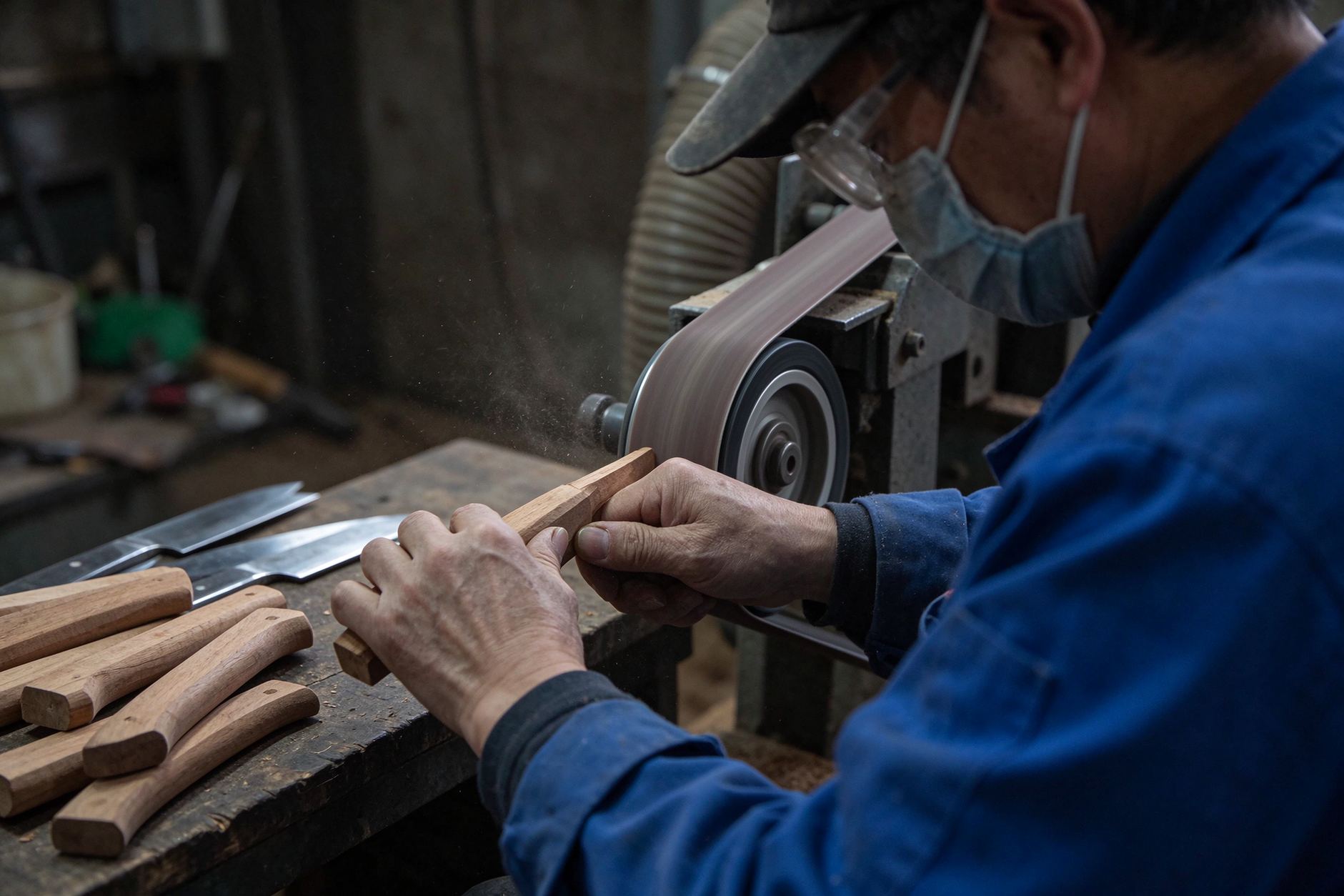
The handle team covers material that behaves nothing alike: wood moves with humidity, G10 and Micarta do not move but dull tools quickly, and a moulded shell arrives with its own gate marks. Cutting, shaping and fitting are three sub-stations inside one team, because the tolerance that matters is cumulative — a handle that is shaped well but fitted badly still leaves a gap.
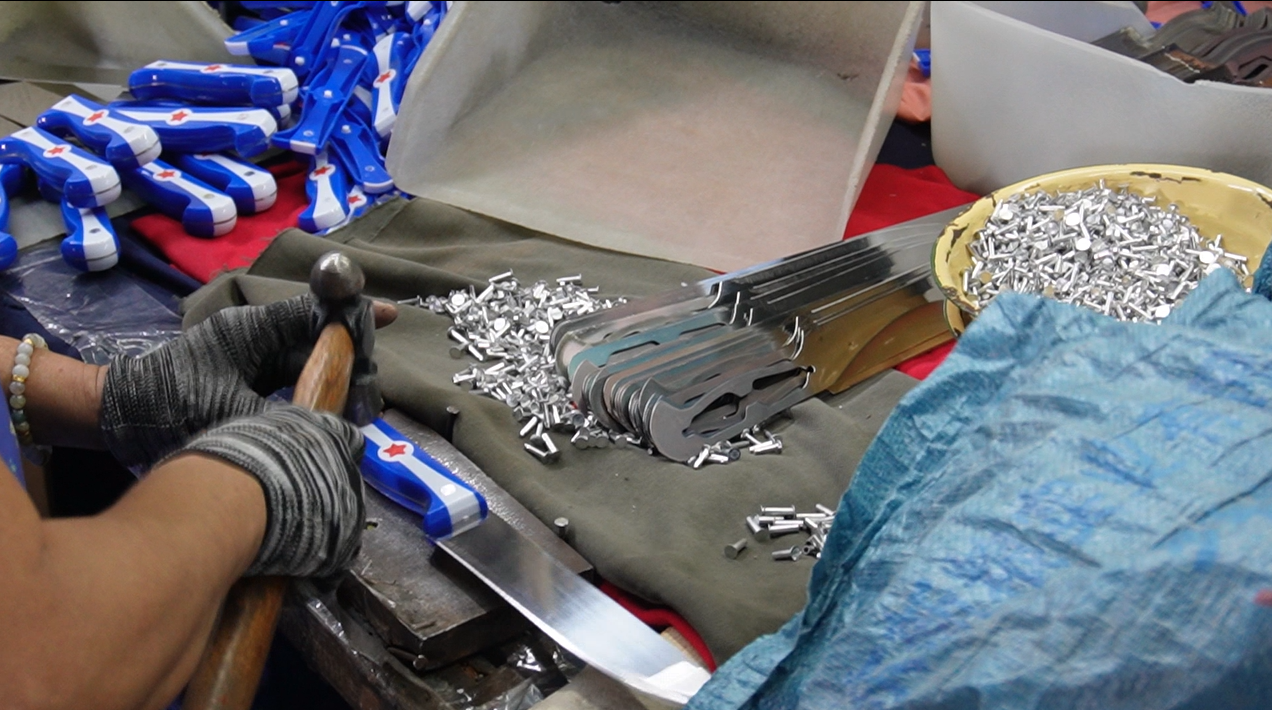
Component supply sits with this team rather than with purchasing, which is a deliberate choice. The person who fits the handle is the person who knows which frame batch runs tight and which runs loose, and that knowledge is worth more at the bench than in an email thread.
Fitting is where most handle complaints are born.A knife with a two-millimetre proud scale, or a rivet set too light, leaves the plant looking fine and arrives at the customer looking cheap. The team checks the joint by feel on every piece and by light on sampled ones.
The finishing team owns the surface the customer sees first. Three finishes are standard here: brushed, where a directional grain is laid across the blade; stone-washed, where the piece is tumbled for a softer, matte look; and sandblasted, where a fine blast gives a low-sheen texture that hides fingerprints.
This is also the team that catches the defects the previous three produced. A brushed line reveals a grind mark that ran across the blade; a matte finish reveals a hardness patch that took the abrasive differently. That is why the finishing station is staffed by long-serving operators rather than rotated labour — a new pair of eyes sees a scratch, an experienced one sees a cause.
Four teams only produce a consistent knife if the handover between them is as disciplined as the work inside them. Every transition carries three things: a batch card with the count, a physical separation so two batches never share a bench, and a label that survives to the carton.
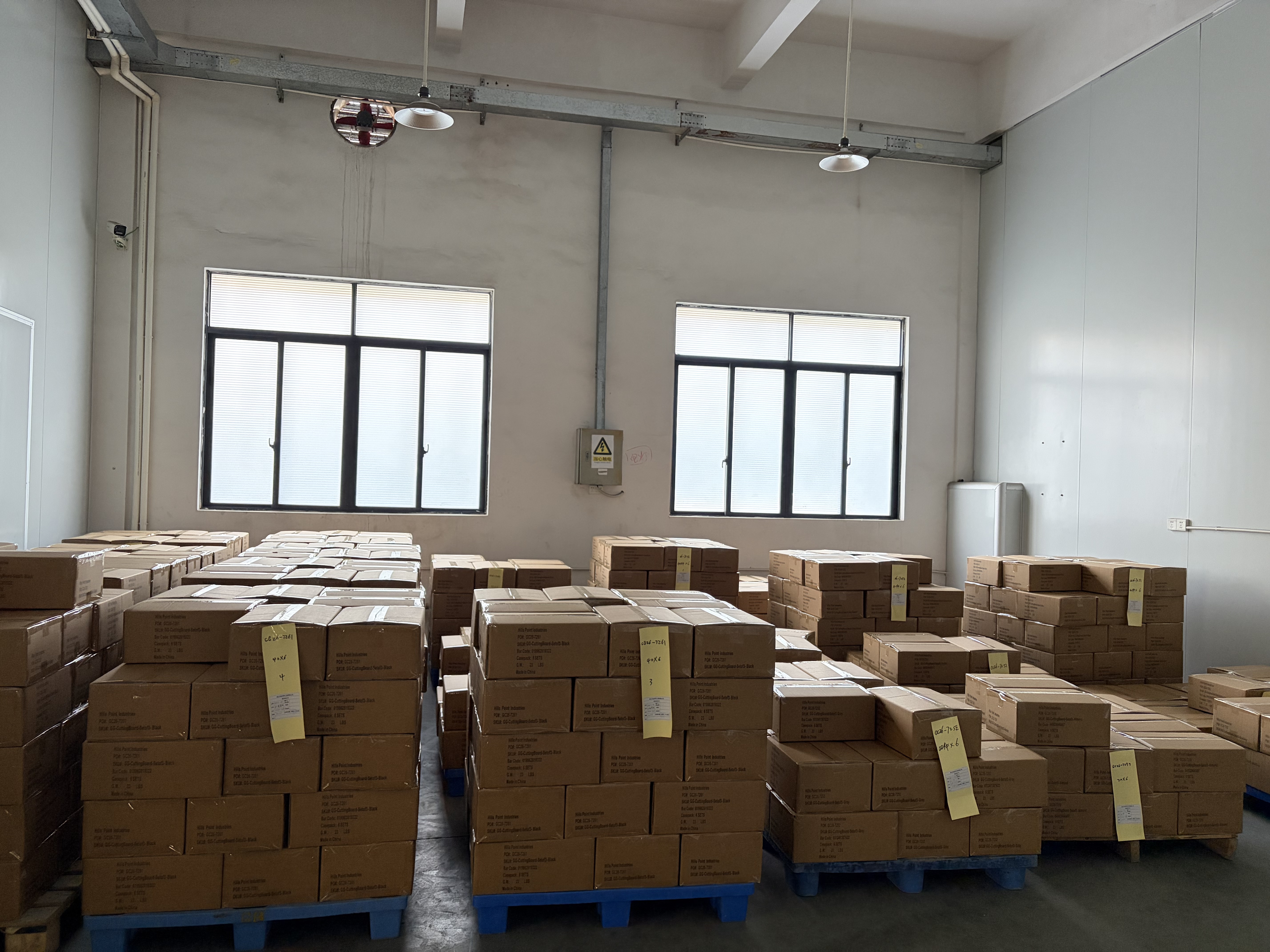
The label looks like the least technical step in the plant and is the one that ties a specific knife back to a steel lot, a heat-treatment batch, a grinding operator and a fitting bench. When a retail partner reports an issue two months later, that label is what turns a complaint into a station, a shift and a cause.
Insight has designed, produced and sold kitchen knives for more than 23 years from Yangjiang, in a 20,000 square metre plant with monthly capacity of roughly five million pieces. The four process teams sit inside the same building as supply, warehousing, assembly and inspection, which is what makes a process change a same-day decision: when a grinding issue is traced to a hardness drift, the heat-treatment team is fifty metres away, not in another province.
We build chef knives, santoku knives, bread knives, paring knives and kitchen tools for brands buying OEM and ODM — private label, finish programmes, block and gift sets. If you are comparing suppliers, the useful question is not how many people work there but who owns each step: ask which team signs the hardness record, who finishes the edge by hand, and who approves the surface under retail light.
Ask for the process map with the four team owners named on it, and a sample built on the line that will actually make your order.
Because the four critical steps fail in unrelated ways. A single team that does everything produces adequate work at every step; four teams that own one step each produce work that can be measured, corrected and repeated.
Both, in sequence: machine rough grinding establishes the bevel, then hand finishing restores the geometry at the tip. The two halves are staffed and measured separately.
Brushed, stone-washed and sandblasted are standard; polished and two-tone finishes are available on request. Every finish is approved under the lighting the retail channel uses.
Yes. The four teams work to the buyer's specification rather than to a fixed catalogue, so steel grade, hardness window, edge angle, handle material and finish are set per programme.


