
- Home
- Products
- About Us
- OEM/ODM
- VR
- Resources
- Contacts


Views: 340 Author: Site Editor Publish Time: 2026-08-27 Origin: Site


Content Menu
● What Is a Titanium Cutting Board?
● The Pros of a Titanium Cutting Board
>> 1. Superior Hygiene and Bacteria Resistance
>> 2. No Odors, Stains or Warping
>> 3. Remarkable Durability and Lifespan
>> 5. Safe, Uncoated Food Contact
>> 6. Effortless Cleaning and Fast Drying
>> 7. Recyclable and Environmentally Friendly
● The Cons of a Titanium Cutting Board
>> 1. The Price Is Genuinely High
>> 2. It Is Harder on Knife Edges
>> 3. A Metallic Sound and Slightly Cool Feel
>> 5. A Slippery Surface for Some Foods
>> 6. Limited Shock Absorption for Heavy Chopping
● Titanium Cutting Board vs. Wood, Bamboo and Plastic
● Who Should Buy a Titanium Cutting Board — and Who Should Not
● Why Yangjiang and 23 Years of Experience Matter
>> 1. Is a titanium cutting board safe for food?
>> 2. Does a titanium cutting board dull knives?
>> 3. Can you put a titanium cutting board in the dishwasher?
>> 4. Why is Titanium Grade I better than other titanium grades for a cutting board?
>> 5. Why are many titanium cutting boards made in Yangjiang, China?
>> 6. What is the main downside of a titanium cutting board?
At Yangjiang Insight Industry And Trade Co.,Ltd., a kitchenware manufacturer with more than 23 years of hands-on experience in designing, producing and exporting knives and kitchen tools, we think about kitchen surfaces every single day. Operating from a 20,000-square-meter facility with a monthly production capacity of around five million pieces, our factory has delivered OEM and ODM products for cutlery and kitchenware brands across the world. That long history has taught us an important lesson: no kitchen material is flawless, and every "must-have" surface deserves an honest, evidence-based review before you spend your money. Few materials have created as much excitement in recent years as titanium. It has already taken over cookware, water bottles, tableware and cutlery, and now titanium cutting boards are showing up in modern kitchens everywhere. If you are weighing the titanium cutting board pros and cons to decide whether one belongs on your countertop, you have found the right guide. Below, we explain what a titanium cutting board is, why Titanium Grade I matters, how this material compares with wood, bamboo and plastic, and exactly who should — and should not — buy one.
A titanium cutting board is a food-preparation surface made from thin, rigid sheets of titanium metal rather than the wood, bamboo, plastic, glass or composite materials used in conventional boards. Because titanium is both lightweight and exceptionally strong, manufacturers can build boards that are slim, sturdy and remarkably easy to move around the kitchen. Most high-quality boards are pressed or stamped from Titanium Grade I, also known as commercially pure (CP) titanium. Grade I is the most formable and corrosion-resistant of the pure titanium grades, containing roughly 99.5 percent titanium with only trace impurities. This purity is exactly what you want in a food-contact surface: there are no coatings, no polymer layers and no plating that can chip, flake or peel into your food. The metal itself is the surface, which is why Grade I titanium is widely used in medical implants and food processing equipment — a strong vote of confidence in its safety. It is worth noting where these boards come from. The city of Yangjiang, in Guangdong province, has been the undisputed capital of China's knife and kitchenware manufacturing for generations. A titanium cutting board made in Yangjiang — whether produced by Yangjiang Insight Industry And Trade Co.,Ltd. under your brand or purchased directly from our workshop — benefits from decades of accumulated metalworking expertise, precise tooling and strict quality control. That heritage matters more than most buyers realize.
The strongest argument in favor of a titanium cutting board is cleanliness. Titanium is completely non-porous, so it offers no microscopic crevices or wood fibers where meat juices, bacteria or mold can hide. Food-safety research has repeatedly shown that porous boards are harder to sanitize than smooth metal surfaces, and for anyone preparing raw chicken, fish or meat, this difference is not trivial. After a quick wash, a titanium board is genuinely clean — not just "clean enough."
Wooden boards absorb onion, garlic and fish odors that linger for days; plastic boards develop deep knife grooves that turn grey and can never be fully scrubbed clean. A titanium cutting board shrugs off all of these problems. It will not absorb the smell of last night's curry, it will not stain from beets or berries, and because it contains no water-absorbing fibers, it will never warp, crack or cup the way wood can.
Titanium is famous for its strength-to-weight ratio, and a well-made board can outlast most of the other tools in your kitchen. It resists corrosion, survives heat from freshly roasted pans and does not degrade with repeated washing. While the board will eventually show cosmetic scratches, its structure stays intact for years. For many users, one titanium board can replace a constant cycle of replacing warped plastic boards and splitting wooden ones.
Because titanium is about 45 percent lighter than steel and roughly 60 percent lighter than cast iron, a titanium board is easy to lift, flip and store. At the same time, the metal's stiffness keeps the board flat and stable on the counter. It is a genuinely pleasant balance — a board that feels solid while cutting but never feels like a burden to wash.
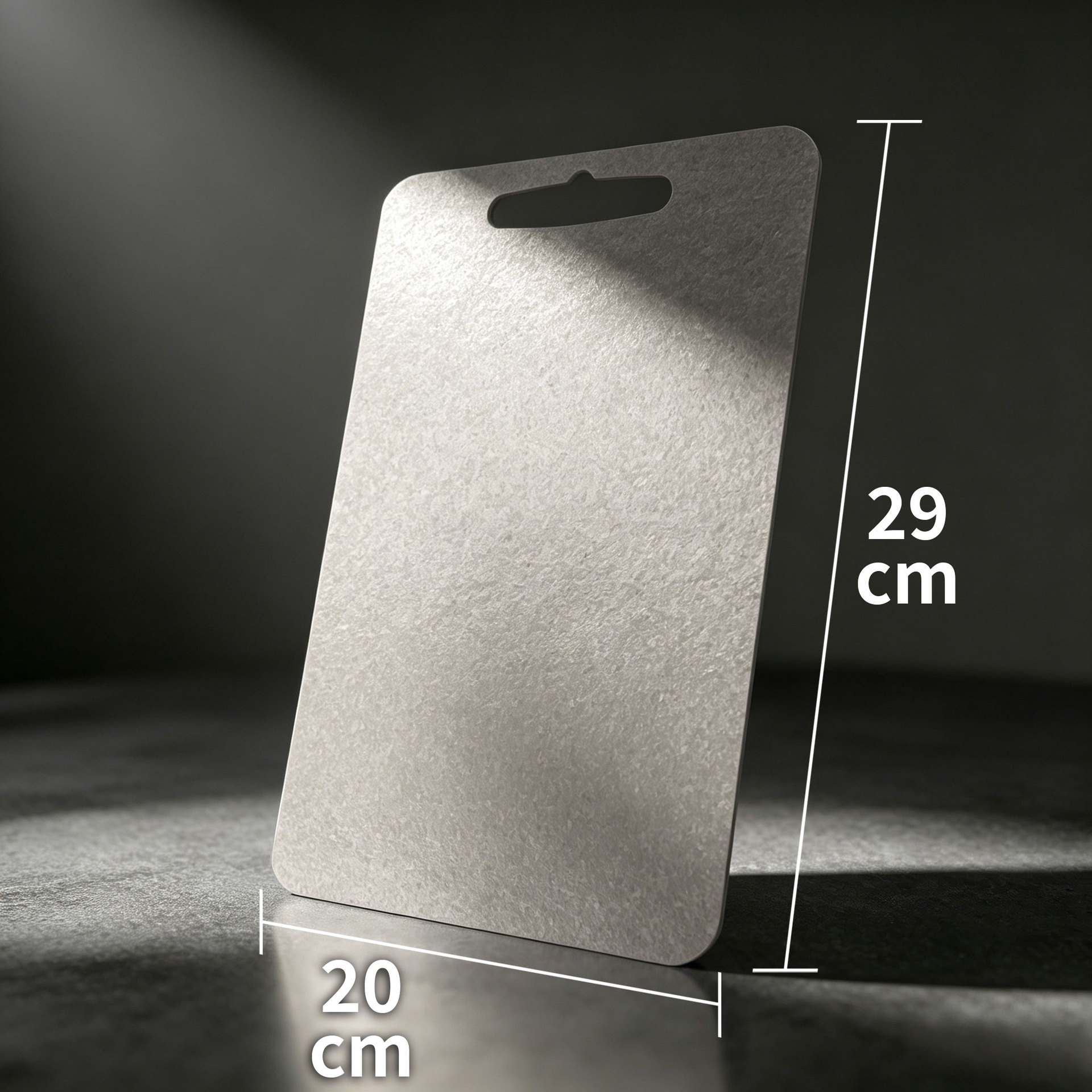
As mentioned above, the best boards use Titanium Grade I with no surface coating. This is a major advantage over some budget products that rely on painted or coated surfaces, which can wear away over time. With Grade I titanium, you never have to wonder whether a worn layer is ending up in your salad. Titanium's biocompatibility — the same property that makes it safe for surgical implants — gives you peace of mind that is hard to match.
A titanium cutting board can go in the dishwasher without warping, and it dries almost instantly because the metal does not hold water. Even a quick rinse under the tap leaves the surface ready for the next task. For busy cooks and small kitchens, this low-maintenance routine is a genuine convenience.
Unlike worn-out plastic boards that end up in landfills for centuries, titanium is a highly recyclable metal. A board that has finally served its full life can be recycled rather than thrown away, which matters to cooks who try to keep their kitchens sustainable.
Let us be direct: a quality titanium cutting board costs significantly more than a wooden or plastic board. You are paying for premium raw material, precision forming and rigorous quality control. For a casual cook who chops vegetables twice a week, the price can be hard to justify.
Titanium is much harder than wood, bamboo or plastic, so it will dull your knife edge faster than those softer surfaces. It is nowhere near as destructive as glass or stone — a titanium board will not ruin a blade the way a glass board can — but chefs who obsess over a razor-sharp edge and do heavy daily chopping may notice they need to sharpen sooner.
Cutting on a metal surface produces a different, higher-pitched sound than the soft thud of wood. Some cooks find this noisy and a little clinical. Titanium also conducts heat away from your hands, so the board can feel cool to the touch, especially in winter. These are cosmetic and sensory issues, but they matter to people who love the warm feel of a wooden block.
Despite being hard, titanium is not scratch-proof. Over time, knife marks will appear on the surface. These scratches are purely cosmetic and do not affect hygiene — unlike on plastic, where grooves trap bacteria — but buyers who want their premium board to stay pristine forever may be disappointed.
Smooth titanium offers less grip than textured wood or rubberized boards. Diced onions and sliced carrots can slide around, and some cooks find that ingredients skate across the surface during prep. You can manage this with a damp paper towel underneath or by choosing a board with an anti-slip silicone rim, but it is a real adjustment.
Metal surfaces are rigid, which means they absorb less impact than a thick wooden board. If you routinely crush garlic, chop through bones or use a heavy cleaver with force, a titanium board transmits more vibration to your wrists. It is fine for standard prep work, but it is not the ideal surface for heavy-duty butchering.
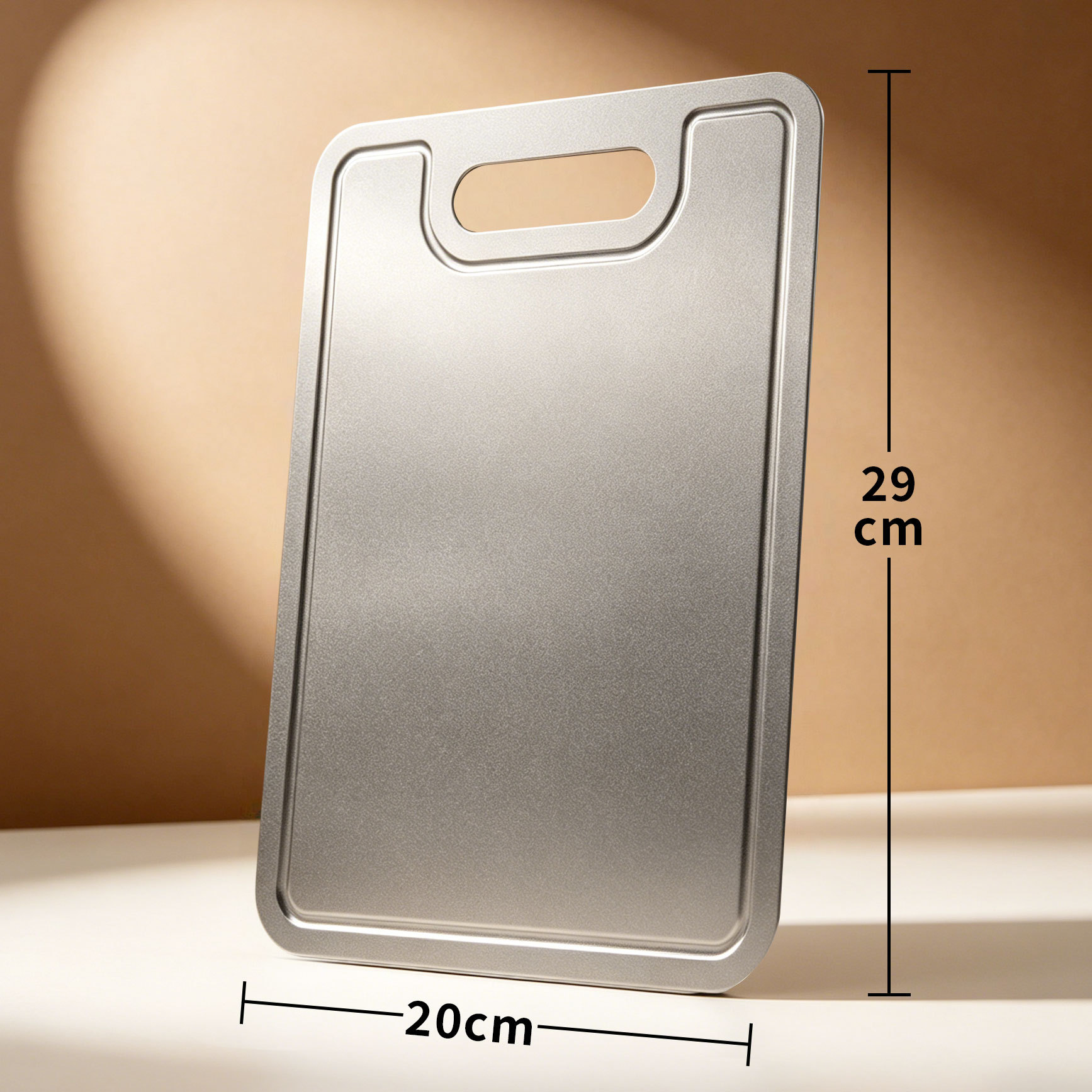
To put the titanium cutting board pros and cons in perspective, it helps to see the material side by side with the alternatives. Wooden boards are beloved for being gentle on knife edges and pleasant to cut on, but they are porous, absorb odors and juices, warp when not oiled, and demand regular maintenance. Bamboo boards are affordable and hard-wearing, yet they are brittle, can crack along the grain, and still harbor bacteria in knife grooves. Plastic boards are cheap and dishwasher-friendly, but they scratch easily, hide bacteria in deep cuts and can retain odors. Glass and stone boards are easy to clean but are notorious for destroying knife edges. A titanium cutting board sits in a different category entirely: it offers the hygiene of glass without the edge-destroying hardness, the durability of metal without the weight of steel, and the easy cleaning of plastic without the bacteria-trapping grooves. The trade-off is price and a slightly harder cutting feel than wood. In short, if hygiene and longevity are your top priorities, titanium is arguably the best-balanced choice on the market.
A titanium board is an excellent fit if you frequently prepare raw meat, poultry or fish and want a surface that can be truly sanitized. It is also ideal for campers and travelers who want a lightweight, unbreakable, odor-free board for outdoor cooking, for tiny kitchens where one multipurpose board must do everything, and for people who dislike the smell of old wooden boards or simply want a modern, low-maintenance surface. On the other hand, you may want to skip it if you are on a tight budget, if you do most of your prep with premium Japanese knives and insist on a very gentle surface, or if you love the warmth, sound and feel of a traditional wooden block. None of these are reasons the board is "bad" — they simply mean a different material suits your habits better.
Caring for a titanium cutting board is almost embarrassingly simple. Wash it with warm water and mild dish soap after each use, or place it in the dishwasher if you prefer. Dry it with a cloth to keep it looking its best — though it will air-dry quickly on its own. Avoid using it as a base for slicing with a serrated blade more than necessary, simply to keep the surface smooth. If light scratches bother you, a very fine metal polish can restore the finish, though this is purely cosmetic. Store it flat or on edge in a dry spot, and it will serve you for many years.
If you are buying a titanium cutting board — or sourcing them for your own brand — the manufacturer behind the product matters as much as the material. Yangjiang has earned its reputation as the capital of China's cutlery industry through generations of specialized craftsmanship. Companies like Yangjiang Insight Industry And Trade Co.,Ltd. have spent more than two decades perfecting the design, production and export of knives and kitchen tools, building a 20,000-square-meter factory that can turn out roughly five million pieces each month. That scale and experience translate into consistent quality, reliable lead times and the ability to support OEM and ODM projects for brands worldwide. When you choose a board from a Yangjiang manufacturer with this track record, you are buying decades of know-how, not just a sheet of metal.
So, is a titanium cutting board worth it? For the right cook, absolutely. The titanium cutting board pros and cons come down to a simple trade: you pay a premium price for the most hygienic, durable, low-maintenance and odor-free surface you can put on a countertop, and in exchange you accept a metal cutting feel and a slightly faster dulling of very sharp edges. If you prepare raw proteins, value cleanliness above all, and want a board that will not warp, stain or smell for years, a Titanium Grade I board — preferably one crafted by a trusted manufacturer in Yangjiang, such as Yangjiang Insight Industry And Trade Co.,Ltd. — is a purchase you will not regret.
Yes. The safest boards are made from Titanium Grade I, a commercially pure, uncoated metal that is non-toxic, non-reactive and biocompatible. It is the same grade of titanium used in food-processing equipment and medical implants, and because there is no coating, there is nothing that can flake or leach into food.
It dulls knives faster than wood, bamboo or plastic, but far slower than glass or stone. For normal home cooking the difference is modest; for cooks who use very fine blades for heavy daily chopping, it may mean sharpening slightly more often.
In most cases, yes. Titanium resists corrosion and will not warp in the dishwasher. Check the manufacturer's instructions, but most high-quality boards — especially those with a simple metal body — are dishwasher safe.
Grade I is commercially pure titanium with the highest corrosion resistance and formability among the pure grades. Because it needs no alloying or coating to be food-safe, it is the cleanest, most durable choice for a cutting surface.
Yangjiang is the historic capital of China's cutlery and kitchenware industry. Manufacturers there, including Yangjiang Insight Industry And Trade Co.,Ltd., combine more than 23 years of expertise, a 20,000-square-meter plant and roughly five million pieces of monthly capacity to produce high-quality OEM and ODM kitchen products for brands worldwide.
The two most common complaints are the higher price and the harder, cooler cutting feel compared with wood. Some cooks also note that the smooth surface can be slippery for certain foods, which is why many boards now include anti-slip rims.


