
- Home
- Products
- About Us
- OEM/ODM
- VR
- Resources
- Contacts


Views: 670 Author: INSIGHT-KNIFE Publish Time: 2026-07-03 Origin: Site


● Introduction to Modern Kitchen Knife Structural Design & OEM Customization
● In-Depth Analysis of All Blade-Side Kitchen Knife Components
>> Point – The Precision Tip for Fine Cutting Tasks
>> Spine – The Reinforced Upper Back of the Blade
>> Edge – The Full Functional Cutting Surface of the Blade
>>> Tip (Front Edge Section) – Fine Slicing & Precision Work Zone
>>> Blade End (Rear Edge Section) – Heavy-Duty Chopping Zone
>> Heel – The Rear Edge Base Adjacent to the Bolster
● Bolster, Tang & Handle Assembly – Ergonomic & Structural Core of Kitchen Knives
>> Bolster – The Transition Guard Between Blade and Handle
>> Tang – The Internal Steel Core Running Through the Full Handle
>> Handle – The Ergonomic Grip Surface for Secure User Control
>>> Rivet – Fastening Hardware Securing Handle Scales to the Tang
>>> Handle End – The Rear Terminal Cap Sealing the Tang
● How Component Customization Powers Differentiated OEM Kitchen Knife Product Lines
● Frequently Asked Questions About Kitchen Knife Structure & OEM Customization
As a leading Chinese kitchen knife OEM manufacturer based in Yangjiang, Yingshi Industry & Trade Co., Ltd., we have spent years supporting international brand owners, bulk distributors, and kitchenware factories with fully customizable cutlery production solutions. Every premium kitchen knife delivers consistent cutting performance, long-term durability, and comfortable handling based on a complete, interconnected structural system. Many overseas buyers only focus on blade material or surface finish when placing OEM orders, yet overlooking the function and customization potential of each individual knife component often leads to mismatched product positioning, subpar user experience, and increased post-production adjustment costs. This comprehensive guide dissects every core part of a professional kitchen knife, explains its functional value for home and commercial culinary use, and outlines how our OEM service tailors each structural element to meet unique market demands across Europe, North America, the Middle East, and Southeast Asia.
A standard chef’s knife, santoku knife, or utility knife consists of two core assemblies: the cutting blade assembly and the gripping handle assembly. Every labeled component shown in standard kitchen knife structure diagrams serves a non-negotiable purpose, balancing cutting efficiency, safety, weight distribution, and service lifespan. For OEM partners, mastering the customization options of each structural segment unlocks the ability to build differentiated product lines—whether targeting entry-level budget retail, mid-tier home culinary enthusiasts, or high-end professional chef equipment for restaurants. In the following sections, we break down blade-side components first, then shift focus to bolster, tang, handle hardware, and finishing elements, with dedicated explanations of OEM customization choices available through our Yangjiang-based production facility.
The Point, also known as the knife tip apex, is the forwardmost sharp corner of the blade, engineered for delicate, pinpoint culinary operations. For home cooks, this component handles tasks like scoring tomato skins, deveining shrimp, mincing small garlic cloves, and carving intricate garnishes from vegetables or fruit. Professional chefs rely on the point to create precise incisions for meat trimming, pastry scoring, and decorative plating work. Structurally, the point is formed by the seamless convergence of the spine’s front curve and the forward cutting edge. The shaping of the point directly alters a knife’s core use case: a sharply tapered, narrow point is standard for paring knives and petty knives, while santoku blades feature a rounded, blunter point to reduce accidental piercing during vegetable chopping, which aligns with the safety preferences of family-focused retail markets.
From an OEM manufacturing perspective, we fully customize point geometry to match regional market cooking habits. European buyers typically request sharp, elongated points for Western-style chef knives suited to meat butchery, whereas Japanese-style santoku OEM orders prioritize soft, rounded points for heavy vegetable preparation common in Asian household kitchens. Our production team controls point thickness and taper during the blade forging stage; thinner points enhance precision but require harder steel grades to prevent bending, while slightly reinforced point construction adds durability for heavy commercial kitchen use. We also integrate subtle grinding adjustments at the point to eliminate weak stress points, a critical upgrade we offer to OEM partners targeting professional hospitality supply chains, where knives undergo daily heavy use for years.
The Spine refers to the thick, unsharpened top edge running the full length of the blade, acting as the primary structural backbone of any kitchen knife. Its core functional roles include weight balance support, hand protection, and mechanical reinforcement against blade warping or snapping under heavy cutting pressure. Home users frequently rest their knuckles against the spine when applying downward chopping force on dense ingredients like squash, root vegetables, or frozen meat, making spine smoothness a key comfort factor. For commercial chefs, a moderately thick spine delivers controlled heft that reduces arm fatigue during long prep shifts, while ultra-thin spines are preferred for lightweight premium lines marketed to casual home cooks who prioritize effortless slicing.
OEM spine customization covers thickness, surface finish, and contour shaping. Budget OEM lines often feature flat, minimally polished spines to cut production costs, while mid and high-end orders request fully rounded, hand-buffed spines to eliminate sharp burrs that irritate the user’s knuckles. We also offer graduated spine tapering as a premium upgrade: the spine thickens near the bolster for maximum structural strength and gradually tapers thinner toward the point, creating natural weight bias toward the blade tip ideal for rapid chopping motions. Material pairing with the spine is equally important; when manufacturing full-tang premium knives, we forge the spine as a single continuous piece with the tang to eliminate weak joints that plague cheaper riveted partial-tang cutlery. Our facility also supports spine engraving for OEM branding, allowing partners to stamp custom logos, origin markings, or material specifications directly onto the spine without disrupting the blade’s structural integrity.
The Edge is the complete sharpened lower surface spanning from the Point all the way back to the Heel, the single most performance-critical component of any kitchen knife. Every slice, chop, dice, and julienne cut relies on consistent edge geometry, uniform grinding angles, and durable steel composition along this surface. The edge is split into two distinct functional zones: the Tip (front edge segment) and the Blade End (rear edge segment near the bolster), each designed for separate culinary workflows, which we detail in the following subsections.
The overall edge grind angle is a core OEM customization parameter we adjust for global markets. Western market OEM orders commonly use a 20–22 degree double bevel grind, delivering robust edge retention for cutting tough beef, bone-in poultry, and dense root vegetables. Asian market santoku and nakiri knife OEM requests lean toward slimmer 15–17 degree double bevel grinds, prioritizing ultra-smooth slicing of soft fish, tofu, and delicate greens. We also offer single-bevel asymmetric edge grinding for specialty Japanese yanagiba sashimi knives, a high-margin customization for premium brand partners focused on authentic Asian culinary tools. Surface finishing for the edge ranges from standard polished mirror finishes for retail display appeal to matte brushed finishes that hide minor scratch marks from daily kitchen abrasion, a popular choice for commercial kitchen OEM bulk orders.

The Tip segment of the Edge covers the forward one-third of the cutting surface, aligned directly beneath the knife’s Point. This narrow edge zone is dedicated to light, precise cutting motions that demand minimal resistance. Home cooks use this section to slice herbs, segment citrus fruit, trim fat from small meat cuts, and peel thin layers from ginger or garlic. Professional pastry chefs utilize the tip edge to cut delicate doughs, chocolate shavings, and decorative fruit garnishes without crushing soft ingredients.
For OEM production, we adjust the grind taper of the tip edge to match target consumer groups. Knives marketed to baking enthusiasts receive an ultra-thin tip edge grind to prevent tearing soft pastry, while all-purpose chef knives for family retail feature a slightly reinforced tip edge to withstand occasional contact with cutting board surfaces without rapid dulling. We also implement anti-stain edge polishing for stainless steel OEM lines, preventing discoloration from acidic ingredients like lemon, tomato, or vinegar—a key selling point we highlight for partners targeting European and American home goods retailers with consumer-focused marketing messaging.
The Blade End represents the rear two-thirds of the Edge, stretching from the mid-blade curve back to the Heel adjacent to the bolster. This thicker, sturdier edge segment handles all heavy-duty culinary tasks that require significant downward force: chopping carrots, potatoes, butternut squash, cutting thick meat steaks, and splitting hard-shell produce like melons or coconut. The structural reinforcement of the Blade End prevents edge rolling or chipping when cutting dense, rigid ingredients, a common failure point on low-quality mass-produced knives that skimp on blade thickness near the bolster.
Our OEM engineering team modifies Blade End thickness based on product tier positioning. Entry-level disposable or budget cutlery features thin Blade End construction to lower material costs, but these products carry higher warranty risk for distributors due to easy edge damage. Mid and high-end OEM lines we produce integrate gradual thickness reinforcement at the Blade End, paired with hardened high-carbon stainless steel alloys to extend edge lifespan by multiple years. For commercial restaurant bulk OEM orders, we add micro-convex grinding to the Blade End, which improves contact stability with wooden and plastic cutting boards and reduces the frequency of professional sharpening required by kitchen staff. Santoku knife OEM designs also include signature indentation grooves across the Blade End surface—known as granton dimples—an optional OEM add-on we implement to create air pockets between the blade and sliced food, eliminating sticking during continuous vegetable chopping, a feature highly requested by North American and Australian kitchenware brands.
The Heel is the thickened, rearmost point of the cutting Edge, positioned immediately in front of the bolster assembly, forming a seamless transition between blade and handle structure. Functionally, the Heel absorbs the maximum amount of impact force during heavy chopping motions, acting as a shock buffer to protect both the cutting edge and the bolster joint from stress fractures. Many professional chefs intentionally use the Heel section to crack small bones, split thick root vegetables, or cut through hard cheese rinds, making structural reinforcement at this position essential for long-term product durability.
OEM customization for the Heel focuses on contour shaping and thickness calibration. Knives designed for heavy butcher-style prep receive an extended, thickened Heel with extra steel mass, while lightweight utility and paring knives feature a shortened, streamlined Heel to reduce overall blade weight for extended light cutting tasks. We also smooth and round all Heel edges as a standard quality control step for every OEM order, eliminating sharp metal burrs that could scratch users’ hands during forceful chopping. For full-tang premium knife OEM lines, we forge the Heel, bolster, tang, and blade as one single solid steel blank, removing any glued or welded joints that create structural weak points common on low-cost imported cutlery from competing manufacturers. This single-piece forging process is a key differentiator we promote to high-end brand partners seeking marketable durability claims for their product catalogs.
The Bolster is the thick metal shoulder positioned between the blade’s Heel and the front of the handle, serving three critical core functions: user safety protection, balanced weight distribution, and structural joint reinforcement between blade and tang hardware. Safety remains the primary benefit of the bolster: it creates a physical metal barrier that stops the user’s fingers from sliding forward onto the sharp cutting edge during chopping or slicing motions, drastically reducing accidental kitchen lacerations—a mandatory safety feature for all cutlery sold in regulated consumer markets across the EU, USA, and Canada with strict product safety standards.
Beyond safety, the bolster acts as the central weight pivot point of the entire knife, directly defining the tool’s balance profile, a major selling factor highlighted in retail product marketing for OEM brand partners. Knives with a thick, heavy bolster deliver blade-forward balance, preferred by chefs who rely on gravity-assisted chopping for rapid prep volume, while slim, lightweight bolsters create handle-biased balance for delicate, controlled slicing tasks common in fine dining and home baking. Our OEM facility manufactures two primary bolster styles for global clients: full integral bolsters forged as part of the single steel blade blank, and welded separate bolsters for cost-sensitive entry-level product lines. Integral forged bolsters are our top recommendation for mid-to-premium OEM orders, as they eliminate the risk of weld corrosion or joint separation after repeated dishwasher use, a frequent consumer complaint reported by our distributor partners who source cheaper welded bolster cutlery from alternative suppliers.
We also customize bolster contour shaping to match regional ergonomic preferences. European OEM orders request wide, rounded bolsters with ample surface area for large adult hands, while Asian santoku and nakiri knife OEM lines feature slim, curved bolsters optimized for smaller hand sizes typical of East and Southeast Asian consumer markets. Surface finishing options for bolsters include mirror polishing for luxury gift-set OEM lines, brushed matte finishing for commercial restaurant bulk orders, and bead blasting for scratch-resistant outdoor barbecue knife OEM products sold to camping and grilling retailers.
The Tang is the unexposed extension of the blade’s steel base that inserts fully into the handle material, forming the hidden structural backbone connecting blade cutting power to user grip. Tang design is widely recognized by kitchenware industry professionals as the single largest determinant of a knife’s long-term durability, with three primary tang construction types available for OEM customization: full tang, partial tang, and hidden half tang. Every high-performance professional kitchen knife we manufacture for global brand partners utilizes full tang construction, where the steel tang extends all the way from the bolster through the complete length of the handle to the Handle End cap.
Full tang design delivers unmatched structural stability by distributing cutting impact force evenly across the entire handle assembly, preventing common failure modes like handle cracking, rivet loosening, or complete blade separation from the grip—defects that plague low-cost partial tang cutlery after limited use. For OEM marketing purposes, full tang construction is a powerful selling feature our partners highlight on product packaging, e-commerce listings, and in-store display signage to differentiate their premium lines from budget competing products. We engineer tang thickness to align with blade weight: heavier 8-inch chef knife blades require thicker tangs to maintain balanced weight distribution, while lightweight paring and utility knives use slimmer tang blanks to avoid creating an overly heavy, unwieldy handle.
Our OEM service supports custom tang shaping to pair with specialized handle materials. Wood, G10 micarta, and pakka wood handle OEM orders use flat tang profiles with pre-drilled rivet holes for secure fastening, while molded polymer injection handle lines feature contoured tangs with locking notches that bond permanently with melted plastic during production, eliminating reliance on rivets entirely. We also offer custom tang engraving for full-tang premium lines, stamping brand logos, material grade markings, or origin information directly onto the tang surface visible through transparent handle scales, a premium aesthetic upgrade popular with boutique kitchenware brand clients targeting luxury gift box sales for holiday retail seasons.
The Handle refers to the exterior gripping shell mounted onto the tang, engineered to deliver non-slip comfort, secure hand positioning, and personalized ergonomics for extended cutting sessions. Unlike blade components that prioritize cutting performance, handle design centers entirely on human factor engineering, accommodating different hand sizes, grip styles, and regional culinary holding techniques. The range of OEM customizable handle materials we supply to international partners covers natural hardwoods (walnut, olive wood, pakka wood), synthetic high-performance composites (G10, micarta, carbon fiber), and budget injection-molded polymers (PP, TPR rubber, ABS plastic), each with distinct pricing, aesthetic, durability, and market positioning profiles.
Ergonomic contour customization is a core OEM service we provide to match regional consumer grip habits. Western chef knife handles typically feature bulbous palm rests and curved finger grooves to suit the standard “pinch grip” used by European and American cooks, where the forefinger rests along the bolster and spine. Japanese-style santoku and nakiri knife handles we produce for Asian markets adopt slimmer, octagonal or rounded straight profiles suited to the traditional full-hand wrap grip common in Chinese, Japanese, and Korean home cooking. For commercial restaurant bulk OEM orders, we prioritize TPR rubber overmolded handles with textured anti-slip surfaces, as kitchen staff frequently work with wet hands from washing produce and meat, drastically reducing slip-related cutting accidents in busy hospitality environments.
Surface finishing for handles varies widely across our OEM product tiers. Luxury gift-set OEM lines receive hand-sanded, oil-treated natural wood handles with polished grain detailing, paired with branded metal rivet caps for visual premium appeal. Mid-tier mass retail OEM cutlery uses smooth, stain-resistant G10 composite handles that withstand repeated dishwasher cycles without fading, warping, or absorbing food odors—a critical advantage over porous natural wood handles that require hand washing maintenance. Budget entry-level OEM lines utilize matte injection-molded plastic handles with subtle textured patterns to balance low production costs with basic slip resistance for price-sensitive discount retail channels. We also offer fully custom handle shape molding for exclusive private label OEM partners, creating unique proprietary grip contours that competitors cannot replicate without custom mold investment, supporting brand differentiation in crowded global kitchenware markets.
Rivets are the cylindrical metal fasteners that lock the two outer handle scale panels firmly against the internal tang, forming a unified, rigid handle assembly. Rivet construction quality directly impacts long-term handle integrity; loose, poorly seated rivets create wobbling handle scales that trap food residue, moisture, and bacteria between the tang and grip, leading to mold growth, wood rot, or complete handle breakdown over time. As a professional OEM manufacturer with strict quality control protocols, we only use food-grade stainless steel, brass, or copper rivets for all cutlery production, avoiding cheap iron rivets that rust and stain handle materials after contact with water and acidic kitchen ingredients.
OEM rivet customization includes material selection, diameter sizing, decorative cap engraving, and placement layout across the handle length. Standard mid-range OEM knife lines feature two evenly spaced rivets for balanced fastening, while premium full-tang chef knife orders receive three rivets to distribute pressure evenly across the extended tang length, minimizing scale shifting during heavy chopping. Luxury private label partners often select brass or copper rivets with custom laser-engraved brand logos on the exposed round caps, creating subtle branding visible on every knife without disrupting the overall handle aesthetic. For polymer injection-molded handle OEM lines, we eliminate rivets entirely by integrating locking tang notches that fuse with molten plastic during manufacturing, a cost-saving customization for mass-produced budget cutlery lines targeting large supermarket retail chains. All rivets installed in our facility undergo a double compression and buffing finishing step to ensure rivet caps sit perfectly flush with the handle surface, eliminating raised edges that catch on kitchen towels or irritate users’ palms during extended cutting work.
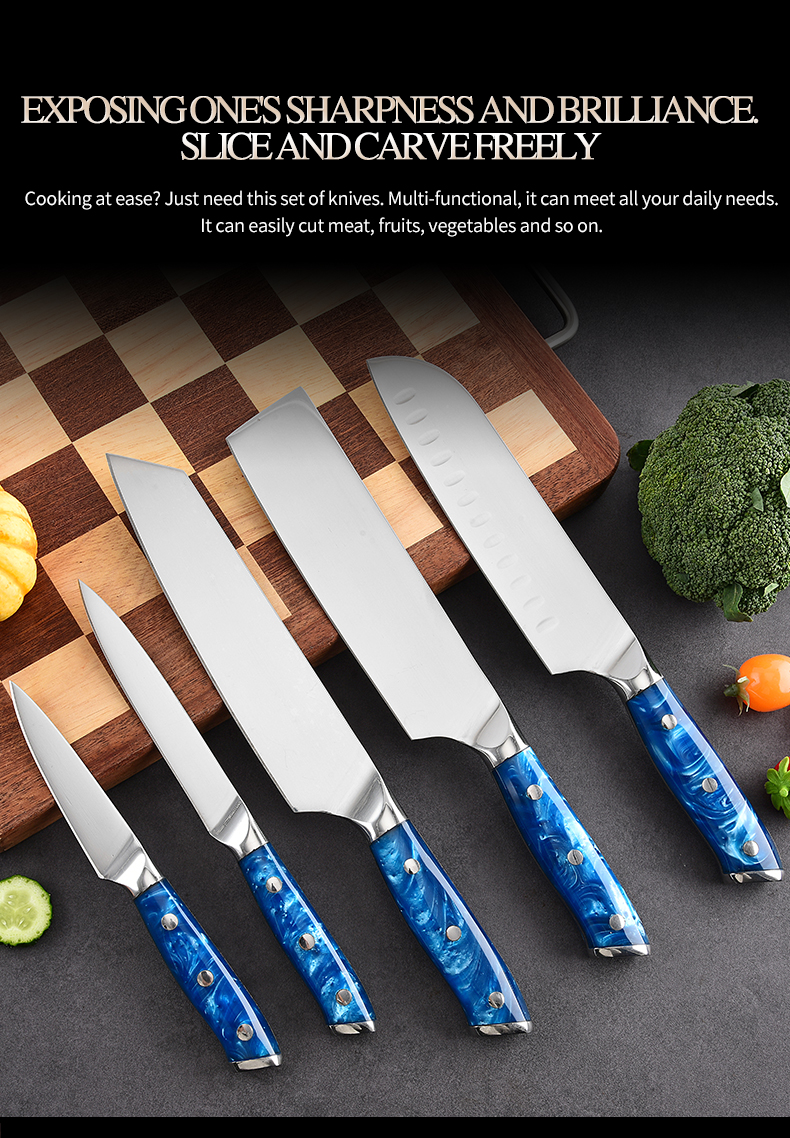
The Handle End is the rear cap covering the final exposed tip of the tang at the far back of the grip, serving dual structural and aesthetic purposes. Structurally, it seals the terminal end of the tang to prevent moisture, food debris, and cleaning liquid from seeping into the gap between tang and handle scales, which would otherwise cause internal rust, wood swelling, or composite delamination over time. A properly fitted Handle End cap also adds balanced rear weight to counteract blade-forward heft, fine-tuning the knife’s overall balance point to match OEM partner ergonomic specifications.
Aesthetic customization of the Handle End is a popular branding upgrade we offer to private label OEM clients. Standard production lines match the Handle End material to the main handle scales for a seamless monochromatic appearance, while premium gift-set orders integrate contrasting metal end caps (stainless steel, brass, or bronze) engraved with brand crests, product model numbers, or origin markings. For full-tang premium knife OEM lines, we extend the steel tang all the way through the Handle End and cap it with a polished metal pommel, eliminating gaps entirely and delivering a cohesive industrial premium look favored by culinary influencer brands selling direct-to-consumer cutlery online. Budget plastic handle OEM lines integrate a single molded Handle End piece as part of the unified injection grip, cutting secondary assembly labor costs to meet tight wholesale price targets for discount global retail markets. For wooden handle OEM products, we seal the Handle End with food-safe mineral oil and clear lacquer coatings to prevent natural wood splitting from humidity fluctuations in different regional climate zones worldwide.
Every structural component detailed in this guide represents an adjustable variable for our OEM clients to build fully unique product portfolios tailored to their target audience, regional market regulations, price tier positioning, and brand identity. Many overseas brand owners initially approach our Yangjiang facility requesting generic standard chef knife molds, only to discover targeted adjustments to individual structural parts unlock stronger retail sales margins, reduced consumer product complaints, and clear differentiation against generic competitor cutlery imported from low-standard manufacturers.
For brand partners targeting high-end professional chef supply channels, we recommend integrating premium structural customizations across all core components: integral forged full bolsters, single-piece full tang steel blanks, hand-buffed rounded spines, reinforced Blade End edge grinding, G10 composite handles with engraved brass rivets, and branded metal Handle End pommels. These structural upgrades translate to marketable product selling points: lifelong durability, dishwasher-safe corrosion resistance, handcrafted ergonomics, and professional-grade cutting performance that command higher wholesale and retail pricing compared to mass-produced generic knives. We provide full technical data sheets outlining each structural customization’s consumer benefit, which partners attach to their wholesale catalogs and e-commerce product listings to educate distributors and end buyers.
For bulk wholesale distributors supplying discount supermarket and dollar store retail chains, we design cost-optimized structural OEM adjustments that maintain basic safety standards while lowering production expenses. These customizations include separate welded bolsters, partial tang steel construction, polished flat spines without hand rounding, standard double-bevel edge grinding without premium micro-convex finishing, injection-molded plastic handles with simplified two-rivet layouts, and unified molded plastic Handle End caps. All cost-saving structural modifications we propose comply with international consumer product safety regulations across the EU, United States, Australia, and Canada, eliminating regulatory compliance risks for our distribution partners importing large container volumes of cutlery to global ports.
For boutique direct-to-consumer kitchenware brands focused on home cooking enthusiasts and gift-set seasonal sales, we offer balanced mid-tier structural OEM customization blending premium aesthetics with accessible wholesale pricing. This tier combines integral forged bolsters and full tang steel blanks for core durability, optional granton dimples on the Blade End anti-stick cutting surface, pakka wood or lightweight carbon fiber composite handles, custom laser-engraved logo rivets, and contrasting metal Handle End caps for subtle luxury branding. These moderately customized structural designs fill a profitable market gap between ultra-expensive professional chef cutlery and low-performance budget mass-market knives, a product segment that consistently delivers strong holiday gift box sales for our OEM brand partners across North America and Europe.
Our in-house engineering team collaborates closely with every OEM client during the pre-production sampling stage to test structural component adjustments against real-world culinary use cases. We produce physical prototype samples with modified point tapers, bolster thickness, tang weight, and handle ergonomics, allowing partners to test cutting performance, grip comfort, and balance before approving mass production container orders. This hands-on structural sampling process minimizes costly post-production rework and ensures every finished knife aligns perfectly with the partner’s target market and consumer expectations, a value-added OEM service unique to our Yangjiang Yingshi Industry & Trade production facility compared to generic cutlery manufacturers offering limited pre-production prototype support.
Answer: The full integral forged tang paired with an integral bolster assembly is the highest-priority structural upgrade for commercial kitchen OEM orders. Professional chefs perform thousands of repetitive chopping motions daily, and partial tang or welded bolster construction rapidly develops structural failure like loose handles or blade separation under constant heavy impact. Single-piece forged full tang and bolster construction evenly distributes cutting force across the entire knife, eliminating weak welded or glued joints, extending product service life for years of daily commercial use, and providing a powerful marketable durability selling feature for wholesale restaurant supply distributors.
Answer: Every single structural component covered in this guide supports full custom OEM modification at our Yangjiang production facility, with no mandatory standard mold restrictions for qualified bulk orders. Clients adjust point taper shape, spine thickness and finish, edge grind angles, bolster weight and contour, tang length and thickness, handle material and ergonomic grip shape, rivet material and decorative engraving, and Handle End pommel design to create fully exclusive proprietary cutlery models. We also develop completely custom steel blade blanks and injection handle molds for partners placing large-volume annual repeat orders, ensuring zero design overlap with competing brands sourcing OEM cutlery from our facility. Only minimum order quantity thresholds apply for fully custom mold development, while minor structural tweaks to existing factory molds are available for small-batch trial OEM orders with no additional mold tooling fees.
Answer: Thick, heavy bolsters shift the knife’s primary weight pivot forward toward the blade, creating blade-biased balance ideal for gravity-assisted chopping of dense vegetables and meat, a preferred design for Western-style all-purpose chef knives marketed to family home cooks. Slim, lightweight bolsters move the balance point backward toward the handle, delivering lighter, more controlled slicing motion perfect for delicate tasks like fish filleting, herb mincing, and pastry prep, commonly requested for Japanese santoku and petty knife OEM lines targeting Asian culinary enthusiasts. Excessively thin bolsters also reduce the critical safety barrier preventing finger slippage onto the cutting edge, so we enforce minimum bolster thickness safety standards for all OEM cutlery sold to regulated consumer retail markets regardless of balance customization requests.
Answer: Adding granton indentation dimples across the Tip and Blade End sections of the cutting Edge is the primary structural customization to eliminate food adhesion for vegetable santoku OEM orders. These evenly spaced concave grooves trap thin air pockets between the flat blade surface and sliced produce, breaking the vacuum seal that causes soft vegetables, cheese, and fruit to cling to standard solid blade surfaces. We also pair granton dimple customization with ultra-thin 15–17 degree double-bevel edge grinding to further lower slicing resistance, a combined structural upgrade consistently requested by North American, Australian, and European home goods brands specializing in plant-based cooking kitchenware product lines.
Answer: Full tang construction delivers three core commercial benefits for gift set OEM brand partners: superior long-term durability that reduces consumer product return rates, a visually appealing premium construction selling point for retail packaging and marketing materials, and consistent balanced weight distribution that elevates perceived product quality for gift buyers. Gift set consumers shop for high-quality, long-lasting kitchen tools as milestone presents (weddings, housewarmings, holidays), and full tang construction is an easily communicated premium feature that justifies higher gift box retail pricing compared to cheaper partial tang cutlery sets. Additionally, full tang design supports decorative branded pommels and engraved tang detailing on the Handle End, adding exclusive personalized branding aesthetics that differentiate gift sets from generic mass-market cutlery sold at discount retailers.


