
- Home
- Products
- About Us
- OEM/ODM
- VR
- Resources
- Contacts


Views: 276 Author: Insight Publish Time: 2026-05-08 Origin: Insight


Content Menu
>> Understanding the Harmonized System for Cutlery
>> Heading 8211: Knives with Cutting Blades
>> Heading 8212: Razors and Razor Blades
>> Classification of Related Kitchen Items
>> Best Practices for Importers and Exporters
>> Conclusion
>> Summary
Navigating the complexities of international trade requires precision, particularly when it comes to classifying goods for customs purposes. For businesses dealing in the import or export of knives and cutlery, understanding the Harmonized System (HS) code is critical. An incorrect classification can lead to shipment delays, unexpected duty payments, and potential legal complications. This guide focuses on the primary HS codes governing these items, specifically looking at headings 8211, 8212, and 8215, to provide clarity for traders dealing with everything from steak knives to specialized cheese tools.
The Harmonized System is a standardized numerical method of classifying traded products. It is used by customs authorities around the world to identify products when assessing duties and taxes and for gathering statistics. For cutlery, the classification process often hinges on the intended use, the material composition, and the specific design of the tool.

Heading 8211 is the primary destination for most knives used in kitchens, dining, and professional settings. It covers knives with cutting blades, serrated or not, including pruning knives.
* 8211.10 Sets of Assorted Articles: This sub-heading is essential for businesses that sell knife sets. If your product is a collection of knives, including steak knives or paring knives sold together in a retail package, this is often the correct classification.
* 8211.91 Table Knives having Fixed Blades: This is the category for most steak knives and dinner knives. When importing steak knives, manufacturers must ensure they are classified correctly to determine the applicable duty rate.
* 8211.92 Other Knives having Fixed Blades: This category captures a broader range of kitchen knives, including chef's knives, boning knives, and paring knives.
* 8211.93 Knives having Other than Fixed Blades: This includes folding knives and pocket knives, which are subject to different regulations compared to fixed-blade kitchen cutlery.
While the focus here is on kitchen cutlery, heading 8212 is important for context. It specifically covers razors and razor blades. Traders should be cautious not to confuse heavy-duty utility blades or specialized culinary scrapers that might resemble razor blades with the items under this heading. If your kitchen tool is designed for cutting food, it belongs in 8211; if it is a grooming tool, it belongs here.
Heading 8215 is often misunderstood. It is the home for "similar kitchen or tableware" that may not technically be a "knife with a cutting blade" under 8211.
* Cheese Knives: Many specialized cheese knives—especially those designed for spreading or soft cheese that do not have a sharp cutting edge—are frequently classified under 8215. This is a common point of confusion for importers.
* Butter Knives: Like cheese tools, these are often blunt and are explicitly mentioned under 8215.
* Cake Servers: These fall squarely into this category.
* Kitchen Utensils: If an item is a specialized tool used for serving or handling food rather than cutting it, 8215 is the correct heading.
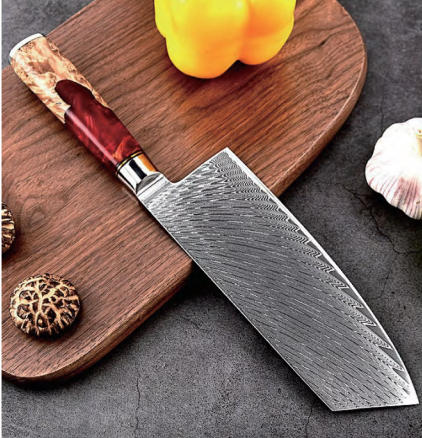
When shipping a "set" that includes both a knife and a board, importers must apply the General Rules of Interpretation (GRI). Often, these items are considered "goods put up in sets for retail sale." The classification is determined by the "essential character" of the set. If the knife is the primary item, the whole set may take the HS code of the knife. If the board is the primary item, or if the items are sold separately, they must be classified individually. Cutting boards themselves, depending on the material, are typically classified under 4419 for wood or 3924 for plastic.
To ensure compliance, traders should:
* Verify Material Composition: Customs authorities may require information on whether the blade is stainless steel, carbon steel, or ceramic.
* Consult Official Explanatory Notes: The World Customs Organization provides detailed notes that clarify what each heading contains.
* Seek Binding Rulings: If you are unsure about the classification of a high-volume product, you can request a binding tariff ruling from your national customs authority to gain certainty.
* Maintain Documentation: Keep detailed technical sheets and descriptions of the product, including its dimensions and intended usage, to provide to customs if questioned.
Mastering the HS codes for cutlery is an essential skill for anyone in the food service or homeware supply chain. By correctly identifying whether your product falls under 8211 for cutting tools or 8215 for serving implements, you can streamline your logistics, manage costs effectively, and ensure your business remains compliant with international trade laws.
1. What is the difference between 8211 and 8215 for a cheese knife?
If the cheese knife has a distinct, sharp cutting blade designed for slicing, it is generally classified under 8211. If it is a spreader or a blunt tool intended for serving, it belongs under 8215.
2. Where do steak knives fall in the HS code system?
Steak knives are typically classified under 8211.91, which covers table knives with fixed blades.
3. Are cutting boards included under knife HS codes?
No, cutting boards are generally classified by material, such as 4419 for wooden boards or 3924 for plastic boards. They are not part of the 8211 or 8215 categories.
4. How do I classify a kitchen knife set containing different types of blades?
Sets are usually classified under 8211.10 as sets of assorted articles. You should verify if the set's composition changes the classification in your specific destination country.
5. Why is classification accuracy so important?
Accuracy determines the duty and tariff rates applied to your goods. Incorrect codes can lead to legal penalties, increased scrutiny by customs, and costly delays at the border.


