
- Home
- Products
- About Us
- OEM/ODM
- VR
- Resources
- Contacts


Views: 8888 Author: Site Editor Publish Time: 2026-07-30 Origin: Site


Content Menu
● 1. Why Do Kitchen Knives Get Rusty? Professional Analysis From a Top Knife Manufacturer
● 2. Classification of Kitchen Knife Rust: Judge the Degree of Corrosion Correctly
>> 2.3 Severe Deep Corrosion Rust
● 3. Practical Remedial Methods for Rusted Kitchen Knives (Suitable for All Knife Types)
>> 3.1 Baking Soda Paste Method (Best for Light Surface Rust)
>> 3.2 Lemon and Coarse Salt Method (Ideal for Moderate Local Rust)
>> 3.3 White Vinegar Soaking Method (For Stubborn Moderate Rust)
>> 3.4 Citric Acid Solution Method (Professional Deep Rust Cleaning)
>> 3.5 Polishing and Oil Maintenance Method (Repair After Rust Removal)
● 4. Key Rust Prevention Tips From Professional Knife Factory Experts
● 5. FAQ: Common Questions About Kitchen Knife Rust Removal and Maintenance
>> Q1: Can a heavily rusted kitchen knife be completely restored to new condition?
>> Q2: Do all stainless steel kitchen knives not rust at all?
>> Q3: Is it safe to use rust-removed kitchen knives for food cutting?
>> Q4: Why does my kitchen knife rust again soon after rust removal?
>> Q5: Are there different rust removal methods for different types of kitchen knives?
Yangjiang Insight Industry And Trade Co.,Ltd. is a professional and experienced knife factory with over 23 years of dedicated experience in the design, production, and global sales of premium kitchen utensils. As a reliable kitchen knife supplier and seasoned knife manufacturer, we specialize in crafting diverse knife products including Chef Knife, Santoku Knife, Bread Knife, Paring Knife, and a full range of supporting kitchen tools. Boasting a 20,000-square-meter standardized production workshop and a monthly production capacity of up to 5 million pieces, we provide high-quality OEM and ODM services for well-known kitchenware brands worldwide. With decades of manufacturing expertise, we deeply understand the material characteristics, daily usage pain points, and maintenance needs of various stainless steel kitchen knives. Rust formation is one of the most common and troublesome issues for household and commercial kitchen knives, which not only affects the appearance of blades but also impairs cutting performance and even threatens food safety. In this comprehensive guide, our professional knife factory team will share practical, safe, and effective remedial methods for rusted kitchen knives, as well as scientific daily maintenance skills to help users restore and extend the service life of their beloved kitchen knives.
Before learning rust removal remedies, it is essential to figure out the root causes of kitchen knife rusting, which helps avoid repeated rust problems fundamentally. As a professional knife manufacturer focusing on kitchen knife production for more than two decades, Yangjiang Insight Industry And Trade Co.,Ltd. summarizes the core reasons for blade rusting based on material research and user feedback from global clients.
First, improper daily cleaning and drying are the primary causes. Most users tend to rinse kitchen knife blades with water after use and casually place them in knife racks or drawers without thorough drying. Residual water droplets, food residues containing salt, acid, and oil will adhere to the blade surface for a long time. These substances will corrode the stainless steel protective layer, leading to oxidation and rust spots, especially in humid kitchen environments.
Second, knife material and production process differences affect rust resistance. Not all kitchen knives have the same anti-rust performance. Low-end carbon steel knives are more prone to rust, while high-quality stainless steel knives produced by regular knife factory adopt advanced quenching and surface polishing processes, with better oxidation resistance. However, even high-grade stainless steel kitchen knives will rust if exposed to corrosive substances for a long time.
Third, incorrect storage and usage habits accelerate rust formation. Placing kitchen knives next to stoves, sinks, or humid cabinets for a long time, or using knives to cut highly acidic and salty foods without timely cleaning, will gradually damage the blade’s anti-rust coating and cause local rust and corrosion.

Different degrees of knife rust require different remedial methods. Blindly using strong cleaning tools will scratch the blade surface and damage the knife’s sharpness. Our knife factory professional technicians divide kitchen knife rust into three categories to help users adopt targeted solutions.
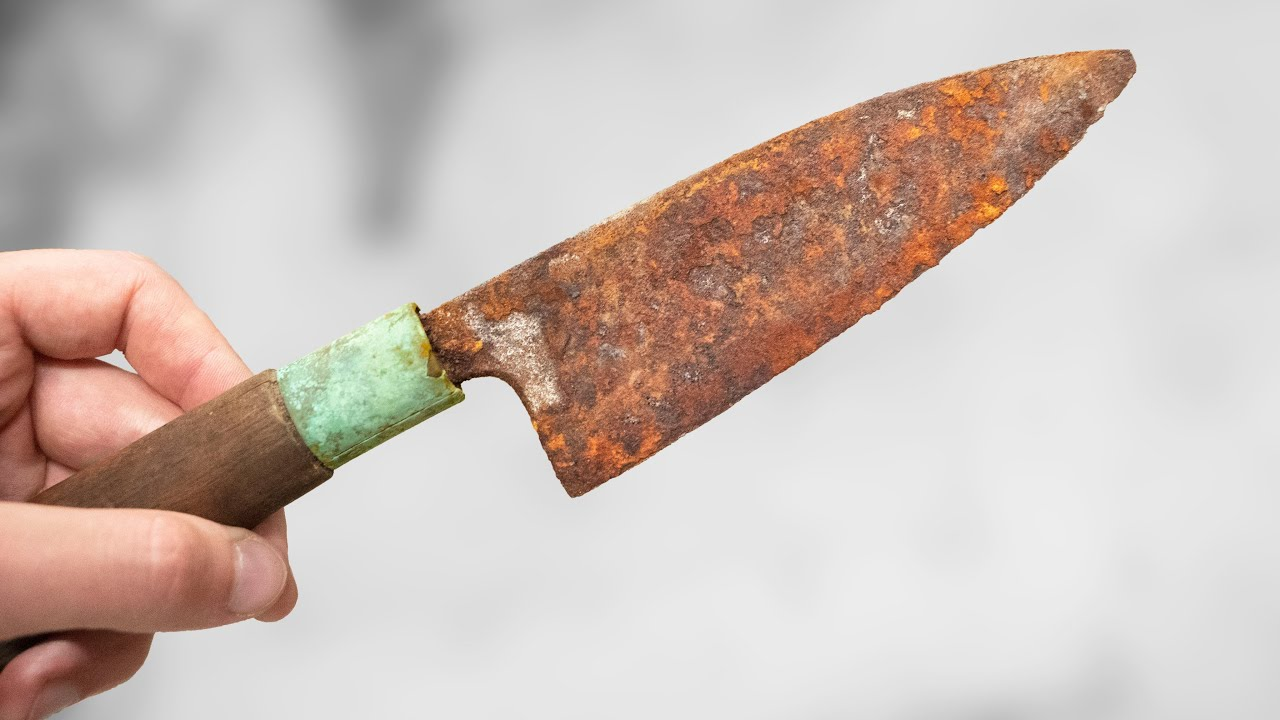
Light surface rust is the most common situation, manifested as tiny shallow rust spots, faint yellow or brown oxidation traces on the blade surface, without pits or blade damage. This kind of rust is only attached to the surface protective layer of the kitchen knife, which is easy to remove and will not affect the knife’s internal structure and cutting performance. It is usually caused by occasional residual water stains and short-term humid storage.
Moderate rust refers to obvious rust patches on the blade, partial fading of the polishing layer, and slight rough blade surface, but no deep corrosion pits. This situation is mostly caused by long-term incomplete cleaning and untimely drying. Professional knife manufacturer maintenance data shows that moderate rust accounts for more than 60% of user knife failure problems, which can be completely repaired with professional cleaning methods.
Severe rust is characterized by large-area rust coverage, deep corrosion pits on the blade, blurred blade lines, and even local metal peeling. This kind of rust is irreversible damage caused by long-term neglect of maintenance and long-term exposure to corrosive environments. For severely rusted kitchen knives, simple rust removal can only improve the appearance, and the original sharpness and service life of the knife will be greatly reduced.
Based on years of kitchen knife production and after-sales maintenance experience, Yangjiang Insight Industry And Trade Co.,Ltd., a professional knife factory, sorts out 5 safe, efficient, and easy-to-operate rust removal methods, suitable for Chef Knife, Santoku Knife, Bread Knife, Paring Knife and all other household and commercial kitchen knife products. These methods do not damage the blade steel and polishing layer, and are suitable for different rust degrees.
Baking soda is a mild abrasive and neutral cleaning material, which can safely remove surface rust without scratching the stainless steel blade, making it the most recommended household rust removal method by our knife manufacturer team. This method is suitable for all fine kitchen knives, especially high-polished Chef Knife and Santoku Knife that are easy to leave scratches.
Operation steps: First, mix baking soda and clean water in a ratio of 2:1 to make a thick non-flowing paste. Evenly apply the baking soda paste to all rusty areas of the kitchen knife blade, ensure all rust spots are completely covered, and let it stand for 15 to 20 minutes to fully decompose surface oxide layers. Then use a soft sponge, cotton cloth or soft-bristled toothbrush to scrub the blade gently in circular motions. After the rust spots fade completely, rinse the blade with warm clean water, and dry it thoroughly with a dry cotton cloth immediately. For stubborn slight rust spots, you can repeat the operation once to ensure a rust-free blade surface.
Lemon contains rich natural citric acid, which can chemically decompose rust oxides, while coarse salt acts as a natural mild abrasive. This combination is efficient and environmentally friendly, with no chemical residue, perfectly suitable for rust removal of food-contact kitchen knife products. Our knife factory maintenance team highly recommends this method for daily moderate rust treatment.
Operation steps: Cut a fresh lemon in half, squeeze an appropriate amount of lemon juice evenly on the rusted blade area, then sprinkle a layer of coarse salt on the rust spots covered with lemon juice. Let the mixture soak for 2 to 3 hours to fully react with the rust layer. Then use the lemon peel with residual pulp to scrub the blade back and forth; the coarse salt can enhance the friction effect and quickly remove stubborn rust patches. After scrubbing, clean the blade with warm soapy water to remove residual juice and salt stains, then dry the blade completely and place it in a dry storage position.
White vinegar contains acetic acid, which has strong oxidation decomposition ability and can penetrate and dissolve thick rust layers that are difficult to remove by baking soda. This method is suitable for moderately rusted kitchen knife blades with large rust areas, and is widely recognized in professional kitchen utensil maintenance by global knife manufacturer industries.
Operation steps: Prepare a clean container and pour an appropriate amount of edible white vinegar. Immerse the rusty blade completely in the vinegar, and note that wooden or plastic knife handles should avoid long-term soaking to prevent handle swelling, cracking or discoloration. Soak the blade for 30 minutes to 2 hours according to the rust severity. After soaking, take out the knife and scrub the rusted areas gently with fine steel wool or a scouring pad. After all rust is removed, rinse the blade repeatedly with clean water to completely remove residual vinegar liquid, otherwise the residual acid will cause secondary corrosion. Finally, dry the blade thoroughly with a dry cloth.
As a professional knife factory engaged in precision kitchen knife production, we use food-grade citric acid for finished knife cleaning and rust prevention in the production process. Food-grade citric acid has stable chemical properties, strong rust removal effect, no damage to blade steel, and no harmful residue, very suitable for deep cleaning of heavily rusted blades without pits.
Operation steps: Dissolve 2 to 3 tablespoons of food-grade citric acid powder in warm water to prepare a uniform citric acid solution. Put the rusted kitchen knife blade into the solution for soaking, keep the handle away from the liquid. Soak for 2 to 4 hours according to the rust degree, during which you can take out the knife regularly to check the rust dissolution state. After most of the rust dissolves, scrub the blade with a soft sponge to remove residual rust traces, then rinse and dry thoroughly.
After removing rust for all kitchen knife products, simple polishing and oil maintenance is essential to restore the blade’s smoothness and rebuild the anti-rust protective layer, which is a key maintenance step summarized by our professional knife manufacturer team. After rust removal, the blade surface will have slight friction traces; timely maintenance can effectively prevent secondary rust.
Operation steps: Use fine sandpaper (320-800 mesh) to polish the blade surface gently along the blade texture to smooth rough traces after rust removal. Then apply a thin layer of food-grade maintenance oil on the entire blade surface, let the oil evenly cover the blade, and let it stand for 10 minutes. Finally, wipe off excess oil with a clean dry cloth. This step can effectively isolate air and moisture, greatly improving the blade’s anti-rust ability.
Rust removal is a remedial measure, while scientific daily maintenance is the fundamental way to keep kitchen knife blades rust-free and durable. As a leading knife manufacturer with complete production and testing systems, Yangjiang Insight Industry And Trade Co.,Ltd. summarizes long-term effective anti-rust maintenance rules suitable for all types of kitchen knives, helping users avoid rust troubles permanently.
First, clean and dry immediately after use. No matter what food the kitchen knife cuts, especially acidic fruits, salty dishes, and oily foods, users must rinse the blade with clean water in time after use, remove all food residues, and dry it thoroughly with a dry cloth. Never leave the knife in a sink or humid environment overnight.
Second, avoid dishwasher cleaning. High temperature, strong detergent and long-term humid environment of dishwashers will damage the blade’s anti-rust coating and accelerate oxidation and rust. All high-quality kitchen knives produced by regular knife factory are suitable for hand washing only, which is the basic guarantee for long-term use.
Third, implement classified dry storage. Equip with a breathable dry knife rack, place the cleaned and dried kitchen knife in a ventilated and dry position, keep away from stove heat sources and sink humid areas. Do not stack knives randomly in closed drawers for a long time, which will cause moisture accumulation and rust.
Fourth, regular oil maintenance. For kitchen knives that are not used for a long time, apply a thin layer of food-grade anti-rust oil on the blade every half month to form a stable protective film. For daily-used Chef Knife, Santoku Knife and other cutting tools, regular oil maintenance can also keep the blade smooth and sharp.
[Image 8: Standard dry storage and daily maintenance display of kitchen knives]
Based on global user consultation data of our knife factory, we sort out 5 most frequently asked questions about kitchen knife rust treatment and maintenance, with professional and detailed answers for reference.
A1: It depends on the rust corrosion degree. If there are only large-area rust spots without deep pits or metal peeling, professional rust removal, polishing and oil maintenance by a professional knife manufacturer can basically restore the blade’s appearance and cutting performance. If the blade has obvious corrosion pits and deformation, the internal metal structure has been damaged, and it cannot be completely restored to new condition, and replacement is recommended for safety.
A2: No stainless steel knife is 100% rust-proof. As a professional knife factory, we clarify that stainless steel only has excellent anti-oxidation and anti-rust ability, but long-term contact with acid, salt, water and corrosive substances, plus poor storage environment, will still cause rust. High-quality stainless steel kitchen knife has higher chromium content and more stable surface treatment process, with far better anti-rust performance than ordinary carbon steel knives.
A3: It is completely safe if the rust removal is thorough and standardized. The above methods recommended by our knife manufacturer all adopt food-grade safe materials, no chemical residue. After rust removal, rinse the blade repeatedly with clean water and dry it, which will not affect food safety. It is forbidden to use industrial strong corrosive cleaners to remove rust, which will leave harmful residues.
A4: The main reasons are incomplete cleaning after rust removal and unscientific daily maintenance. If residual acid substances or water stains remain on the blade after rust removal, secondary oxidation will occur quickly. In addition, long-term humid storage, frequent contact with corrosive foods without timely cleaning, and lack of regular oil maintenance will lead to repeated rust. Following the anti-rust rules of our professionalknife factory can completely solve this problem.
A5: The core rust removal principles are consistent, but there are subtle operational differences. For sharp thin-bladed Paring Knife and Santoku Knife, avoid excessive friction and hard polishing to prevent blade deformation; for Bread Knife with serrated edges, focus on cleaning the tooth gap rust; for wooden-handled Chef Knife, strictly avoid long-term soaking to prevent handle damage. Our professional knife manufacturer can provide targeted maintenance guidance for all customized kitchen knife products


