
- Home
- Products
- About Us
- OEM/ODM
- VR
- Resources
- Contacts


Views: 292 Author: Insight knife Publish Time: 2026-06-01 Origin: Insight knife(Isabella)


In the evolving landscape of industrial automation, precision cutting blades play a critical role in ensuring system efficiency, operational stability, and product consistency. For manufacturers of high-speed automated equipment, even minor deviations in blade geometry or material performance can lead to costly downtime, system failures, or compromised output quality.
At Yangjiang Insight Industry And Trade Co., Ltd., with over 23 years of experience in knife and kitchen tool manufacturing and a monthly production capacity exceeding 5 million units, we have increasingly expanded our expertise into high-precision industrial blade OEM and ODM solutions. This case highlights how our engineering team addressed one of the most technically demanding challenges in ultra-thin blade manufacturing: the mass production of a 0.4mm double-sided edge stainless steel blade for a Korean automation equipment client.
The client, a South Korea-based automation equipment manufacturer, required a custom cutting blade component for integration into their high-speed automated system. These machines operate continuously under strict performance conditions, requiring components that maintain dimensional stability and cutting precision over extended cycles.
The core product specifications included:
- Material: S/S301 stainless steel
- Thickness: 0.4mm (ultra-thin category)
- Edge Design: Double-sided edge (replacing traditional single-edge blades)
- Application: High-speed automated cutting systems
The transition from single-edge to double-sided edge design aimed to improve cutting efficiency, reduce wear asymmetry, and enhance compatibility with next-generation equipment architectures.
However, achieving this specification at scale introduced multiple layers of manufacturing complexity.
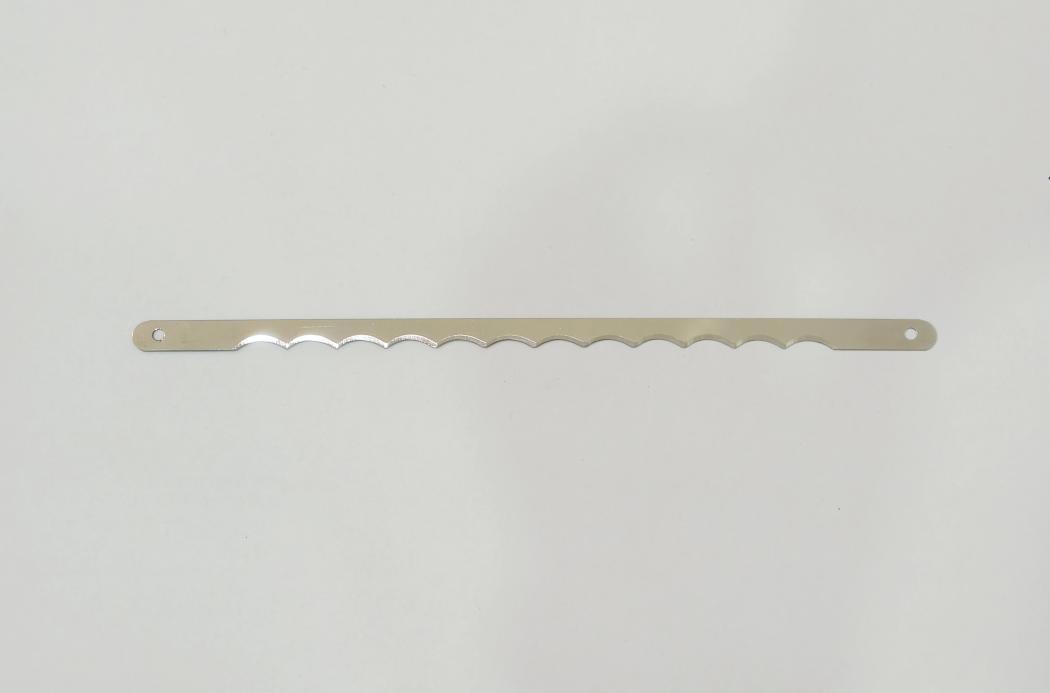
From an engineering perspective, this project represented a convergence of two high-risk manufacturing variables: ultra-thin material processing and dual-edge precision alignment.
Traditional industrial blades predominantly feature a single cutting edge. Introducing a double-sided edge significantly increases the difficulty of maintaining symmetrical geometry.
Key risks included:
- Edge misalignment during grinding processes
- Inconsistent cutting angles between sides
- Increased probability of blade deviation during high-speed operation
- Potential jamming or instability within automated systems
Maintaining perfect symmetry across thousands of units required not only tooling precision but also process stability at scale.
With a thickness of just 0.4mm, the blade falls into the ultra-thin metal processing category. Under conventional high-temperature heat treatment:
- Thermal expansion leads to warping or distortion
- Internal stress concentration affects flatness
- Dimensional tolerances become difficult to control
- Scrap rates increase significantly
For automation applications, even micron-level deviations can compromise performance. Therefore, eliminating deformation while preserving material strength became a critical requirement.
To overcome these challenges, our engineering team conducted a full process re-evaluation, focusing on material behavior, tooling precision, and in-line quality control.
Instead of applying traditional full heat treatment, we implemented a controlled low-stress processing route tailored for S/S301 stainless steel.
This approach achieved:
- Reduced thermal deformation risk
- Improved flatness and dimensional stability
- Preservation of material mechanical properties
- Enhanced consistency across production batches
By minimizing thermal exposure, we ensured that the ultra-thin structure retained its integrity throughout manufacturing.
One of the most critical innovations in this project was the development of a customized double-sided synchronous edge grinding fixture system.
This system enabled:
- Simultaneous processing of both edges
- Precise positional alignment during grinding
- Consistent edge angle and geometry
- Reduced human-induced variability
From a manufacturing standpoint, this tooling innovation directly addressed the industry-wide challenge of dual-edge consistency in mass production.
To guarantee product reliability in high-speed automation environments, we introduced a multi-point inspection system with micron-level accuracy.
Inspection parameters included:
- Edge symmetry
- Thickness tolerance
- Straightness and flatness
- Surface integrity
Each blade underwent strict in-process quality checks, ensuring that deviations were identified and corrected in real time rather than post-production.
Through systematic process optimization and engineering innovation, the project successfully transitioned from prototype development to stable mass production.
- Achieved consistent double-sided edge alignment across all production batches
- Eliminated deformation issues associated with ultra-thin material processing
- Maintained strict dimensional tolerances suitable for high-speed automation systems
- Delivered stable cutting performance without jamming or misalignment
From the client's operational perspective, the results translated into:
- Improved equipment efficiency and cutting precision
- Reduced maintenance and downtime
- Enhanced compatibility with upgraded automation systems
- Reliable supply through ongoing batch production
Following initial validation, the client moved into long-term procurement, with repeat orders supporting their equipment expansion plans.

From an industry expert's viewpoint, this case represents a significant advancement in two critical areas of precision manufacturing:
Processing stainless steel at 0.4mm thickness while maintaining structural stability is inherently challenging. This project demonstrates that with the right process control strategy, ultra-thin materials can be reliably used in high-performance industrial applications.
Double-sided edge blades are often limited to low-volume or specialized applications due to alignment complexity. By developing a scalable solution, this project opens new possibilities for:
- High-speed automation systems
- Precision cutting applications
- Next-generation industrial equipment design
The success of this project was not based on a single innovation but on the integration of:
- Material science understanding
- Precision tooling design
- Process engineering
- Real-time quality control systems
This holistic approach is essential for solving complex manufacturing challenges in modern industrial environments.
With over two decades of manufacturing experience, Yangjiang Insight Industry And Trade Co., Ltd. combines large-scale production capability with advanced engineering expertise.
Key strengths include:
- 20,000㎡ manufacturing facility with monthly output of ~5 million units
- Extensive experience in OEM and ODM blade solutions
- Proven capability in non-standard and high-precision blade customization
- Strong process control for ultra-thin and complex geometries
- Dedicated engineering team for customized industrial applications
This case reinforces our position as a reliable partner for global brands seeking high-performance cutting solutions for automation and industrial systems.
The successful development of the 0.4mm S/S301 double-sided edge blade highlights how advanced process engineering can overcome traditional manufacturing limitations. By addressing both material and structural challenges, we delivered a solution that meets the demanding requirements of high-speed automation systems while ensuring long-term production stability.
For manufacturers seeking precision blade OEM/ODM partners capable of handling complex, non-standard requirements, this case serves as a proven example of what is achievable through expertise, innovation, and disciplined process control.


